In this July 24, 2020, file photo, healthcare worker Rahaana Smith instructs passengers how to use a nasal swab, at a drive-thru COVID-19 testing site at the Miami-Dade County Auditorium, in Miami. U.S. health officials have sparked a wave of confusion after posting guidelines that coronavirus testing is not necessary for people who have been in close contact with infected people. (AP Photo/Wilfredo Lee, File)
By Mike Stobbe
U.S. health officials have sparked a wave of confusion after posting guidelines that coronavirus testing is not necessary for people who have been in close contact with infected people.
The new guidance was posted earlier this week on the website of a federal agency, the Centers for Disease Control and Prevention.
The CDC previously had advised local health departments to test people who have been within 6 feet of an infected person for more than 15 minutes. But on Monday a CDC testing overview page was changed to say that testing is no longer recommended for symptom-less people who were in close contact situations.
There was a caveat, however. Testing may be recommended for those with health problems that make them more likely to suffer severe illness from an infection, or if their doctor or local state officials advise they get tested.
CDC officials referred all questions to the agency's parent organization, the U.S. Department of Health and Human Services in Washington, D.C. That suggests that HHS ordered the change, not CDC, said Jennifer Nuzzo, a Johns Hopkins University public health researcher.
HHS officials have offered little explanation but scheduled a briefing for Wednesday afternoon to answer questions.
Across the country, public health experts called the change bizarre. They noted that testing contacts of infected people is a core element of public health efforts to keep outbreaks in check and that a large percentage of infected people — the CDC has said as many as 40 percent — exhibit no symptoms.
"I was taken aback and didn't know that it was under consideration," said John Auerbach, president of Trust for America's Health, a nonprofit that works to improve U.S. preparedness against disease. "The recommendation not to test asymptomatic people who likely have been exposed is not in accord with the science."
Ultimately, restricting testing could be self-defeating, because it could skew the numbers and create a perception that rates of infection are higher. Testing people who appear to be healthy would tend to lower the overall rate of positive results while narrowing testing to people who are sick would raise the overall positive rate, Auerbach said.
Why HHS would order such a change quickly became a matter of speculation. Dr. Carlos del Rio, an infectious diseases specialist at Emory University, suggested in a tweet that there are two possible explanations.
One is that it may be driven by testing supply issues that in many parts of the country have caused delays in results of a week or more, he suggested.
The other is that President Donald Trump simply wants to see case counts drop, and discouraging more people from getting tested is one way to do it, he said.
Dr. Tom Frieden, who was head of the CDC during the Obama administration, said the move follows another recent change: to no longer recommend quarantine for travelers coming from areas where infections are more common.
"Both changes are highly problematic" and need to be better explained, said Frieden, who now is president of Resolve to Save Lives, a nonprofit program that works to prevent epidemics.
Frieden said he, too, believes HHS forced CDC to post the changes. He called it "a sad day" because "CDC is being told what to write on their website."
___
Associated Press writer Ricardo Alonso-Zaldivar in Washington, D.C. contributed to this report.
___
The Associated Press Health and Science Department receives support from the Howard Hughes Medical Institute's Department of Science Education. The AP is solely responsible for all content.
The memoir, "COMPROMISED: Counterintelligence and the Threat of Donald J. Trump", tells a familiar story from a bit of a different source: Peter Strzok himself, former FBI Counterintelligence Agents and Agency Veteran who spent most of his very long career investigating some of the most controversial inquiries, most notably in recent American history. Those inquiries were Hillary Clinton's email to even Trump Russia investigations. Former FBI Agent and Author of "Compromised" Peter Strzok, joined Cheddar to discuss more.
President Biden's first year did not come to the close that he had hoped after last night's Senate vote blocked the voting rights bill, a priority that Biden has promoted since his inauguration. Joining us to discuss the voting rights bill, and many others passing through congress is congresswoman Lori Trahan, representing Massachusett's 3rd district.
Members of Congress have voted to advance a bill meant to address antitrust concerns related to tech giants including Amazon, Apple, Google, and Meta. The 'American Innovation and Choice Online Act' is largely seen as one of the best chances for the government to reign in Big Tech's dominance
Seth Schachner, Managing Director StratAmericas; Digital Business Executive joined Cheddar's Opening Bell to discuss.
American semiconductor company, Intel officially announcing plans to build a new $20 billion chip manufacturing complex outside Columbus, Ohio. This comes as the global chip shortage continues to hamper production of everything from smart phones, to cars. Jennifer Smith - Logistics and Supply Chain Reporter, WSJ joined Cheddar's Opening Bell to discuss.
The U.S. has put more than 8,000 American troops on high alert for possible deployment to Eastern Europe as the West prepares for a potential Russian invasion of Ukraine. With Russia building up more than 100,000 troops near the Ukrainian border, concerns over the country's behavior are mounting. Joel Rubin, Former Deputy Assistant Secretary of State and President of the Washington Strategy Group, joined Cheddar to discuss what this means for U.S.-Russia relations, and where the conflict might be heading next.
As the midterm election looms, things aren't looking too promising for President Joe Biden. One year into his term as president, Biden is facing one of the lowest approval ratings of any modern-day president, threatening his party's control of the House in 2022. Brian Bennett, Senior White House Correspondent for TIME, joined Cheddar's Opening Bell to discuss.
A full one year into his term as President of The United States, President Biden addressed the nation on Wednesday, facing questions on everything from inflation to chip shortages and covid-19. As Biden enters his second year in office, he is facing one of the lowest approval ratings of any modern-day president. Kate Davidson, Reporter, POLITICO joined Cheddar's Opening Bell to discuss.
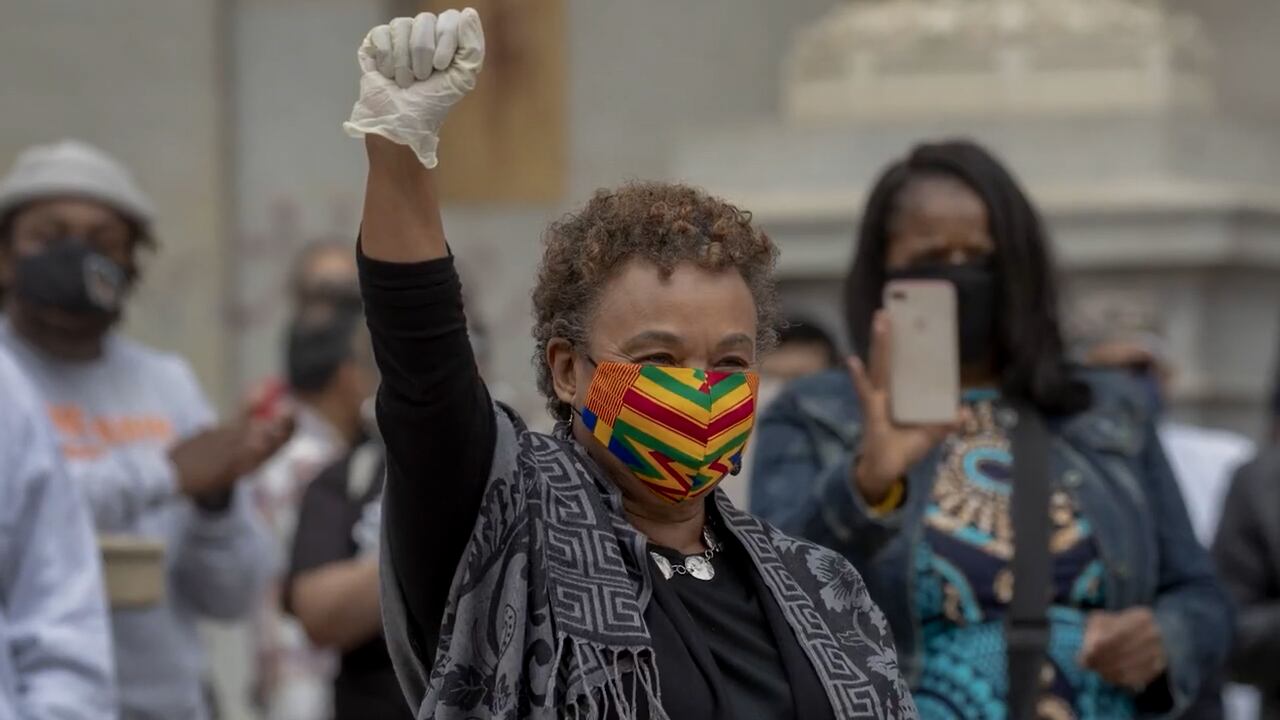
"Barbara Lee: Speaking Truth to Power" is the story of how the longtime House Democrat became, as she Is known to some, as "the Conscience of Congress." The film also
shows Representative Lee from her days working to fight community poverty to famously becoming the only member of Congress to vote "no" against the war in Afghanistan days after 9/11. The film is nominated for an NAACP Image Award, and Premieres on Starz on February 1. Film director Abby Ginzberg and Rep. Barbara Lee (D-Calif. 13th District), joined Cheddar to discuss more.
San Diego has just implemented a new law that could set the stage for how the country deals with food waste. This new law hopes to make a dent in that. Businesses and groceries stores out in San Diego will need to put a plan in place to *donate edible food rather than toss it straight to the trash. Food Rescue Manager at Feeding San Diego, Kate Garret