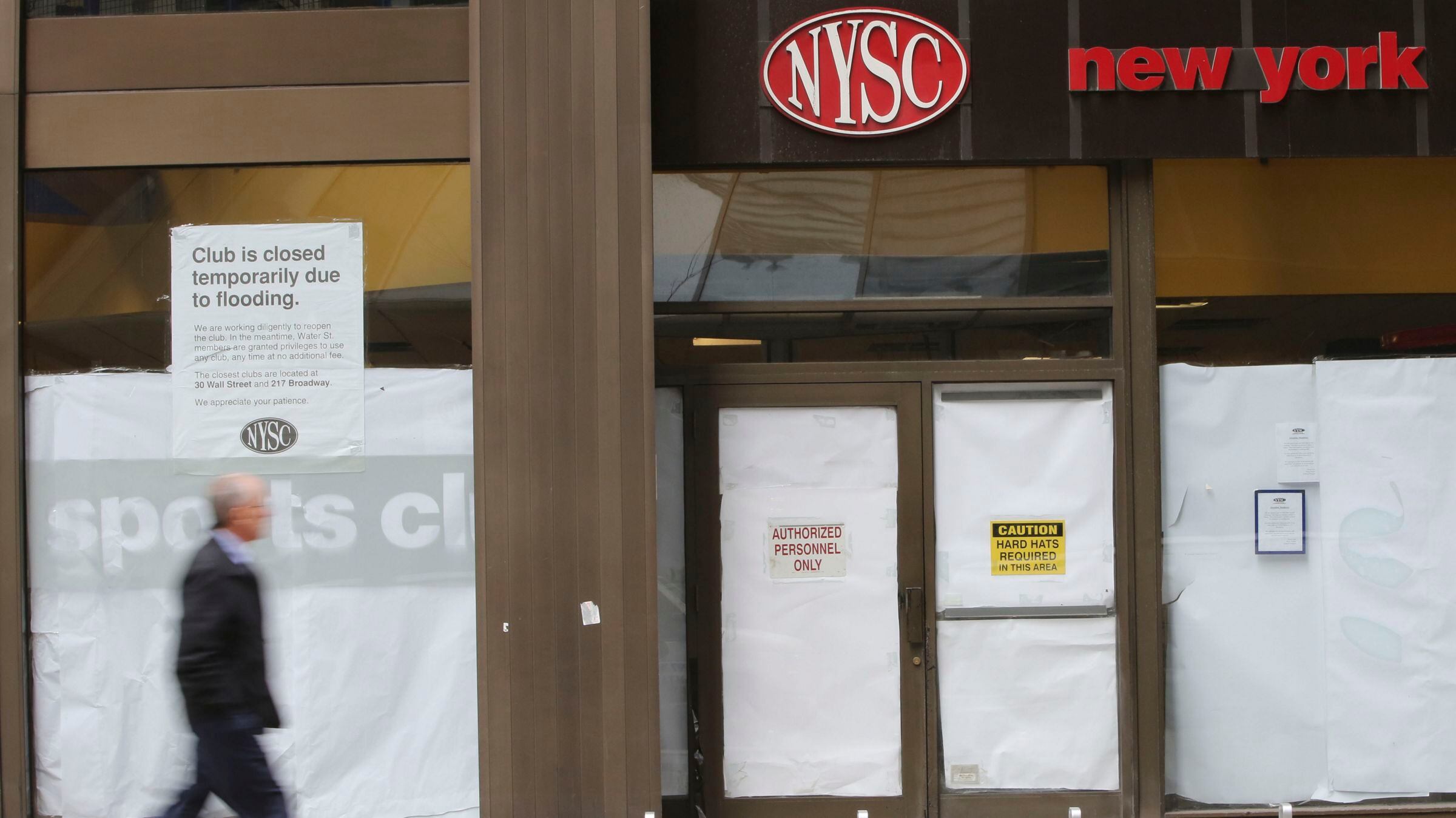
In this Feb. 7, 2013 photo, a man walks past a shuttered New York Sports Club on Water St. in New York. Town Sports International Holdings Inc., the owner of New York Sports Club and Lucille Roberts filed for Chapter 11 bankruptcy Monday, Sept. 14, 2020, as gym operators struggle to keep afloat amid nationwide shutdowns. (AP Photo/Mary Altaffer, File)
By Damian J. Troise
The company that runs New York Sports Club and Lucille Roberts gyms filed for bankruptcy protection with COVID-19, still prevalent in man parts of the U.S., gutting membership rolls at fitness companies nationwide.
Gold's Gym sought bankruptcy protection in May and 24 Hour Fitness Worldwide filed for bankruptcy in June. Many companies, including Planet Fitness, furloughed workers in order to conserve cash.
Town Sports International Holdings Inc., which also operates Washington Sports Club and Total Woman Gym and Spa, said Monday that it can no longer pay its debts.
The company lost $136 million during the first quarter this year, only a fraction of which included state- and city-mandated shutdowns of retail shops, gyms, salons, restaurants, and bars. By the end of the three-month reporting period, 95 percent of Town Sports' clubs had been closed.
Town Sports operates 185 clubs and serves 580,000 members, mostly in the Northeast.
Gyms have been allowed to reopen at a fraction of their capacity in some regions like the Northeast. Those who do go to gyms in New York City are required to wear a mask at all times and gyms can only operate at one-third capacity. Group fitness classes are still not permitted.
Yet with more than 33,000 COVID-19 related deaths in New York, most of them in New York City, thousands of one-time gymgoers have taken their routines outdoors, or to their own homes.
Home fitness company Peloton reported a 172 percent surge in revenue during its most recent quarter and it doubled its subscribers. Bike shops in New York, as well as most outdoor fitness gear sellers, have been largely cleared out.
Danielle Dimartino Booth, CEO & Director of Intelligence at Quill Intelligence and former Advisor to Dallas Fed, talks about what to expect from the FOMC meeting, and how labor participation and wage growth may impact inflation going forward.
Kristina Hooper, Chief Global Market Strategist at Invesco, talks about the Fed's flexibility around tapering and what to expect for the October Jobs Report.
Will Rhind, Founder & CEO of GraniteShares, talks about consumer spending amid inflation concerns and discusses the headwinds impacting the tech and energy sectors.
a.k.a Brands, an accelerator for next-gen, direct-to-consumer fashion brands like Princess Polly, released its first earnings report as a publicly-traded company with strong results. CEO Jill Ramsey joined Cheddar's "Opening Bell" to discuss the company's recent quarter and how the company has grown since its IPO in September.
Rivian is set to makes its market debut as the biggest IPO since Facebook in 2021. The EV maker priced its stock above the expected range at $78 apiece, allowing it to raise a whopping $11.9 billion. Matt Toole, director of deals intelligence at Refinitiv, joined Cheddar to discuss Rivian's highly anticipated IPO and how it's sending the already booming IPO market even higher.
A judge shot down a request by Apple to hold off on changes to payment options in the app store that would allow companies like Epic Games to use external payment systems. Apple had sought a stay that could delay making changes for years but the judge ordered them to implement fixes by December. The tech giant plans to appeal.
Twitter has officially launched its paid subscription service, Twitter Blue, which provides subscribers with a number of new features, including the option to edit tweets, post 10-minute videos, and view ad-free news articles.
David Mazza, Managing Director and Head of Product at Direxion, joins Cheddar to break down the key themes coming out of earnings season, and an outlook for the ongoing chip shortage.