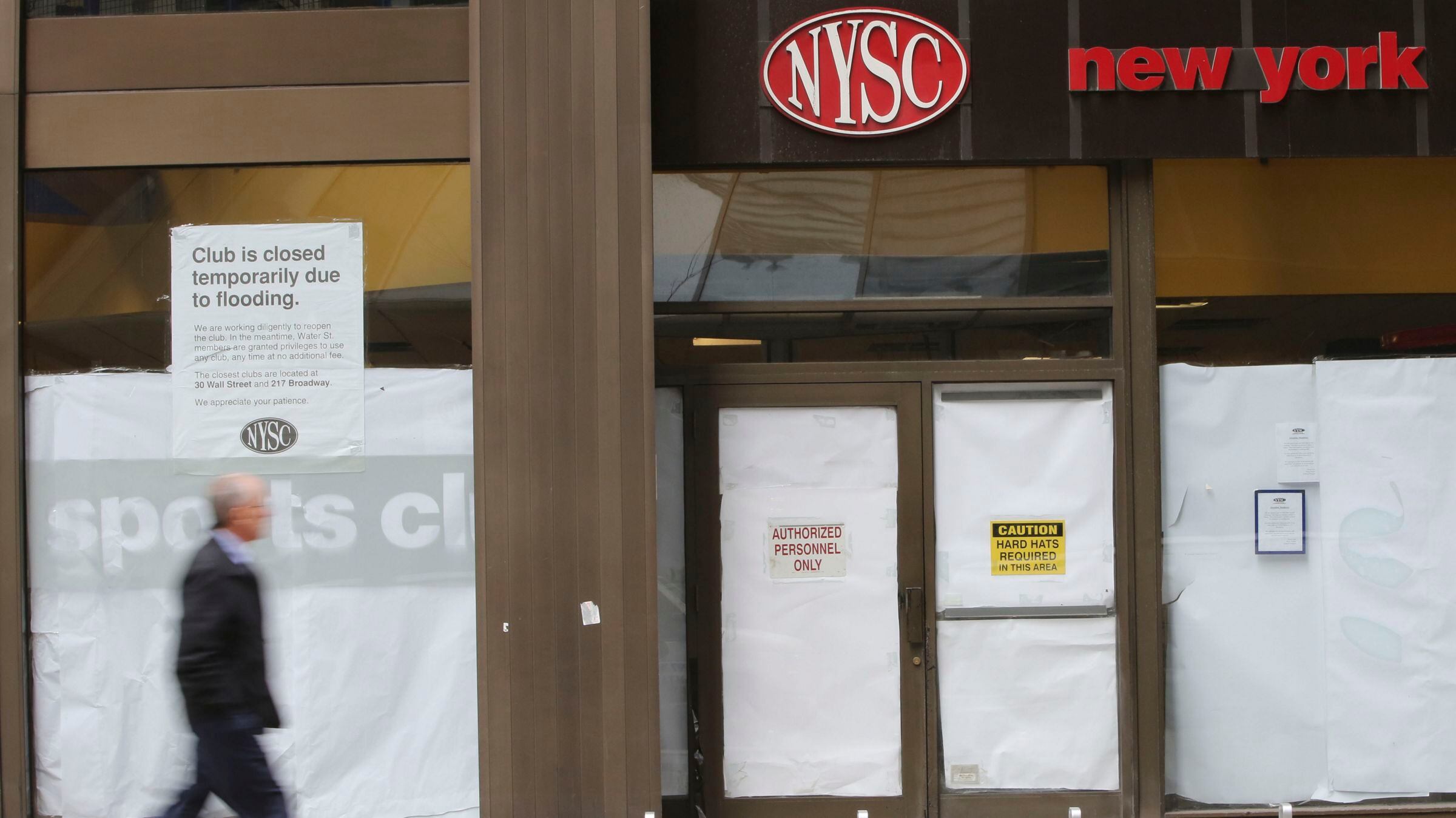
In this Feb. 7, 2013 photo, a man walks past a shuttered New York Sports Club on Water St. in New York. Town Sports International Holdings Inc., the owner of New York Sports Club and Lucille Roberts filed for Chapter 11 bankruptcy Monday, Sept. 14, 2020, as gym operators struggle to keep afloat amid nationwide shutdowns. (AP Photo/Mary Altaffer, File)
By Damian J. Troise
The company that runs New York Sports Club and Lucille Roberts gyms filed for bankruptcy protection with COVID-19, still prevalent in man parts of the U.S., gutting membership rolls at fitness companies nationwide.
Gold's Gym sought bankruptcy protection in May and 24 Hour Fitness Worldwide filed for bankruptcy in June. Many companies, including Planet Fitness, furloughed workers in order to conserve cash.
Town Sports International Holdings Inc., which also operates Washington Sports Club and Total Woman Gym and Spa, said Monday that it can no longer pay its debts.
The company lost $136 million during the first quarter this year, only a fraction of which included state- and city-mandated shutdowns of retail shops, gyms, salons, restaurants, and bars. By the end of the three-month reporting period, 95 percent of Town Sports' clubs had been closed.
Town Sports operates 185 clubs and serves 580,000 members, mostly in the Northeast.
Gyms have been allowed to reopen at a fraction of their capacity in some regions like the Northeast. Those who do go to gyms in New York City are required to wear a mask at all times and gyms can only operate at one-third capacity. Group fitness classes are still not permitted.
Yet with more than 33,000 COVID-19 related deaths in New York, most of them in New York City, thousands of one-time gymgoers have taken their routines outdoors, or to their own homes.
Home fitness company Peloton reported a 172 percent surge in revenue during its most recent quarter and it doubled its subscribers. Bike shops in New York, as well as most outdoor fitness gear sellers, have been largely cleared out.
A jam-packed Freitag pod with Carlo and Baker: new Covid hotspots, Kyle Rittenhouse trial, Belarus making trouble for Europe, red-hot housing market, and how to manage a PR crisis the right way.
This week's inflation data showed that consumers are not imagining higher prices at the register - prices jumped 6.2% in October, the biggest inflation surge in 30 years. Both the S&P 500 and Nasdaq felt the impact of that data, but today recovered after a sell-off. Sean O'Hara, President at Pacer ETFs, joins Cheddar News' Closing Bell to discuss today's market close amid this week's hot inflation data, and third-quarter earnings season.
Self-driving truck startup Kodiak Robotics recently announced a $125 million funding round as the trucking industry is facing major challenges, including growing shipping demand and driver shortages. Kodiak says its autonomous technology can help businesses move goods faster, safer, cleaner, and more efficiently. Kodiak Robotics founder and CEO Don Burnette joined Cheddar News' Closing Bell to discuss.
Francisco Marte, Founder of the Bodega and Small Business Association, joined Cheddar to discuss the recent boom in ultrafast delivery services and what it means to bodegas and mom & pop shops in New York City.
Damian Mason, a farm owner, Agricultural Economist and Author of 'Food Fear,' joined Cheddar to discuss the rising prices of food as we approach the holiday season.
Meta, the parent company of Facebook, turned heads on Tuesday when it announced it will block some ad-targeting, specifically those of a political and religious nature.
This is one of the most direct moves the company has made in order to minimize ad-targeting by advertisers on its platforms. Hastie Afkhami, Head of Digital at S-3 Group, joins Cheddar News to discuss the impact of this move.