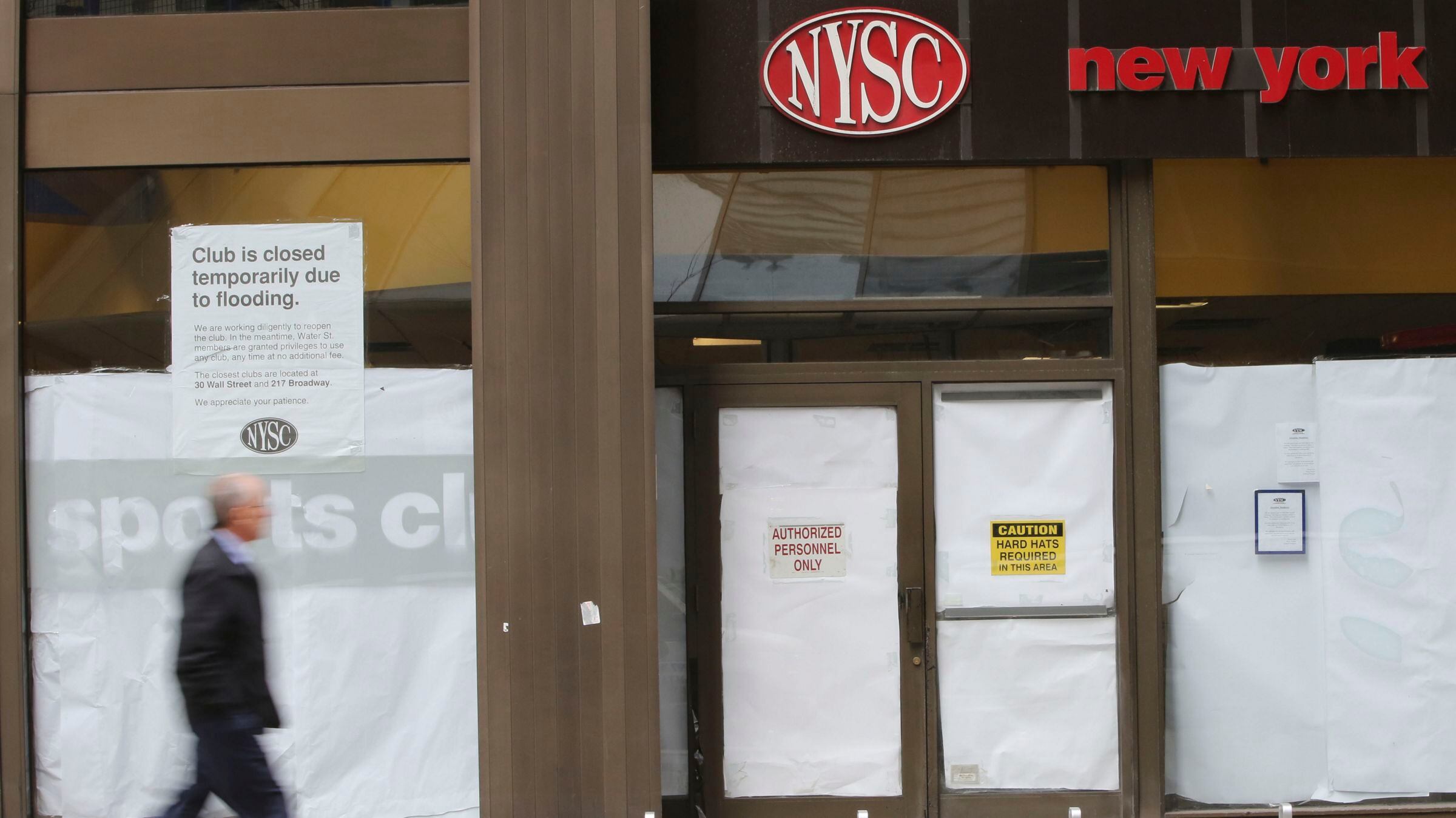
In this Feb. 7, 2013 photo, a man walks past a shuttered New York Sports Club on Water St. in New York. Town Sports International Holdings Inc., the owner of New York Sports Club and Lucille Roberts filed for Chapter 11 bankruptcy Monday, Sept. 14, 2020, as gym operators struggle to keep afloat amid nationwide shutdowns. (AP Photo/Mary Altaffer, File)
By Damian J. Troise
The company that runs New York Sports Club and Lucille Roberts gyms filed for bankruptcy protection with COVID-19, still prevalent in man parts of the U.S., gutting membership rolls at fitness companies nationwide.
Gold's Gym sought bankruptcy protection in May and 24 Hour Fitness Worldwide filed for bankruptcy in June. Many companies, including Planet Fitness, furloughed workers in order to conserve cash.
Town Sports International Holdings Inc., which also operates Washington Sports Club and Total Woman Gym and Spa, said Monday that it can no longer pay its debts.
The company lost $136 million during the first quarter this year, only a fraction of which included state- and city-mandated shutdowns of retail shops, gyms, salons, restaurants, and bars. By the end of the three-month reporting period, 95 percent of Town Sports' clubs had been closed.
Town Sports operates 185 clubs and serves 580,000 members, mostly in the Northeast.
Gyms have been allowed to reopen at a fraction of their capacity in some regions like the Northeast. Those who do go to gyms in New York City are required to wear a mask at all times and gyms can only operate at one-third capacity. Group fitness classes are still not permitted.
Yet with more than 33,000 COVID-19 related deaths in New York, most of them in New York City, thousands of one-time gymgoers have taken their routines outdoors, or to their own homes.
Home fitness company Peloton reported a 172 percent surge in revenue during its most recent quarter and it doubled its subscribers. Bike shops in New York, as well as most outdoor fitness gear sellers, have been largely cleared out.
2021 proved that crypto currency is here to stay. This year saw more and more adoptions of crypto, from top athletes looking to be paid in bitcoin, to Elon Musk even experimenting with bitcoin and dogecoin payments for a bit over at Tesla. And it wasn't all bitcoin either - other cryptos like Cardano and Solana saw some action in 2021 as well. Patrick McConlogue, CEO of Overline and former Citadel Investment Group Engineer explains why 2021 was such a good year for crypto, and what to expect in 2022.
2021 saw markets continue to be impacted by the onslaught of the coronavirus pandemic -most recently in the form of the Omicron variant- in addition to the global supply chain shortage, and increased inflation. But it wasn't all bad news, as crypto soared throughout the year, and meme stocks continued to have a moment. With the year coming to a close, investors are keeping an eye out to see if they should expect more of the same in the new year. Chris Vecchio, Senior Analyst, at DailyFX tells us what market trends to be on the watch for in 2022.
2021 proved to be yet another formidable year for Tesla. In a year that saw electric vehicles carve out their own space in the transportation world, the company made further strides, keeping its spot on top even as new companies threatened competition. Tesla was able to hit the trillion dollar valuation mark, increase vehicle deliveries even as the world grappled with supply chain and delivery issues and sign a major deal with Hertz this year. And of course, you can't talk about Tesla without talking about Elon Musk, CEO and founder of the company, richest man in the world and Time Magazine Person of the Year, who saw plenty of successes in 2021 as well. Al Root, Senior Writer at Barron’s, explains just how good a year it was for Tesla.
The S&P CoreLogic Case-Shiller 20-city home price index showed an 18.4 percent surge in October as the housing market continues to boom. October's levels are a slight downturn from the roughly 19 percent increase the index saw in September, but come roughly in line with economist expectations. Michael J. Romer, Managing Partner, Romer Debbas joined Wake Up with Cheddar to discuss.
U.S. airlines have canceled more than 6,000 flights since Christmas eve, causing headaches for travelers.
Airlines cited staffing shortages amid the omicron outbreak as the primary reason for the interruptions to service. The cancellations come at the busiest time of year for air travel. Steve Shur, President, The Travel Technology Association joined Wake Up with Cheddar to discuss.
Dr. Soumi Eachempati, co-founder and CEO of Cleared4 and former professor of surgery and public health at Weill Cornell Medical College, joined Cheddar to breakdown what people should know about the recently FDA-approved emergency use of Merck and Pfizer's COVID-19 treatment pills. He noted that not only do people need to be aware of other medications they are taking that could cause adverse effects if coupled with COVID-19 pill treatments, he also talked about the intense in-take regiment. "The Merck pills are actually about 40 pills over five days. The Pfizer ones are three pills over five days, so people have to be prepared for that because it is a lot of pills you'll have to take to get full value from these drugs," Eachempati told Cheddar.
Adult-use cannabis sales kicked off in Nevada in 2017, but four years later, there isn’t a legal way for the 40 million tourists who visit the state annually to consume. That’s all about to change. Following the passage in June of a bill to legalize consumption lounges, the world’s largest dispensary, Planet 13, is planning a cannabis club as extravagant as Las Vegas. Cheddar’s Chloe Aiello visited the cannabis entertainment complex to find out more.