Americans have been asked to make responsible decisions this year in order to stop the COVID-19 pandemic, but it can be difficult to make appropriate choices without meaningful information. That is why Tech:NYC has created COVID Alert NY, New York's official contact tracing app designed to help mitigate the spread of the virus.
More than 200,000 New Yorkers signed up within the first 24 hours of the app's launch, according to Julie Samuels, executive director at Tech:NYC.
So how exactly does this technology work?
Once participants download the app from Google Play or the App Store on iOS, they will receive a notification if they've been within six feet of an infected person for 10 minutes or longer and will then be prompted to take a test or advised to quarantine.
It is the responsibility of an infected person to report their status on the app for the most accurate results.
But as privacy concerns sit in the forefront of our minds, particularly with sensitive medical information, Samuels made assurances that a user's data is protected.
"This is why it's so important that Google and Apple are working with state governments," Samuels said. "It's an important distinction that the app uses bluetooth and not GPS, which means that no one knows where you were, just that you were near another phone at some point."
Samuels recommends not signing up for an app that has not partnered with state governments. Tech:NYC created the app in conjunction with the New York State Department of Health.
The COVID Alert NY app, according to Samuels, is another tool in our defense against the virus and should be used regularly in the same way that social distancing and mask wearing have become leading defenses in mitigating the spread.
"I don't think any of us are pretending that this app alone is going to eradicate COVID. However it is such an easy thing to do and it's going to help," she noted.
For the U.S. to get past the virus and resume some form of normal life, it likely will have to be a societal effort, not something the government will be able correct on its own.
"I think what we've seen from the White House, which is abundantly clear, is no one is coming to save us but ourselves, so this is one tool, among many, to do that," she said.
NASA is launching its new generation of space telescopes just before Christmas. The James Webb Space Telescope, set to launch on December 24th, will succeed the Hubble space telescope as the world's most powerful complex space observatory. The project has been 30 years in the making and is one of the most highly anticipated space science missions of the 21st century. Klaus Pontoppidan, astronomer and JWST Project Scientist at the Space Telescope Science Institute joined Cheddar's Opening Bell to discuss.
With Omicron becoming the dominant COVID-19 variant in the U.S., President Joe Biden announced that he will make 500 million rapid tests available to Americans in January 2022. Cheddar News speaks with Dr. Shereef Elnahal, President and CEO of University Hospital why testing is key to combatting the spread of the virus.
2021 has been a year filled with extreme weather conditions. Hundreds of thousands of people recently saw the effects of massive tornados that swept across six states. Now, experts say climate change could have played a major role. Jennifer Marlon, research scientist and lecturer at the Yale School of the Environment, joins Cheddar News to discuss.
Anthony Tall, sports agent and president of Miracle Sports Agency, joins Cheddar News to talk about the challenges professional sports leagues are facing amid a surge in coronavirus cases across the U.S.
Extreme weather hit all of us in 2021. Deadly heat hit parts of the U.S. that normally don't even need air conditioning. More than 52,000 wildfires broke out, a terrifying example of what can happen when extreme heat mixes with drought. Hurricane Ida was so powerful it actually briefly reversed the flow of the Mississippi River. Cheddar News did a deep dive into this year's unbelievable weather and how climate change may have impacted it.
With the New Year just around the corner, many people will be making new health and fitness goals. However, after the initial January push, it's easy to drop your resolutions and go back to your old habits. Joan Ifland, CEO of Food Addiction Reset, discusses her best tips for following through with New Year's Resolutions.
Carlo and Baker preview President Biden's address to the nation as Omicron becomes the new dominant Covid strain. Plus, Trump gets booed for getting his booster and the White House gets a new puppy.
Alinda Mashiku, Conjunction Analysis and Risk Assessment Deputy Manager at the NASA Goddard Space Flight Center, joins Future of Space: Humankind's Leap Forward to explain how space debris is threatening operations in space at a time when more satellites are being deployed.
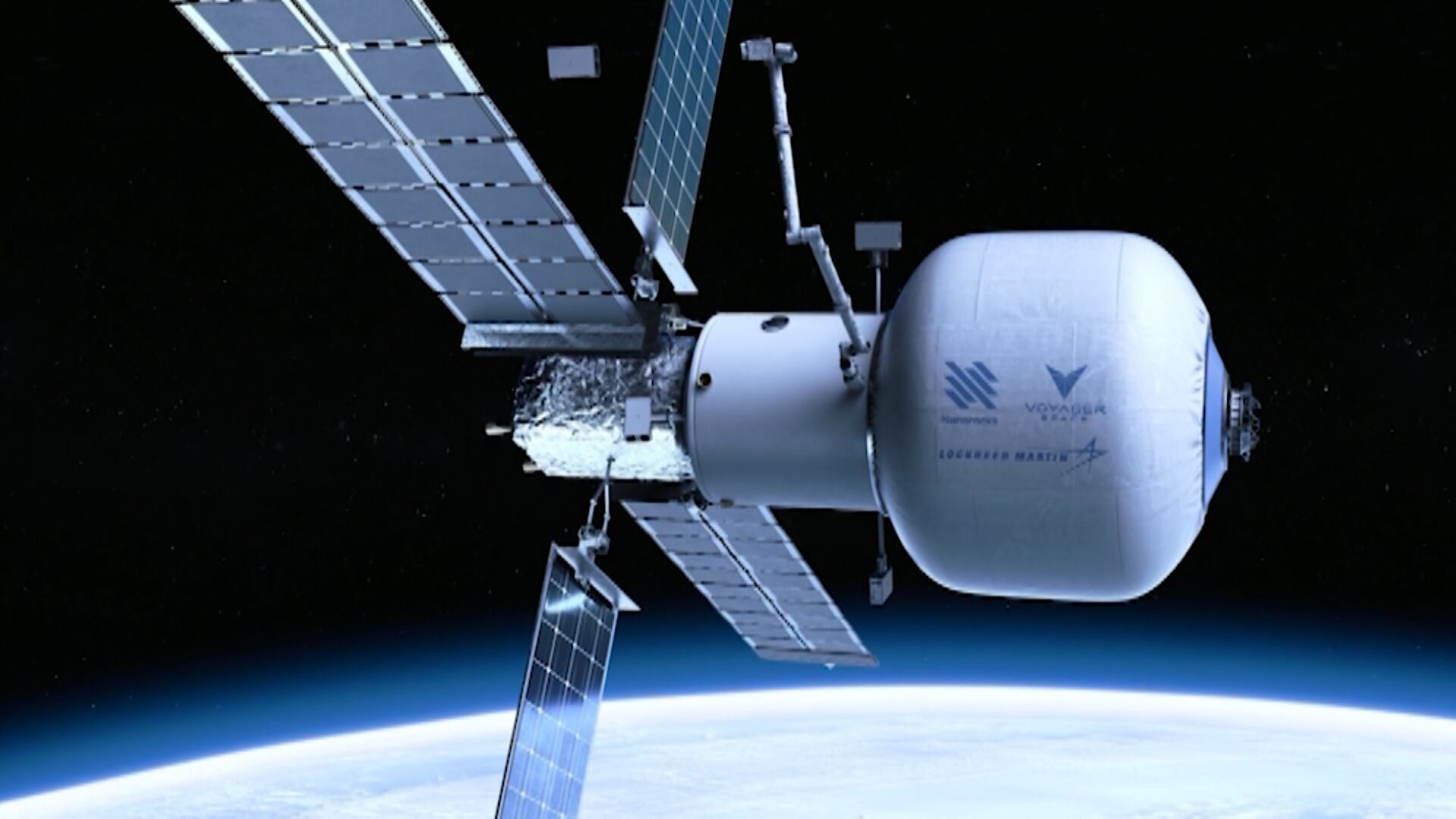
Marshall Smith, Senior Vice President of Space Systems at Nanoracks and Kirk Shireman, Vice President of the Lunar Exploration Campaign at Lockheed Martin join Future of Space: Humankind's Leap Forward to discuss upcoming plans for developing their Starlab commercial space station after being awarded a $160 million contract by NASA.
The CDC recently endorsed the advisory committee's recommendation that people should receive the Pfizer or Moderna COVID vaccines over the Johnson & Johnson shot, leaving some questions and concerns for the public. Epidemiologist Dr. Eric Feigl-Ding, spoke to Cheddar about the shift in the agency's stance, and what it might mean. "If you already have it, any side effects are already long past," he said. "Going forward is what they're saying. That getting a booster you should get the Moderna or the Pfizer booster, and I don't think they're encouraging anyone to get de novo Johnson & Johnson as their first shot anymore."