By Jake Coyle
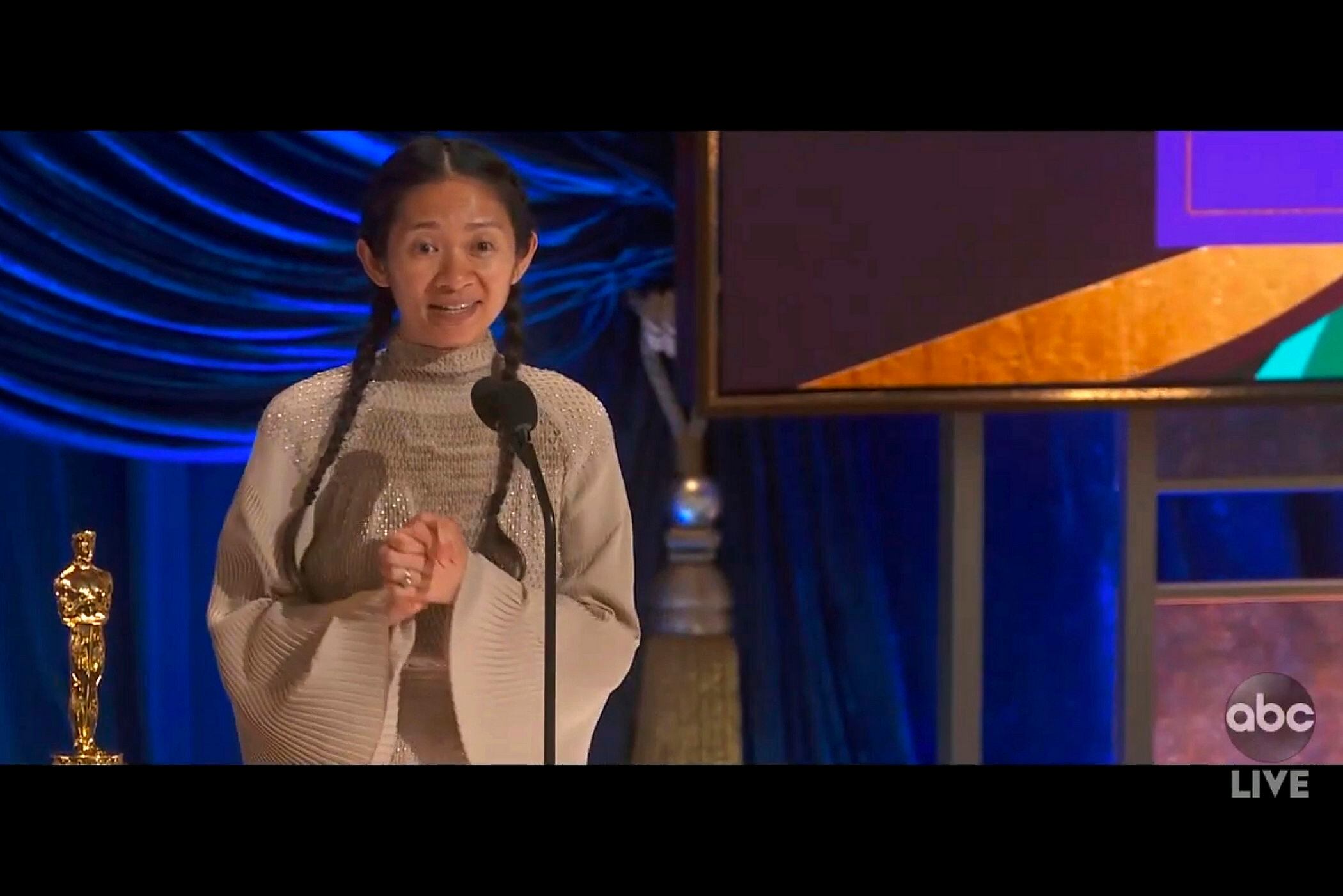
Chloe Zhao’s “Nomadland,” a wistful portrait of itinerant lives on open roads across the American West, won best picture Sunday at the 93rd Academy Awards, where the China-born Zhao also became just the second woman to win best director, and the first woman of color.
The “Nomadland” victory, while widely expected, nevertheless capped the extraordinary rise of Zhao, a lyrical filmmaker whose winning film is just her third, and which — with a budget less than $5 million and featuring a cast populated by non-professional actors -- ranks as one of the most modest-sized movies to win Hollywood’s top honor. Zhao’s next film, Marvel’s “Eternals,” has a budget approximately 40 times that of “Nomadland.” Only Kathryn Bigelow, 11 years ago for “The Hurt Locker,” had previously won best director.
But “Nomadland,” as a plain-spoken meditation on solitude, grief and grit, stuck a chord in a pandemic-ravaged year. It made for an unlikely Oscar champ: A film about people who gravitate to the margins took center stage.
“I have always found goodness in the people I’ve met everywhere I went in the world,” said Zhao when accepting best director. “This is for anyone who has the faith and the courage to hold on to the goodness in themselves and to hold on the goodness in other no matter how difficult it is to do that.”
With a howl, “Nomadland” star Frances McDormand implored people to seek out her film and others on the big screen. Released by the Disney-owned Searchlight Pictures, “Nomadland” premiered at a drive in and debuted in theaters, but found its largest audience on Hulu.
“Please watch our movie on the largest screen possible and one day very, very soon, take everyone you know into a theater, shoulder to shoulder in that dark space, and watch every film that’s represented here tonight,” McDormand said.
Soon after, McDormand won best actress, too. The win puts McDormand (previously a winner for “Fargo” and “Three Billboards Outside Ebbing, Missouri”) in rare company as a three-time acting winner. Only Katherine Hepburn (a four-time winner) has won best actress more times.
In the night’s biggest surprise, best actor went to Anthony Hopkins for the dementia drama “The Father.” The award had been widely expected to go to Chadwick Boseman for his final performance in “Ma Rainey’s Black Bottom.” Hopkins was not in attendance.
The most ambitious award show held during the pandemic, the Oscars rolled out a red carpet and restored some glamour to the nearly century-old movie institution, but with a much transformed — and in some ways downsized — telecast. It was a year when, to paraphrase Norma Desmond, the pictures got smaller were overwhelmingly seen in the home, not in the big screen, during a pandemic year that forced theaters close and prompted radical change in Hollywood.
It was also perhaps the diverse Academy Awards ever, with more women and more actors of color nominated than ever before — and Sunday brought a litany of records and firsts across many categories, spanning everything from hairstyling to composing to acting. It was, some observers said, a sea change for an awards harshly criticized as “OscarsSoWhite” in recent years, leading the film academy to greatly expand membership.
The ceremony — fashioned as a movie of its own and styled as a laidback party — kicked off with opening credits and a slinky Regina King entrance, as the camera followed the actress and “One Night in Miami” director in one take as she strode with an Oscar in hand into Los Angeles’ Union Station and onto the stage. Inside the transit hub (trains kept running), nominees sat at cozy, lamp-lit tables around an intimate amphitheater. Some moments — like Glenn Close getting down to “Da Butt” — were more relaxed, but the ceremony couldn't just shake off the past 14 months.
“It has been quite a year and we are still smack dab in the middle of it,” King said.
Daniel Kaluuya won best supporting actor for “Judas and the Black Messiah.” The win for the 32-year-old British actor who was previously nominated for “Get Out,” was widely expected. Kaluuya won for his fiery performance as the Black Panther leader Fred Hampton, whom Kaluuya thanked for showing him “how to love myself.”
“You’ve got to celebrate life, man. We’re breathing. We’re walking. It’s incredible. My mum met my dad, they had sex. It’s amazing. I’m here. I’m so happy to be alive," said Kaluuya while cameras caught his mother's confused reaction.
With the awards capping a year of national reckoning on race and coming days after Minneapolis police officer Derek Chauvin was convicted for killing George Floyd, police brutality was on the minds of many attendees. King said that if the verdict had been different, she might have traded her heels for marching boots.
Travon Free, co-director of the live-action short winner “Two Perfect Strangers,” wore a suit jacket lined with the names of those killed by police. His film dramatizes police brutality as an inescapable time loop like a tragic “Groundhog’s Day" for Black Americans.
“Today, the police will kill three people. And tomorrow, the police will kill three people. And the day after that, the police will kill three people because on average, the police in America everyday kill three people, which amounts to about a thousand people a year," said Free. "Those people happen to disproportionately be Black people.”
Best supporting actress went to Yuh-Jung Youn for the matriarch of Lee Isaac Chung’s tender Korean-American family drama “Minari.” The 72-year-old Youn, a well-known actress in her native South Korea, is the first Asian actress to win an Oscar since 1957 and the second in history. She accepted the award from Brad Pitt, an executive producer on “Minari.” “Mr. Brad Pitt, finally," said Youn. “Nice to meet you.”
Hairstylists Mia Neal and Jamika Wilson of “Ma Rainey’s Black Bottom” became the first Black women to win in makeup and hairstyling. Ann Roth, at 89 one of the oldest Oscar winners ever, also won for the film’s costume design.
The night’s first award went to Emerald Fennell, the writer-director of the provocative revenge thriller “Promising Young Woman,” for best screenplay. Fennell, winning for her feature debut, is the first woman win solo in the category since Diablo Cody (“Juno”) in 2007.
The broadcast instantly looked different. It’s being shot in 24 frames-per-second and in more widescreen format. In a more intimate show without an audience beyond nominees, winners were given wider latitude in their speeches.
The telecast, produced by a team led by filmmaker Steven Soderbergh, moved out of the awards' usual home, the Dolby Theatre, for Union Station. With Zoom ruled out for nominees, the telecast included satellite feeds from around the world. Performances of the song nominees were pre-taped and aired during the preshow. “Husavik (My Hometown)” from “Eurovision Song Contest: The Story of Fire Saga.,” was preformed from the Iceland town’s harbor. Others were sung from atop of the academy’s new $500 million film museum.
Pixar notched its 11th best animated feature Oscar with “Soul,” the studio’s first feature with a Black protagonist. Peter Docter’s film, about a about middle-school music teacher (Jamie Foxx), was one of the few big-budget movies in the running at the Academy Awards. (It also won best score, making Jon Batiste the second Black composer win the award, which he shared with Trent Reznor and Atticus Ross.) Another was Christopher Nolan's “Tenet,” which last September attempted to resuscitate moviegoing during the pandemic, took best visual effects.
David Fincher's “Mank," a lavishly crafted drama of 1940s Hollywood made for Netflix, came in the lead nominee with 10 nods and went home with award for cinematography and for production design.
Best adapted screenplay went to the dementia drama “The Father.” “My Octopus Teacher,” a film that found a passionate following on Netflix, won best documentary. Danish director Thomas Vinterberg’s “Another Round” won best international film, an award he dedicated to his daughter, Ida, who in 2019 was killed in a car crash at age 19.
The red carpet was back Sunday, minus the throngs of onlookers and with socially distanced interviews. Only a handful of media outlets were allowed on site, behind a velvet rope and some distance from the nominees. Casual wear, the academy warned nominees early on, was a no-no. Stars, limited to a plus-one, went without their usual battalions of publicists.
But even good show may not be enough to save the Oscars from an expected ratings slide. Award show ratings have cratered during the pandemic, and this year's nominees — many of them smaller, lower-budget dramas — won't come close to the drawing power of past Oscar heavyweights like “Titanic” or “Black Panther.” Last year's Oscars, when Bong Joon Ho's “Parasite” became the first non-English language film to win best picture, was watched by 23.6 million, an all-time low.
Sunday's pandemic-delayed Oscars bring to a close the longest awards season ever — one that turned the season's industrial complex of cocktail parties and screenings virtual. Eligibility was extended into February of this year, and for the first time, a theatrical run wasn't a requirement of nominees. Some films — like “Sound of Metal” — premiered all the way back in September 2019. The biggest ticket-seller of the best picture nominees is “Promising Young Woman,” with $6.4 million in box office.