By Steve Peoples

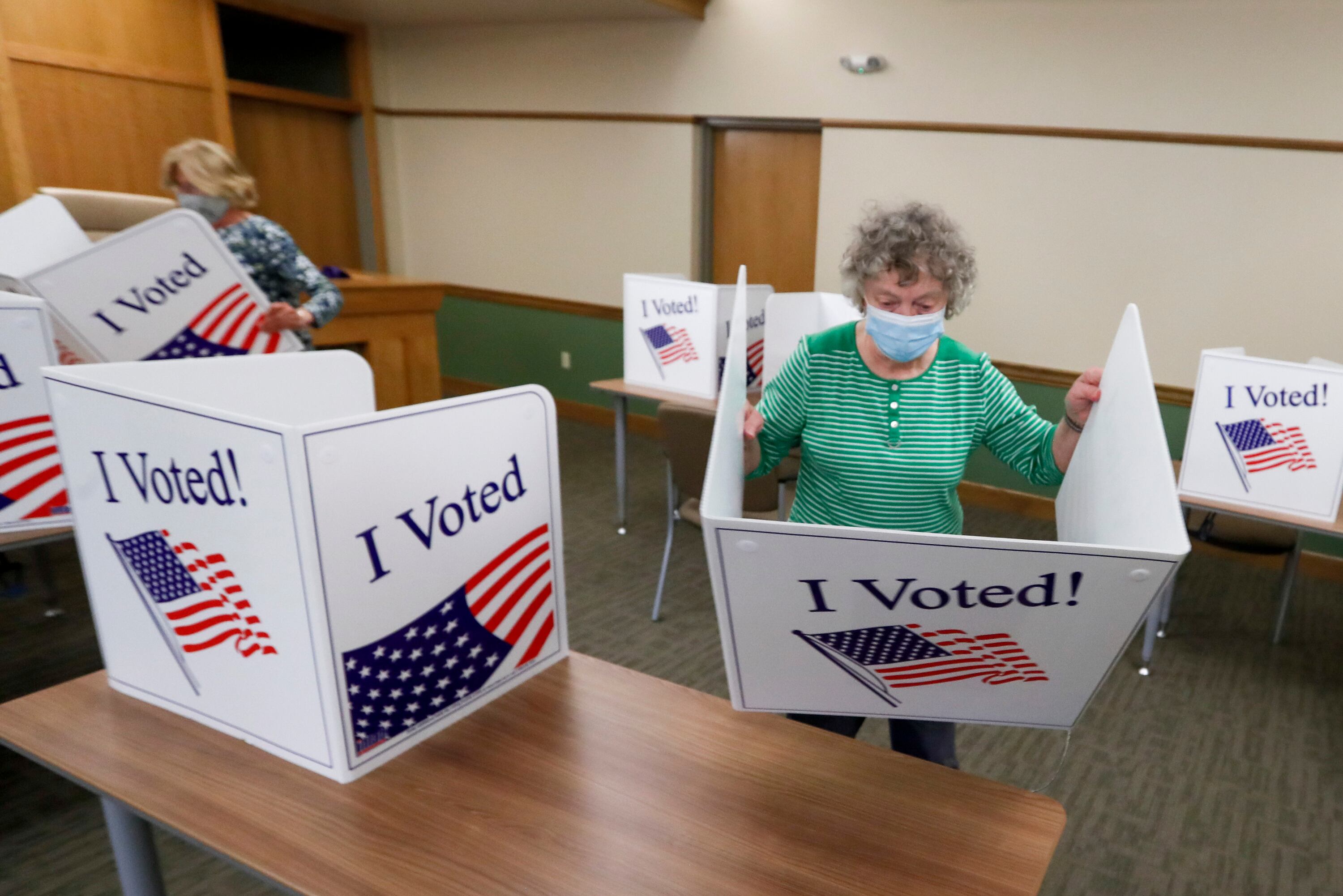
Voters are navigating curfews, health concerns, and a sharp increase in mail balloting on Tuesday as elections take place from Maryland to Montana.

Four states were originally scheduled to vote in April but delayed their contests because of the coronavirus outbreak. Pennsylvania offers the day's biggest trove of delegates and represents a high-profile test case for Republicans and Democrats working to strengthen their operations in one of the most important general election battlegrounds.

“We think we’re prepared,” Pennsylvania Democratic Party Chairwoman Nancy Patton Mills said. “Thank goodness we have the opportunity of working this out in the primary because we don’t know where we’ll be with the pandemic in November.”

Joe Biden was in Philadelphia on Tuesday morning to deliver remarks about the civil unrest that has erupted across the nation after the police killing of George Floyd. He didn't talk about the primary, instead, focusing his attention on President Donald Trump, whom Biden blasted as “more interested in power than in principle.”

Biden is already the presumptive Democratic presidential nominee and needs to win 89% of all delegates at stake on Tuesday to formally clinch the nomination. With a dominant showing on Super Tuesday in early March, the former vice president pushed out all his major opponents. He will almost certainly secure the needed delegates later in the month, if necessary.

Vermont Sen. Bernie Sanders is not actively campaigning, having suspended his operation and endorsed Biden, but his name will appear on the ballots. On the eve of Tuesday's primaries, senior adviser Jeff Weaver encouraged progressives to vote for Sanders anyway.

“People who support Bernie Sanders and his agenda, who want to maximize the influence of progressives at the convention, should cast their vote for Bernie Sanders,” Weaver said, reminding voters that the Vermont senator is seeking leverage to shape the party's platform and rules.

The comments serve as a reminder that Biden may have no legitimate Democratic rivals remaining but must still win over skeptical activists from his party’s far-left flank, who worry he’s too close to the political establishment.

Party unity will likely be an afterthought this week, however, as more immediate health and safety concerns dominate the national conversation. The coronavirus death toll has surged past 100,000 nationwide, and thousands of new cases are reported each day.

At the same time, several major cities, including some voting Tuesday, are grappling with protests.

Some voters said Trump’s increasingly tough tone toward protesters inspired them to participate in the democratic process. Nicholas Autiello, who works in finance in Rhode Island, said he was disturbed by police driving back peaceful demonstrators near the White House on Monday.

“Last night, we have a president who is acting like a dictator,” Autiello said. “So being able to come out here this morning and fill in a circle next to a name for someone who I know will restore honor and decency to the presidency was so important.”

Washington, D.C., Mayor Muriel Bowser ordered a 7 p.m. curfew on Tuesday, though voting places will be open until 8 p.m. Voting has been deemed essential, and city officials say voters will not be subject to arrest if they cast ballots during the curfew. Philadelphia moved its 6 p.m. curfew back to 8:30 p.m. for Tuesday to accommodate voting.

“We are in unique times, and voting is a unique challenge for people,” said Josh Schwerin, chief strategist for the pro-Democrat super PAC Priorities USA. He said that his organization and others will be watching closely on Tuesday “to see how well it works, where issues are and where obstacles have been put in place.”

Political groups have had to adjust as some states move to a system that relies largely on voting by mail. They include Montana, where all 56 counties decided to vote entirely by mail. Voting rights watchdogs in multiple states have expressed concerns about access to mail ballots, confusion about deadlines, and a shortage of poll workers that could lead to long lines.

Those voting Tuesday include the District of Columbia, Idaho, Indiana, Maryland, Montana, New Mexico, Pennsylvania, Rhode Island, and South Dakota. Another state holding primary elections, Iowa, chose its presidential nominee early in the year and focused on other offices.

___

Associated Press writer Rodrique Ngowi in Providence, R.I., contributed to this report.

Share:
More In Politics
Economist Sees Six Rate Hikes in 2022 After High January PPI Number
Inflation remains hot as the January PPI has increased by 1 percent, twice what analysts had been expecting with a jump of 9.7 over the year. Beth Ann Bovino, the U.S. chief economist, for S&P Global Ratings, joined Cheddar News to discuss the rapid pace of inflation alongside higher wages, predicting the Federal Reserve will act quickly and forcefully this year. "They haven't changed their forecast, yet, that's gonna come out soon. But we expect that a March rate hike is basically pretty much baked in the cake," she said. "We think six rate hikes in total for 2022."
U.S Chamber of Commerce Hosts Virtual Event 'Developing the Black-Owned Business Ecosystem'
For black history month, Cheddar is highlighting black business leaders who are driving the need for representation forward. On February 10, the U.S. Chamber of Commerce hosted an event called 'Developing the Black-Owned Business Ecosystem.' The virtual event was organized under the lobbying group's two initiatives -- the Equality of Opportunity Initiative, and the Coalition to Back Black Businesses. The event highlighted the developments needed to develop more black-owned businesses in the U.S. Dr. Anthony Wilbon, Dean of the School of Business at Howard University, joined Cheddar News' Closing Bell to discuss his experience as a speaker at the event.
Two Democratic Senators Allege Secret CIA Spying On Americans
A newly declassified letter by senators Ron Wyden and Martin Heinrich claimed the CIA. has been conducting a Secret Surveillance Program which has been collecting a bulk of data from American citizens. The letter which was written in April of 2021 urges the CIA to come clean about the kind of data it collects and how many Americans have been impacted. According to these two senators, the program did not have the safeguards of congressional oversight.
Stocks Close Lower to Begin Week as Russia-Ukraine Tensions Weigh on Sentiment
Art Hogan, Chief Market Strategist at National Securities, joined Cheddar News' Closing Bell, where he says investors are taking a wait-and-see approach when it comes to the situation between Russia and the Ukraine and elaborates on the impact higher oil prices stemming from the conflict would have on the market.
Behind Lawmaker Concerns Over Possible CIA Data Collection on Americans
Last week, Senators Ron Wyden of Oregon and Martin Heinrich of New Mexico, Democrats on the Senate Intelligence Committee, wrote a a letter airing concerns that the CIA is collecting the data of American citizens without their consent. The lawmakers fear that the program might be exploiting private data. Morgan Wright, the chief security advisor at cybersecurity firm SentinelOne, joined Cheddar News to discuss the ramifications of the letter. "We don't have all the dots in one place to connect them," said Wright, cautioning against jumping to conclusions.
Glimpse of Hope for Diplomatic Solution Over Russia-Ukraine Tensions
As the number of Russian troops rose to 130,000 along its Ukrainian border, hopes for a diplomatic solution remain among world leaders. Jason McMann, head of geopolitical risk analysis at Morning Consult, joined Cheddar News to break down the fluid situation. "We saw signs pointing towards an increase in tensions between Ukraine and Russia, whereas today we're seeing some signs that the Russian government may be willing to continue down a path of diplomatic negotiations to try and find some sort of non-military solution," he said.
'STOCK' Act Aimed at Preventing Insider Trading Within Congress...But Does It?
Nancy Pelosi and House Democratic leaders are now planning to amend the stop trading on congressional knowledge act, otherwise known as the 'Stock' Act. This 2012 law governs how members disclose the purchase or sale of stocks and amending it would close a loophole, eliminating the trading of individual stocks by members of congress. Pelosi has consistently opposed a ban on stock trading by lawmakers and congressional staff...so what's changed? Kedric Payne, Vice President of Campaign Legal Center, joins Cheddar News to discuss.
SCOTUS Allows GOP- Drawn Alabama Map to Remain
In a 5-4 vote, the U.S. Supreme Court allowed for a controversial new version of the Alabama congressional map to remain in place. The lower court had previously ordered that the state must redraw that congressional map because it violates the Voting Rights Act by diluting the political power of Black voters. Redistricting expert Yurij Rudensky joins Cheddar News to weigh in.
Load More