By Pat Graham
Imagine Tyreek Hill catching passes again from Patrick Mahomes. Not in a Super Bowl, either, but with a gold medal on the line for Team USA.
Anything's about to become possible after flag football was elevated to Olympic status. The non-contact sport was added to the program for the 2028 Summer Games in Los Angeles. Miami's Hill and Kansas City's Mahomes are among the NFL players who’ve shown an interest in possibly wearing the red, white and blue in the Olympics.
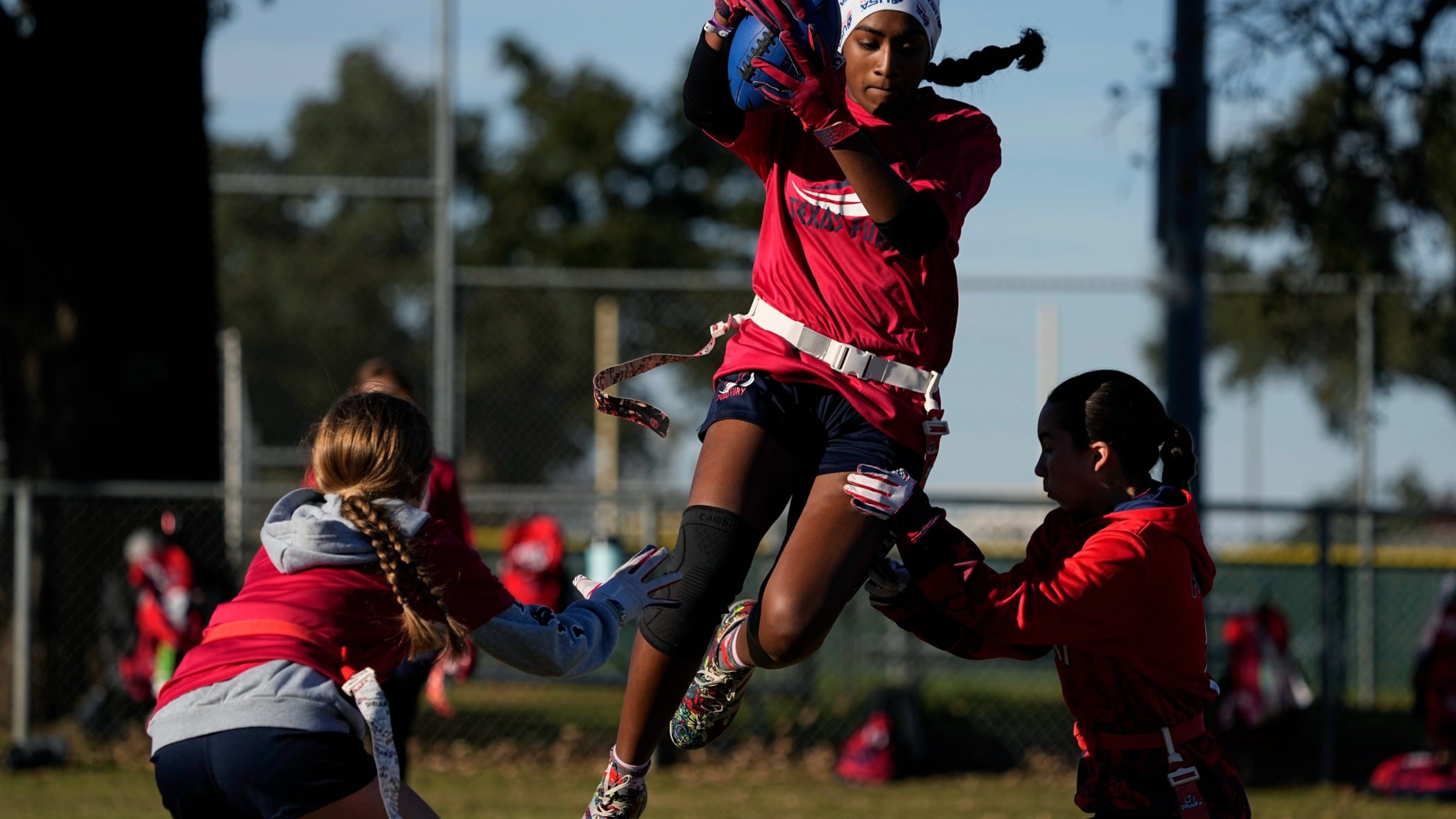
Flag football is a sport many may have grown up playing in the backyard or at recess in elementary school or in gym class or through leagues. In this version of American football, everyone is eligible to catch a pass on offense. And on defense, ending up with a flag is a good thing (it's how you stop a player). The NFL has jumped on board, too, adding flag football to the league's Pro Bowl activities.
What are the rules?
The standard style of the game is five-on-five with no linemen. It's played on a field that’s 50 yards long — along with 10 yards for each end zone — and 25 yards wide. That's about half the size of an NFL field. A stop is made by ripping off one of the flags attached by a belt to a ball carrier’s waist. The offensive team has four downs to reach midfield for a first down. If they reach midfield, the team has four more downs to score.
An offensive touchdown is worth six points with the subsequent extra-point attempt varying in value. A successful try from the 5-yard line is awarded one point, while a successful attempt from the 10-yard line is awarded two points. A defensive touchdown earns two points.
Each game consists of two 20-minute halves, and the clock stops within the final two minutes of each half. If a game is tied after regulation, there is an overtime period where each team receives an offensive possession. There are no running plays when a team is 5 yards or less from the end zone.
What equipment is needed to play?
Flags, a belt to hold the flags, cleats, jerseys, mouth guard and, of course, the ball. There are 12 players on a roster. The governing body for the sport is the International Federation of American Football (IFAF).
Is flag football in the Olympics forever?
The sport was one of five added for the LA Games. But it’s only an invitational sport for the moment. Another invitational sport, breakdance, will make its Olympic debut in Paris this summer but won’t return for LA. The flag football community is already working ahead for the 2032 Brisbane Games.
“So we clearly give ourselves the best chance for longevity and ultimately becoming a true sport in the Olympic movement,” Scott Hallenbeck, the CEO of USA Football, said.
Can NFL players compete?
In theory and for now, yes. But really it’s going to boil down to what the league, owners and teams have to say. Some big-name players have already expressed a strong desire to play. It’s a different style of game, though, and the national teams feature world-class players, too. The U.S. men have won four straight world championships, while the women have captured two in a row. But Team Mexico, led by standout QB Diana Flores, won the gold medal at the World Games in 2022.
There could even be a mix of current NFL players, retired ones and those players in the talent-development pipeline for USA Football.
It’s still a ways away, but beginning next season, there are official USA Football sanctioned events, tournaments and combines to kick off the selection process.
“Our job is fundamentally to put together the best team that can go and win gold,” Hallenbeck said. “It’s that simple.”
What can this mean for flag football going forward?
There are eight states — Alabama, Alaska, Arizona, California, Florida, Georgia, Nevada, and New York — that have sanctioned girls flag football as a high school varsity sport. In addition, there are around two dozen NAIA schools that played women's flag football in 2023 — and more plan to be in upcoming seasons.
According to USA Football research, more than 1 million kids between the ages of 6 and 12 played the sport in 2022. There's also been more than 1.5 million participants between 6 and 17 who have played in each of the past two seasons.