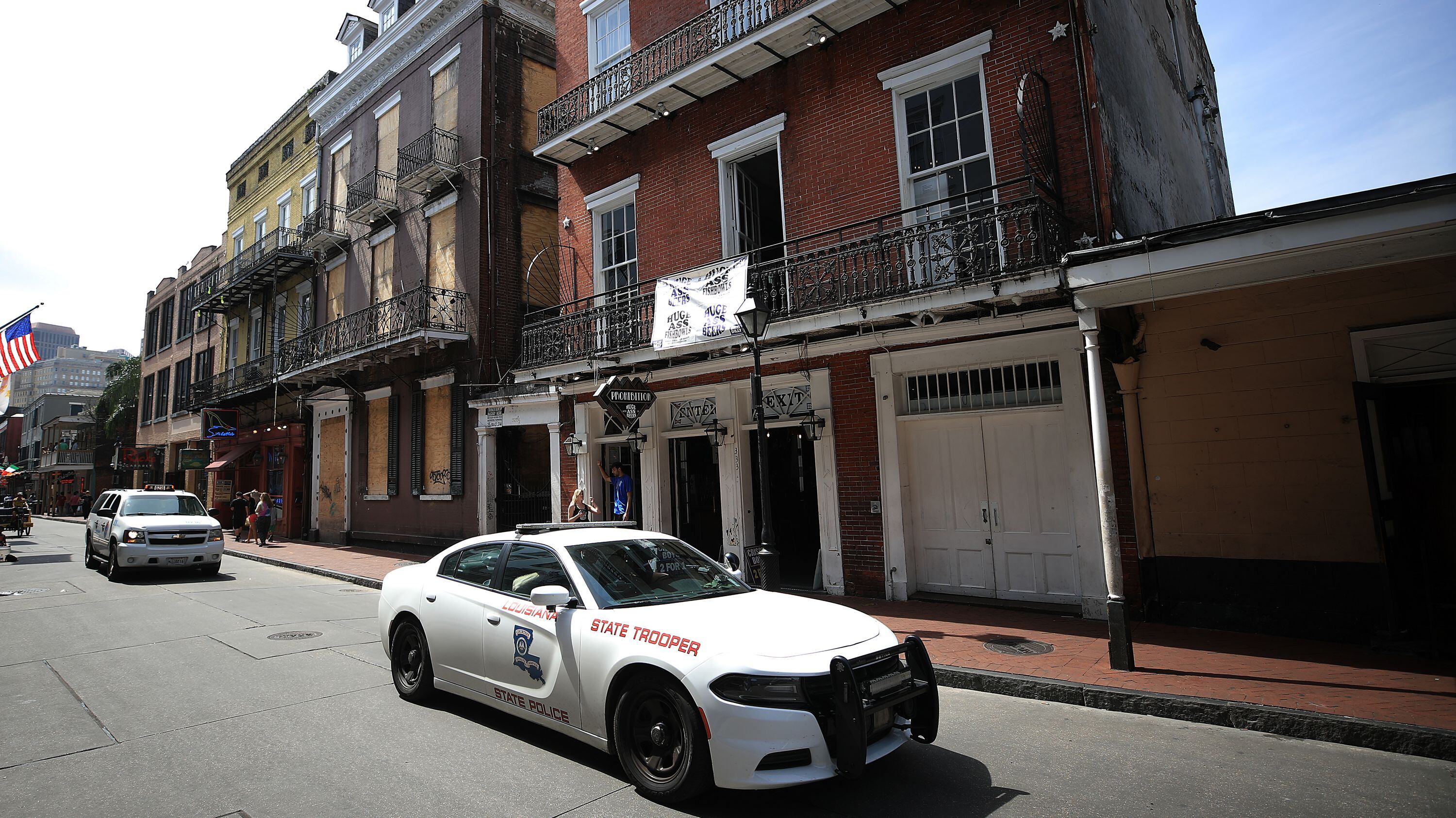
New Orleans police cleared the city's famous Bourbon Street over the weekend to stem the spread of coronavirus.
Officers attempted to disperse crowds by driving slowly down the street, still crowded with revelers in spite of the pandemic ripping across the U.S. and the world.
"Large groups of people are prohibited from congregating together. Your actions are jeopardizing public health. We are directing you to clear the streets and go home or back to your hotel," an officer can be heard announcing in a video uploaded to Twitter on Sunday night, and retweeted by the New Orleans Police Department.
The action came on the heels of an executive order by Louisiana Gov. John Bel Edwards, banning gatherings of 250 people or more across the state and shutting down schools. The Pelican State reported on Saturday its first fatality from COVID-19, the respiratory disease caused by the novel coronavirus.
The first victim of the virus was a 58-year-old New Orleans resident with underlying health conditions. The city has since reported another death, a 53-year-old patient, also with underlying medical conditions, who New Orleans Mayor LaToya Cantrell called a personal friend.
"The news this morning of a second death in New Orleans is deeply heartbreaking to me, personally — and is additional tragic news for the people of our City. The patient in this instance was a friend of mine, but every one of those impacted by this outbreak is someone's friend, someone's loved one," she wrote on Facebook on Sunday morning.
Louisiana's tally of reported COVID-19 cases more than tripled over the weekend to 114 on Monday morning — from 33 presumptive positive cases across the state as of Friday morning. Of those, 79 cases are in New Orleans, the state's most populous city. The Louisiana Department of Health reported 302 total tests completed as of Monday morning.
Louisiana has joined other states in implementing extreme measures to stem the spread of the novel coronavirus, a disease that spread from Wuhan, China to close to 150 countries across the globe. It has killed 41 and sickened more than 1,600 in the U.S. so far as of Friday, according to the CDC. The Pelican State also became the first state in the nation, according to the New York Times, to postpone its presidential primary, out of an abundance of caution for elderly poll workers who are "among the most vulnerable to this virus," Gov. Edwards said in a statement. The election was originally scheduled for April 4, but has been postponed by more than two months. Georgia has since followed suit, and other states are reportedly considering similar action.