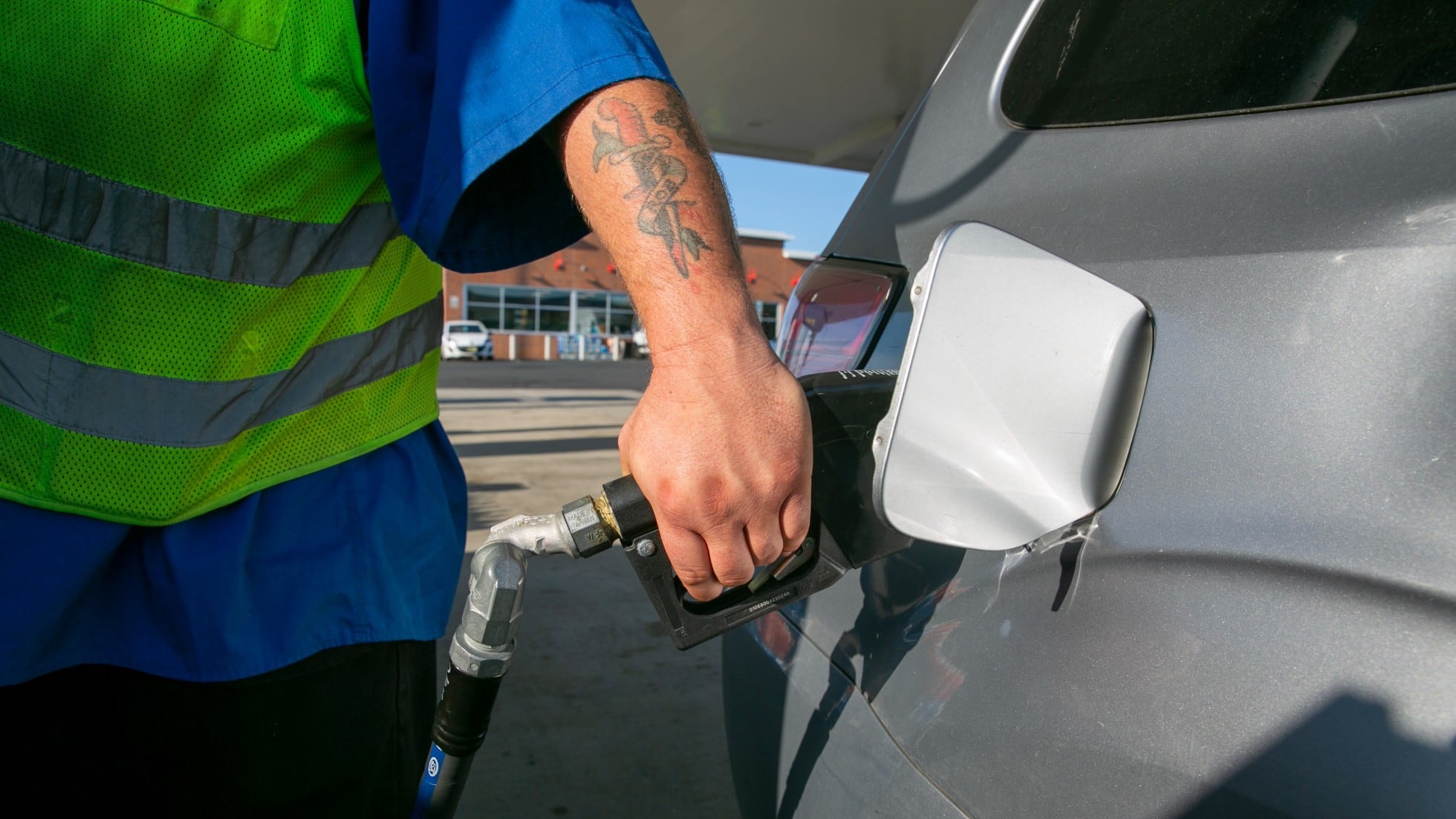
A gas station employee pumps gas into a vehicle at a Sunoco station in Wall Township, New Jersey, on the Garden State Parkway on Friday, July 22, 2022. (AP Photo/Ted Shaffrey)
By Wayne Parry
New Jersey will prohibit the sale of new gasoline-powered vehicles by 2035 as part of an effort to improve air quality and reduce planet-warming pollutants, officials announced Tuesday.
A rule that will take effect Jan. 1 commits the state to an eventual move toward zero-emission vehicles, the state Department of Environmental Protection said in a news release.
It is one of a growing number of states to do so, including California, Vermont, New York, Washington, Oregon, Massachusetts, Virginia, Rhode Island, Maryland and Connecticut, according to Coltura, a Seattle-based nonprofit advocating for an end to gasoline vehicle use.
New Jersey will start limiting the amount of new gasoline-powered cars that can be sold in the state starting in 2027, eventually reaching zero in 2035.
The move does not prohibit ownership or use of gasoline-powered cars, not does it force consumers to buy electric vehicles, the DEP said. It will not prohibit the sale of used cars powered by gasoline, and consumers would still be free to purchase gas-fueled cars elsewhere and bring them into New Jersey, as long as they met certain emissions standards.
“The steps we take today to lower emissions will improve air quality and mitigate climate impacts for generations to come, all while increasing access to cleaner car choices,” said Phil Murphy, the state's Democratic governor.
"Cleaner cars and trucks mean cleaner air for our children and families, because the tailpipes of our own vehicles are a leading cause of poor local air quality,” said Shawn LaTourette, the state's environmental protection commissioner. “As New Jersey transitions to a zero-emission vehicle future, we will improve our quality of life and public health. At the same time, we will reduce climate pollutants from the transportation sector, the greatest source of planet-warming pollution in New Jersey and the nation.”
The rule has been hotly opposed by business groups since word that the state was moving to implement it started circulating earlier this year.
Ray Cantor, an official with the New Jersey Business and Industry Association, said over 100 business, labor and other groups have sent nearly 10,000 letters to state legislators “asking them to step in to stop a proposed DEP rule that will ultimately mandate what type of car residents can drive, and in some cases, if they can afford to drive.”
“This ban of the sale of new gas-powered cars in such an expedited time does not take costs or feasibility into account," he said. “It does not take the lack of local and highway infrastructure into account. It does not take grid capacity into account. It ignores consumer choice. It doesn’t take New Jersey residents into account, especially low- and moderate-income families.”
Environmental groups hailed the decision.
"This is a huge win not only for the environment, but for public health and the communities who suffer every day from the pollution from congested roadways,” said Anjuli Ramos-Busot, director of the New Jersey Sierra Club.
“The electric vehicle revolution is upon us, and the benefits are far-reaching — even for those who never plan to get behind the wheel of an EV," added Kathy Harris, an official with the Natural Resources Defense Council.
On this episode of Cheddar Innovates: Yat Labs Co-Founder breaks down how a 'Yat' is changing the way people think about their online identities; Scythe Robotics CEO explains how it's bringing innovation to the landscaping industry with its autonomous, all-electric mowers; Founder of California Cowboy discusses how its creating clothing designed for creating in-person connections with others with features like a beverage pocket, bottle opener, and conversation cards; Cheddar gets a look at Curiosity Stream's 'Beyond the Spotlight' biography series.
Amazon founder Jeffrey Bezos took to the stage at the U.N.'s COP26 Climate Summit to unveil a new plan to combat climate change, but some say it might do more harm than good. Justine Calma, Science Reporter at The Verge, joined Cheddar to discuss.
Pfizer has asked the FDA to expand authorization of COVID booster shots for all adults. The agency is expected to grant the request in the coming weeks, allowing vaccinated Americans as young as 18 to get boosted before the holidays. Dr. Bayo Curry-Winchell, Regional Clinical Director at Carbon Health, joined Cheddar to discuss.
Wood modification technology company Kebony recently raised $34 million in its latest funding round. The company's patented technology transformed sustainable softwood using leftover materials and makes it into a product that behaves like premium hardwood. The process has the potential to transform the global construction industry, as it is cost-effective and eco-friendly. Kebony CEO Norman Willemsen joined Cheddar News' Closing Bell to discuss.
Emma Searson, an author on the just-released Renewables on the Rise report and the director, 100% Renewable Campaign at Environment America, joined Cheddar to discuss the rapidly growing renewable energy sector. Between 2011 and 2020, the report shows that wind, solar, and geothermal energy production grew about 15 percent annually and that wind and solar alone account for 11 percent of electricity in the country. "There are a few really important drivers of the renewable energy progress that we're seeing all across the country," Searson said, highlighting falling prices, technology improvements, and supportive policies.
On this episode of 'Cheddar Reveals', Lydia McMullen-Laird and Samuel McMullen, co-founders of Live Zero Waste, discuss the sum of humanity's 'trash addiction' and lifestyle changes people can make to help reduce their individual trash output; Ryan Lupberger, Sustainability Pioneer and CEO of Cleancult, breaks down how Cleancult is redefining cleaning products and solutions to reduce their impact on the planet; Cheddar gets a look at Curiosity Stream's 'Going Circular.'
The U.S. has reopened its borders for fully vaccinated international visitors, ending a ban on foreign travelers that started more than a year ago. It's a welcome change for families separated by the pandemic and a sign of hope for the battered travel industry. Steve Shur, president of the The Travel Technology Association, discusses the new rules and how they could propel the travel industry into a post-pandemic boom.