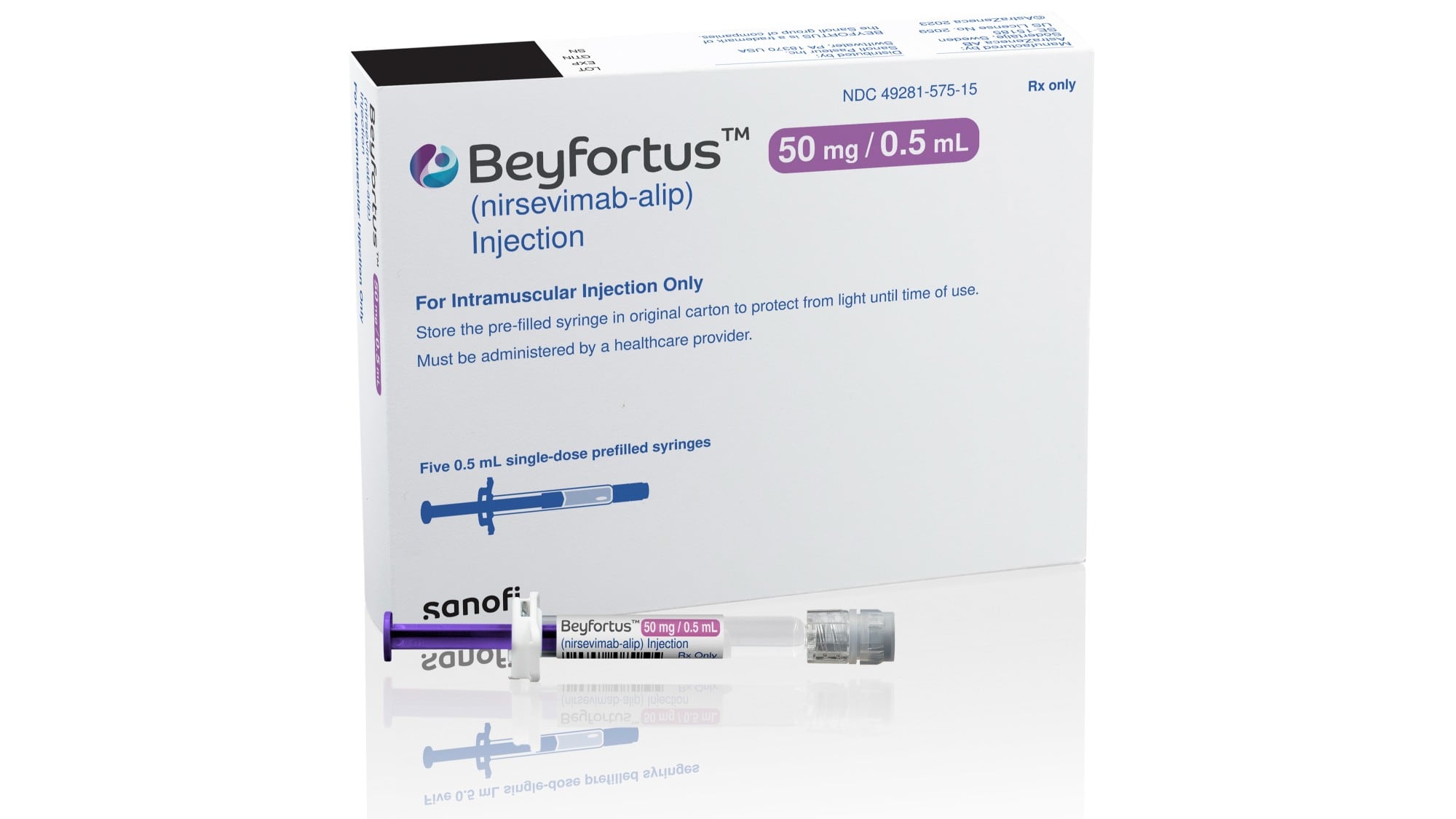
This illustration provided by AstraZeneca depicts packaging for their medication Beyfortus. U.S. officials have approved a new long-acting drug to protect babies and toddlers against a respiratory virus that causes thousands of hospitalizations each year. The Food and Drug Administration on Monday, July 17, 2023 approved the injection for infants and children up to 2 years old. (AstraZeneca via AP)
By Matthew Perrone
U.S. officials on Monday approved the first long-acting drug to protect babies and toddlers against a respiratory virus that sends tens of thousands of American children to the hospital each year.
RSV is a cold-like nuisance for most healthy people, but it can be life-threatening in the very young and the elderly.
The Food and Drug Administration approved the injection for infants and children up to 2 years old who face increased risk of severe RSV.
“Today’s approval addresses the great need for products to help reduce the impact of RSV disease on children, families and the health care system” said FDA's Dr. John Farley in a statement.
Last year, a surge in RSV cases flooded U.S. hospitals with wheezing children. There are no vaccines for babies yet, though Pfizer and other companies are working on them.
AstraZeneca’s drug, to be sold under the brand name Beyfortus, is a laboratory-made version of an antibody that helps the immune system fight off RSV. Under the FDA approval, babies — including preterm infants — can receive a single injection to protect against their first season of RSV, which typically lasts about five months. Children up to age 2 can receive another dose to protect them during their second season facing the virus.
Beyfortus, which will be marketed in the U.S. by Sanofi, is already approved in Canada, Europe and the U.K. Sanofi did not immediately announce the U.S. price of the treatment.
FDA officials approved the drug based on three studies showing Beyfortus reduced the risk of RSV infection between 70% and 75% among infants and children 2 and younger.
Advisers to the Centers for Disease Control and Prevention will meet early next month to recommend exactly who should get the drug.
A similar antibody drug won FDA approval more than 20 years ago, but it’s only recommended for high-risk babies and requires monthly injections. Pediatricians say the drug is underutilized and they expect the longer-lasting effect of AstraZeneca's shot to improve uptake.
In the U.S., about 58,000 children younger than 5 are hospitalized for RSV each year and several hundred die.
After decades of setbacks for RSV research, drugmakers have made big strides this year, launching the first vaccines against the virus. In May, the FDA approved two RSV vaccines for older adults from GlaxoSmithKline and Pfizer. In August, the FDA is expected to make a decision on approving Pfizer’s vaccine for pregnant women, with the aim of passing along protection to their newborns.
The Associated Press Health and Science Department receives support from the Howard Hughes Medical Institute’s Science and Educational Media Group. The AP is solely responsible for all content.
Catching you up on what you need to know on April 6, 2022, with updates on the FDA’s meeting to discuss a second COVID booster shot, more on the war in Ukraine, tornadoes on the Gulf coast, a third suspect arrested in connection to the mass shooting in California, Darwin’s lost notebooks mysteriously returned, and more.
Two of naturalist Charles Darwin’s notebooks that were reported stolen from Cambridge University have been returned, two decades after they disappeared.
Tensions from the Russia-Ukraine war have spilled into space. The head of Russia's space agency has threatened to pull the country out of the International Space Station if sanctions aren't lifted on the country — but that doesn't seem to be happening any time soon. What would it mean if Russia really did leave the ISS, who would it harm the most, and what would the consequences be both for the other ISS partners, and private space travel? Casey Dreier, Chief Advocate & Senior Space Policy Adviser at The Planetary Society, joins Closing Bell to discuss.
Almost every industry now uses online shopping and ordering, but some products require a different packing material, and many times, shipping products can be wasteful. TemperPack aims to solve both issues with its ClimaCell liners, which you might recognize if you have ever ordered a meal subscription kit. Brian Powers, co-founder and Chief Growth Officer at TemperPack, joins Closing Bell to discuss TemperPack's ClimaCell liners, the company's sustainability mission, its corporate customer base, and more.
Bees are responsible for the bulk of fruit and vegetable pollination — and they're negatively being affected by climate change. Tech startup Beewise is offering a solution with artificial intelligence to create robotic, autonomous hives to help the vulnerable bee populations. Saar Safra, co-founder & CEO, joined Cheddar News to talk about the company's recent $80 million to help make this project possible. "Our solution is not only hardware," he said. "Its software and biology all in one device. That's the challenge, and that's what sets us apart."
Space tourism continues to be generating buzz after the most recent Blue Origin launch. Two of its passengers made history as the first married couple to travel to space. The couple, Marc Hagle, CEO at Tricor, and Sharon Hagle, CEO at Spacekids Global, joined Cheddar News fresh off of their trip to talk about their experience and future space travel plans. "If there is a Santa Claus, we’ll have the opportunity to fly with Virgin Galactic, and maybe we'll have the opportunity to fly with SpaceX," said Marc Hagle, followed by Sharon explaining they had already signed up with Virgin Galactic about 15 years ago.
The metaverse may be the next big thing in the music world. Cheddar News’ Michelle Castillo sat down with Jon Vlassopulos, VP and head of music at Roblox, to discuss virtual concerts and more.
The head of Russia’s space program says the future of the ISS hangs in the balance after the U.S., EU, and Canadian space agencies missed a deadline to meet Russian demands for lifting sanctions on Russian enterprises and hardware.
Catching you up on what you need to know on April 4, 2022, with reports of Russian war crimes in Ukraine, a weekend shooting in Sacramento killing six and injuring 12, Mexico ending its gas subsidization for U.S. drivers, and the University of South Carolina winning the women's NCAA basketball championship, and more.
Peter Zalzal, associate vice president for clean air strategies at the Environmental Defense Fund, a nonprofit environmental advocacy group, joined Cheddar to discuss the Biden Administration's unveiling of stricter fuel-efficiency standards for new automobiles. "The administration estimated that these rules will reduce about 2.5 billion tons of climate pollution by 2050, and using less fuel also means that we have to go to the gas pump less often. And so it means we save money, thousands of dollars in avoided fuel costs each year for consumers," he noted.