By Robert Burns and Lorne Cook
At President Joe Biden's direction, the Pentagon is putting about 8,500 U.S.-based troops on heightened alert for potential deployment to Europe to reassure allies amid rising fears of a possible Russian military move on Ukraine.
Pentagon press secretary John Kirby said Monday no final decisions had been made on deployments, which he said would happen only if the NATO alliance decides to activate a rapid-response force “or if other situations develop” in connection with tensions over Russia's military buildup along Ukraine's borders.
“What this is about is reassurance to our NATO allies," Kirby said, adding that no troops are intended for deployment to Ukraine itself.
Kirby said Defense Secretary Lloyd Austin recommended to Biden that about 8,500 troops be ordered to prepare for potential deployment to Europe in light of signs that Russian President Vladimir Putin is not de-escalating his military pressure on Ukraine. Kirby said he was not prepared to identify the U.S.-based units because they were still being notified.
“We’ve always said we would reinforce our allies on the eastern flank, and those conversations and discussions have certainly been part of what our national security officials have been discussing with their counterparts now for several weeks,” said White House press secretary Jen Psaki.
Later Monday, Biden held a video call with several European leaders on the Russian military buildup and potential responses to an invasion, the White House said.
Kirby said Austin was anticipating the potential for NATO to activate what it calls the NATO Response Force, a multinational force totaling about 40,000 troops. Most of the 8,500 U.S. troops being put on higher alert would be sent as part of that response force, if it's activated, Kirby said. He added that he could not rule out that U.S. troops already based in Europe could be shifted east as further reinforcements.
As an example of the effect of Austin's order to make U.S.-based units more prepared for deployment, Kirby said that those currently required to be ready to move on 10-days notice will be required to be ready on 5-days notice.
The Pentagon's move comes as tensions have soared between Russia and the West over concerns that Moscow is planning to invade Ukraine, with NATO outlining potential troop and ship deployments, Britain saying it would withdraw some diplomats from Kyiv, and Ireland denouncing upcoming Russian war games off its coast.
Prior to the U.S. announcement, the Western alliance’s statement summed up moves already described by member countries, but restating them under the NATO banner appeared aimed at showing resolve. The West is ramping up its rhetoric in the information war that has accompanied the Ukraine standoff.
Russia has massed an estimated 100,000 troops near Ukraine’s border, demanding that NATO promise it will never allow Ukraine to join and that other actions, such as stationing alliance troops in former Soviet bloc countries, be curtailed. Some of these, like any pledge to permanently bar Ukraine, are nonstarters for NATO — creating a deadlock that many fear can only end in war.
Russia denies it is planning an invasion, and says the Western accusations are merely a cover for NATO’s own planned provocations. Recent days have seen high-stakes diplomacy that failed to reach any breakthrough and maneuvering on both sides.
NATO said Monday it is bolstering its “deterrence” in the Baltic Sea region. Denmark is sending a frigate and deploying F-16 warplanes to Lithuania; Spain is sending four fighter jets to Bulgaria and three ships to the Black Sea to join NATO naval forces; and France stands ready to send troops to Romania. The Netherlands also plans to send two F-35 fighter aircraft to Bulgaria from April.
NATO will “take all necessary measures to protect and defend all allies,” Secretary-General Jens Stoltenberg said. "We will always respond to any deterioration of our security environment, including through strengthening our collective defense.”
In Moscow, Kremlin spokesman Dmitry Peskov said it was NATO and the U.S. who were behind the escalating tensions, not Russia.
“All this is happening not because of what we, Russia, are doing. This is happening because of what NATO, the U.S. are doing,” Peskov told reporters.
The NATO announcement came as European Union foreign ministers sought to put on a fresh display of unity in support of Ukraine, and paper over concerns about divisions on the best way to confront any Russian aggression.
In a statement, the ministers said the EU has stepped up sanction preparations and they warned that “any further military aggression by Russia against Ukraine will have massive consequences and severe costs.”
Separately, the EU also committed to increase financial support for embattled Ukraine, vowing to push through a special package of 1.2 billion euros ($1.4 billion) in loans and grants as soon as possible.
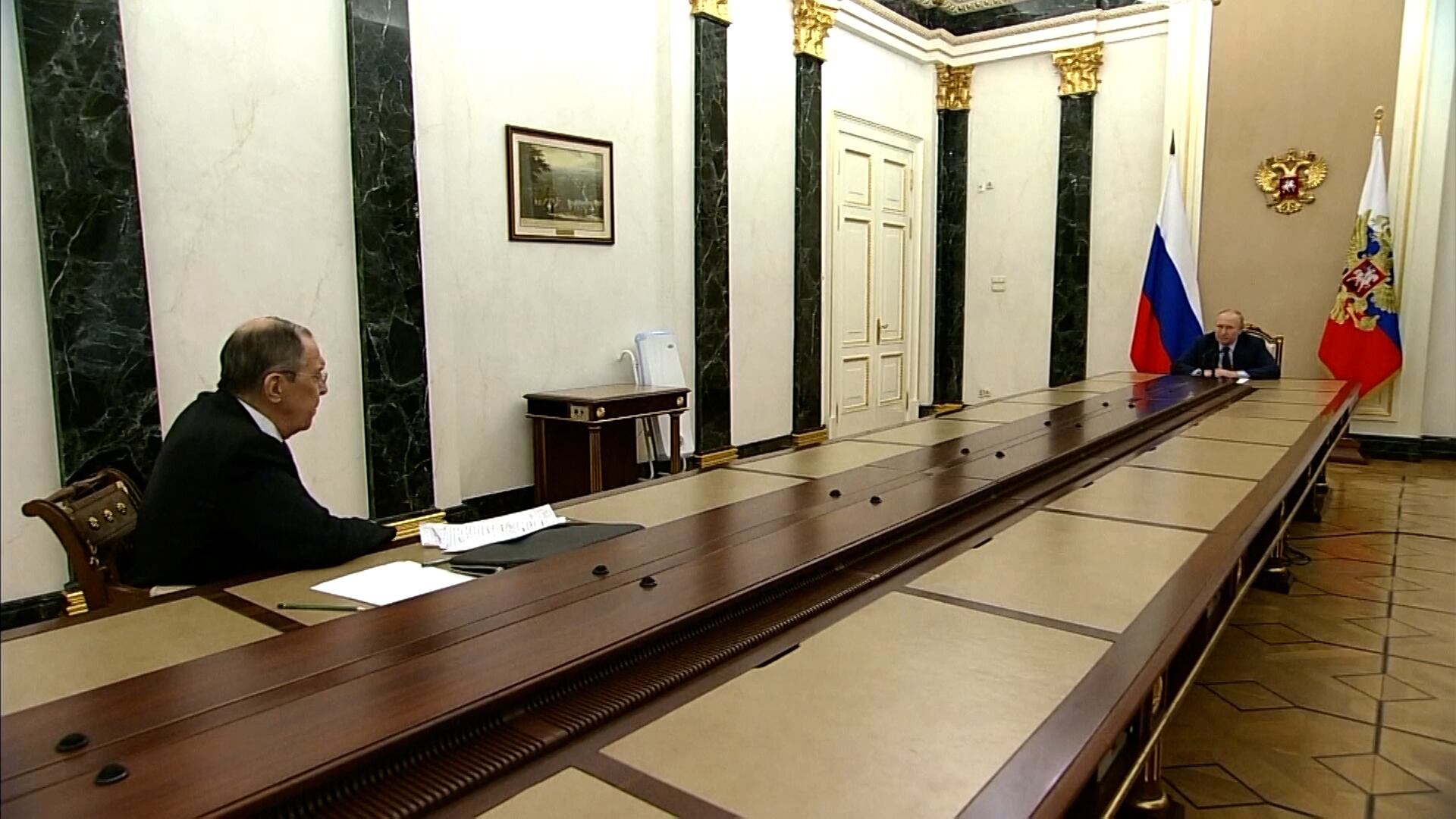
U.S. Secretary of State Antony Blinken held talks with Russian Foreign Minister Sergey Lavrov on Friday and said the U.S. would give Russia written responses to Moscow’s proposals this week, offering some hope that any invasion could be delayed for at least a few more days.
The West is nervously watching Russian troop movements and war games in Belarus for any signs of an invasion. Russia has already invaded Ukraine once, annexing the Crimean Peninsula in 2014. It also supported pro-Russian Ukrainian separatists fighting the Kyiv government in the country's eastern region known as the Donbass. About 14,000 people have been killed in the conflict.
Asked whether the EU would follow a U.S. move and order the families of European embassy personnel in Ukraine to leave, EU foreign policy chief Josep Borrell said: “We are not going to do the same thing.”
Britain said it is withdrawing some diplomats and dependents from its Kyiv Embassy.
British Prime Minister Boris Johnson said an invasion was not inevitable, but “the intelligence is pretty gloomy.” He added that "I think that sense can still prevail.”
Ukraine's Foreign Ministry spokesman, Oleg Nikolenko, said the U.S. decision was “a premature step” and a sign of “excessive caution.” He said Russia is sowing panic among Ukrainians and foreigners in order to destabilize Ukraine.
Germany has issued no similar order, with Foreign Minister Annalena Baerbock stressing that “we must not contribute to unsettling the situation further."
At the EU meeting, Irish Foreign Minister Simon Coveney said he would inform his counterparts about planned Russian war games 240 kilometers (150 miles) off southwestern Ireland — in international waters but within Ireland's exclusive economic zone.
“This isn’t a time to increase military activity and tension in the context of what’s happening with and in Ukraine.” he said. “The fact that they are choosing to do it on the western borders, if you like, of the EU, off the Irish coast, is something that in our view is simply not welcome.”
NATO members Estonia, Latvia and Lithuania said they plan to send U.S.-made anti-tank and anti-aircraft missiles to Ukraine, a move endorsed by Washington.
In talks with European allies throughout the crisis, administration officials said they have remained cognizant that Europe’s trade, energy and financial linkages with Russia are far more significant than they are for the U.S.
Russia's brittle economy is overly reliant on energy exports. President Vladimir Putin has made clear his ambition to diversify the economy, particularly in sectors like defense and civil aviation, but the U.S. and European allies have a dominant position in producing and exporting the technologies, software and equipment crucial for Russia in those sectors.
___
Associated Press writers Yuras Karmanau in Kyiv, Ukraine, Dasha Litvinova in Moscow, Geir Moulson in Berlin, Aritz Parra in Madrid, Jill Lawless in London, Robert Burns and Aamer Madhani in Washington, Mike Corder in The Hague, and Raf Casert in Brussels contributed.
Updated on January 24, 2022, at 4:34 p.m. ET with the latest details.