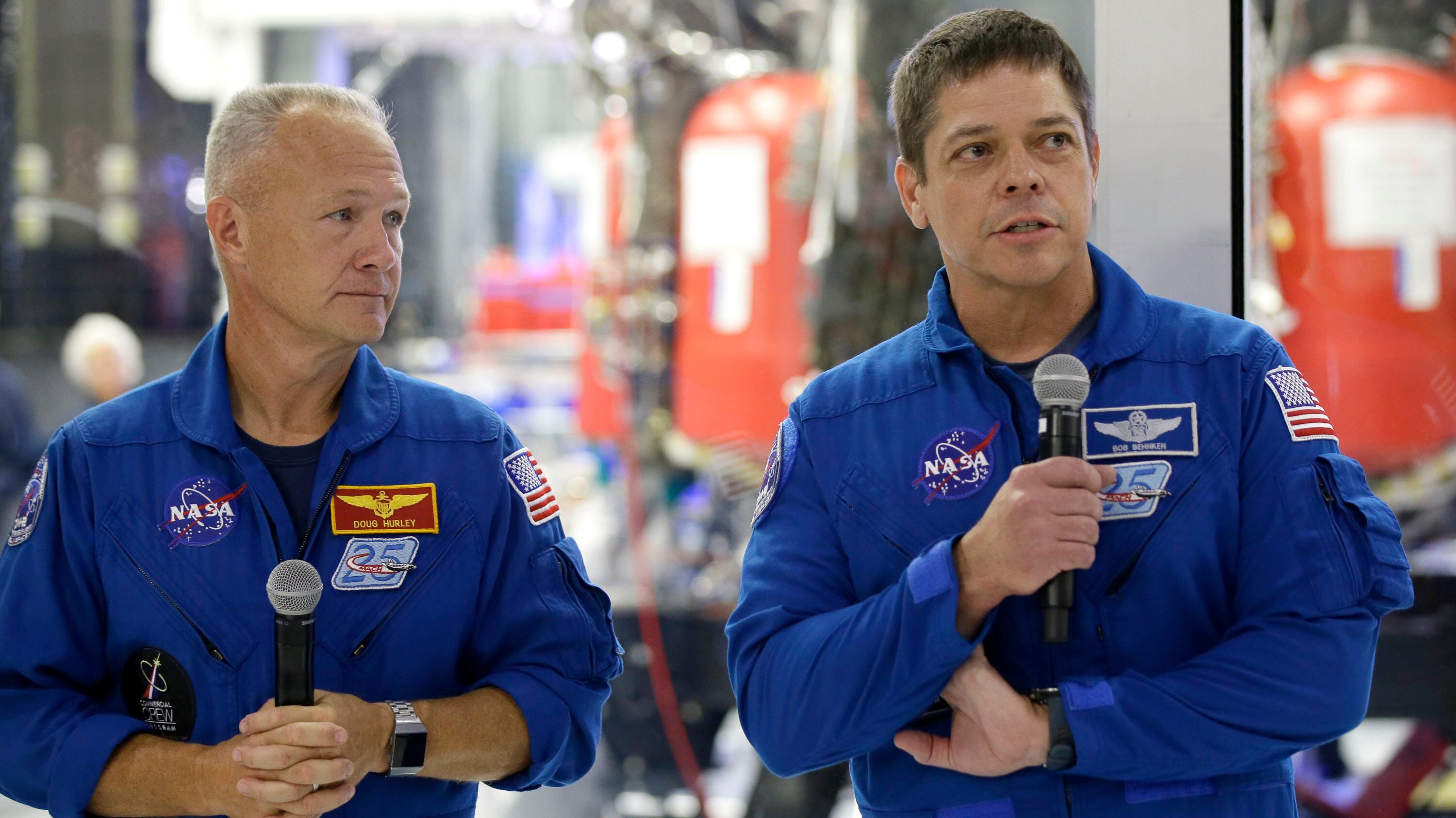
In this Thursday, Oct. 10, 2019 file photo, NASA astronauts Bob Behnken, right, and Doug Hurley talk to the media in front of the Crew Dragon spacecraft at SpaceX headquarters in Hawthorne, Calif. On Friday, April 17, 2020, NASA and SpaceX announced May 27 for resuming human launches from the U.S. after nearly a decade. Hurley and Behnken will blast off atop a SpaceX Falcon 9 rocket, departing from the same Kennedy Space Center launch pad used by Atlantis in July 2011. (AP Photo/Alex Gallardo)
By Marcia Dunn
NASA and SpaceX have picked May 27 for resuming astronaut launches from the U.S. after nine years of complete Russian dependence.
NASA Administrator Jim Bridenstine announced the launch date Friday. Astronauts haven’t launched into orbit from the U.S. since NASA’s last space shuttle flight in 2011. SpaceX aims to end the drought by sending two NASA astronauts to the International Space Station.
“On May 27, @NASA will once again launch American astronauts on American rockets from American soil!” Bridenstine tweeted.
Astronauts Doug Hurley and Bob Behnken will blast off atop a SpaceX Falcon 9 rocket, departing from the same Kennedy Space Center launch pad used by shuttle Atlantis in July 2011, as well as the Apollo moonshots a half-century ago. Hurley served as pilot on that last shuttle mission and will be the spacecraft commander for SpaceX's Dragon crew capsule.
Launch day will be a Wednesday, with a liftoff time of 4:32 p.m. EDT. It's too soon to know whether the coronavirus pandemic will prompt crowd restrictions.
Only three countries have launched people into orbit since 1961: Russia, the U.S. and China, in that order. SpaceX would be the first company.
SpaceX successfully conducted its first test flight of a Dragon crew capsule a year ago, sending the capsule — minus a crew — to the space station. The returned capsule was accidentally destroyed during ground testing at Cape Canaveral, further delaying the astronaut launch.
With the space station crew now down to three, Hurley and Behnken will spend weeks, perhaps months, helping to maintain the orbiting lab. The length of their mission is still under review, according to NASA.
NASA, meanwhile, is in the process of buying another seat on a Russian rocket. Russian Soyuz capsules have been the sole means of crew transportation to and from the space station since 2011.
SpaceX has been using Falcon 9 rockets to launch cargo to the space station in the company’s original Dragon capsules since 2012. NASA turned to private companies for deliveries once the shuttle program ended.
Boeing also is working to launch astronauts under NASA's commercial crew program, but the company's effort suffered a serious setback following last December's botched test flight. Launching without anyone on board, Boeing's Starliner capsule failed to reach the space station after ending up in the wrong orbit and came close to destruction twice because of software errors.
Boeing plans to repeat the test flight, again without astronauts, this fall.
___
The Associated Press Health and Science Department receives support from the Howard Hughes Medical Institute’s Department of Science Education. The AP is solely responsible for all content.
The airline industry says it is contending with staff shortages that threaten to hamper operations amid the COVID resurgence, andDelta Airlines CEO Ed Bastian called on the CDC to revise its guidance for vaccinated workers who test positive from a 10-day quarantine to just five. Chuck Liberman, chief investment officer and managing partner at Advisors Capital Management LLC, joined Cheddar to talk about the current guidance on isolation and why he believes the omicron variant calls for more relaxed guidance given its reportedly mild symptoms.
Schools are shutting down in droves as the highly contagious omicron variant surges across the country. Denisha Merriweather, director of public relations and content marketing at the American Federation for Children, an advocacy organization for vouchers and tax credits for school choice, joined Cheddar's "Opening Bell" to discuss the impact of remote learning on children. She argued that school districts have to be more proactive about the steps they are taking to engage students, and if they are unable to form better teaching methods, parents should be able to find alternative schools.
The boys discuss President Biden's plans to send out free rapid tests as the testing supply chain starts to buckle ahead of the holidays. Also, why aren't Americans having more babies, and The Matrix returns.
With the Build Back Better plan essentially out of the picture, economists are highlighting what the country might lose without the provisions designed to strengthen it. Among other things, this includes no more monthly payments for tens of millions of families, no universal Pre-K for 6 million children a year, and no billions of dollars in tax incentives for climate initiatives. Grace Segers, staff writer for The New Republic, joined Cheddar to discuss the various impacts on the economy without President Biden's spending bill.
Electric vehicle companies took a tumble Monday after Senator Joe Manchin killed Biden's 'Build Back Better' plan. Shares of Tesla, Lucid, and Rivian all fell rapidly as the plan had included significant incentives for the growing EV sector. Rich Steinberg, former executive at Nissan, BMW and Electrify America joined Cheddar's Opening Bell to discuss.
Michael Robinson, Chief Technology Strategist at Money Map Press, joins Cheddar News' Closing Bell, where he explains why small and mid-cap stocks heating up during Tuesday's session is a very good sign for a stock market that ended the day's session sharply higher.
Coming off a 2021 campaign where the prices of Bitcoin, Ether, and other cryptocurrencies reached unpreceded levels, Bitwise Asset Management CIO Matt Hougan and OpenNode Co-Founder & CTO João Almeida join Cheddar News' Crypto Craze: The Year of the Token to discuss the ways the crypto market can soar even higher in 2022.