*By Christian Smith*
After an overdose earlier this week, Demi Lovato's life was reportedly saved by Narcan, a nasal administrator of naloxone that counteracts the effects of opioids. When administered quicklyーthrough either nasal mist or injectionーnaloxone can temporarily halt an overdose, allowing EMTs enough time to respond. The medication is available without a prescription in 49 states, and the generic version costs about $20 per dose.
But all merits aside, is the drug's accessibility enabling addicts to push their limits?
Dr. Roger Crystal, the lead inventor of Narcan and CEO of Opiant Pharmaceuticals, says there's little evidence to support that concern.
"Addiction like any kind of chronic disease is something you can control using better medication, but ultimately you can't cure," Crystal told Cheddar. "To think about an opioid addict behaving rationally and saying, 'well because I have access to Narcan I'll shoot more heroin, inject more heroin' there's no proof for that whatsoever."
Naloxone is considered some of the best ammunition on the front lines of America's growing opioid epidemic. A reported 2 million Americans have an addition to opioidsーand the number isn't going down. U.S. Surgeon General Jerome Adams [issued an advisory](https://www.surgeongeneral.gov/priorities/opioid-overdose-prevention/naloxone-advisory.html) in April urging anyoneーand their close family and friendsーwho uses painkillers, heroin, fentanyl, or other opioids to carry naloxone in case of an emergency.
Crystal isn't stopping at Narcan: he told Cheddar he's also developing a heroin vaccine, suggesting the inventor has lofty ambitions for the future of overdose prevention.
Although Crystal may be aware of lingering ethical concerns, he doesn't think they dwarf his mission. After all, Lovato has him to thank.
"Putting it in the hands of everyone and anyone is critical," Crystal said.
For more on this story, [click here](https://cheddar.com/videos/how-one-pharmaceutical-company-is-fighting-the-opioid-epidemic).
The 'Block 5' rocket is the first Falcon 9 rocket that can theoretically be reused 10 times without any maintenance, and up to 100 times with just minor servicing. If SpaceX can pull off seven successful 'Block 5' launches, the company could get clearance from NASA to do manned missions, says Will Goodman, managing editor of Rockets Are Cool.
Mark Kaufman, science reporter at Mashable, discusses California's history-making decision to mandate solar panels on all new homes and low-rise apartment buildings. [We talk what this means for the solar panel companies and the rest of the U.S.](https://mashable.com/2018/05/09/california-becomes-first-state-to-mandate-solar-panels-on-new-homes)
Rob Marvin, associate features editor for PCMag, discusses the biggest announcements from Microsoft's Build conference. Marvin weighs in on Microsoft introducing AI for Accessibility, an integration between its digital assistant Cortana and Amazon Alexa.
Zachariah Reitano's Roman Health is using the treatment of erectile dysfunction to save lives by helping men discover the sometimes very serious underlying causes of the condition.
Emily Manor-Chapman, a NASA engineer on the 'InSight' lander, explains what the new mission to Mars hopes to accomplish.
The on-demand app that connects patients with doctors has seen rapid growth in the past few years, particularly in mental health services, and recently raised an additional $74 million in funding. "Not only does it make access to a doctor much, much easier, it also addresses a lot of the stigma associated with mental health," says CEO Hill Ferguson.
Jill Steinberg, the wife of Cheddar's CEO, took the DIY genetic test out of curiosity and found out she was prone to breast cancer. "There's always something there to learn," says Anne Wojcicki, CEO and founder of 23andMe.
Is the surface of a comet really a winter wonderland? Not exactly. Cheddar's Pat Jones explains what's going on in this viral space gif.
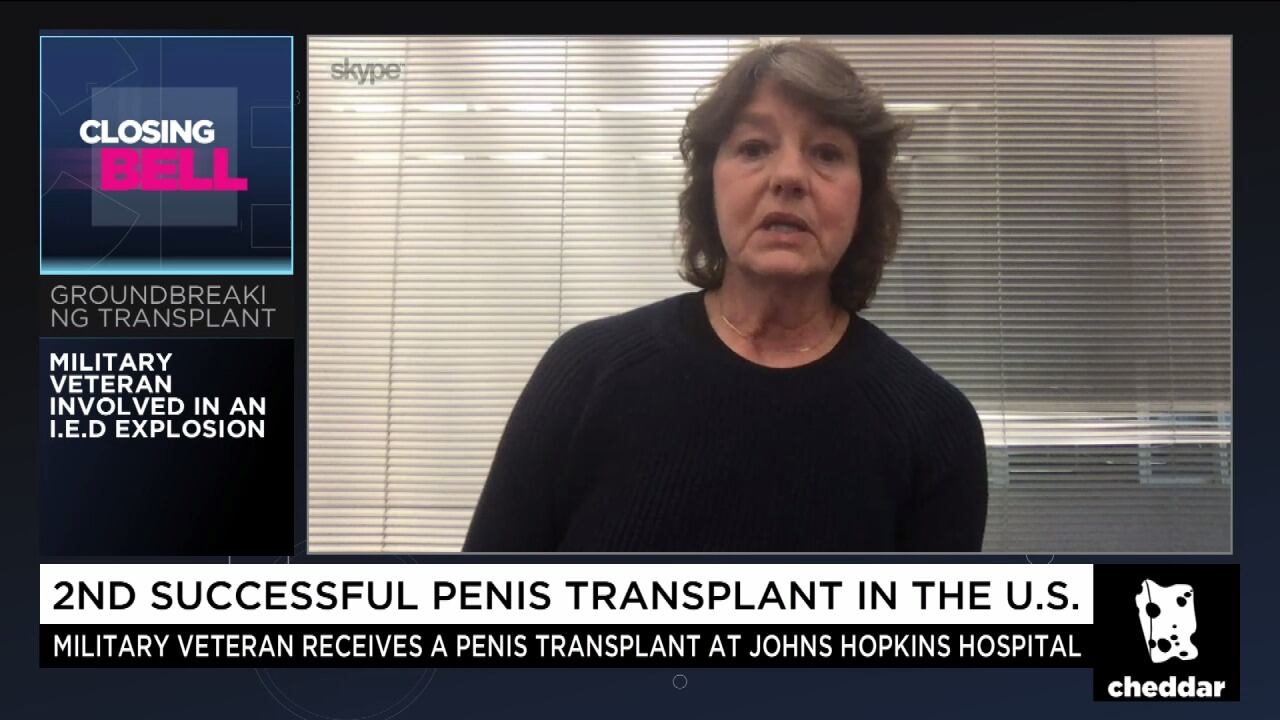
John Hopkins Hospital recently completed the second-ever successful penis transplant in the U.S., an incredibly complex surgery that lasted 14 hours. New York Times reporter Denise Grady explains why the vet needed the surgery in the first place.
A recent survey by Parents Magazine found that 62 percent of participants waited more than five weeks to get their children help with mental health issues. A majority of those said they were trying not to overreact to their child's behavior, explains Liz Vaccariello, Editor-in-Chief of Parents Magazine.