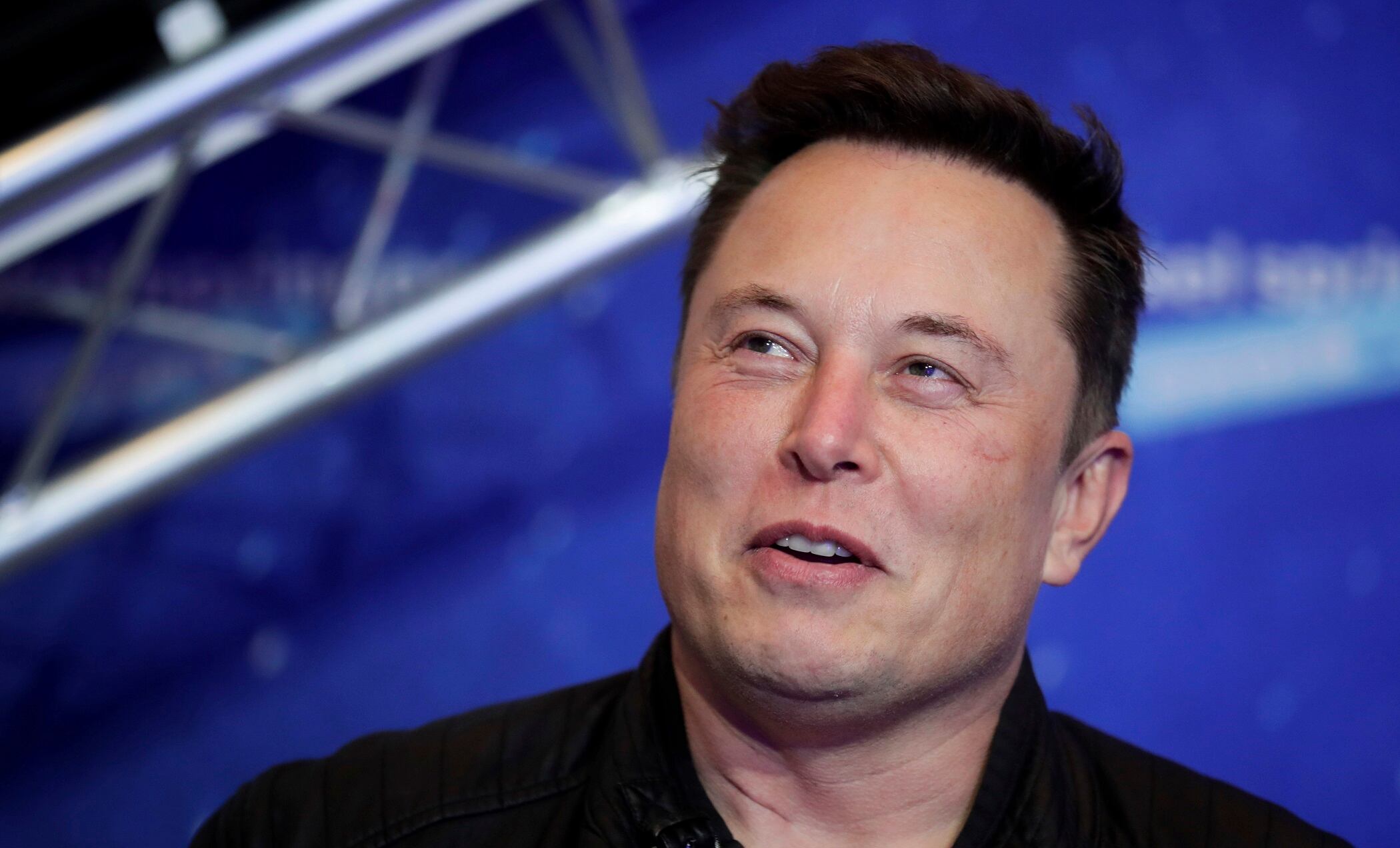
Tesla and SpaceX CEO Elon Musk arrives on the red carpet for the Axel Springer media award in Berlin on Dec. 1, 2020. Musk says he has lined up $46.5 billion in financing to buy Twitter, and he’s trying to negotiate an agreement with the company. The Tesla CEO says in documents filed Thursday, April 21, 2022 with U.S. securities regulators that he’s exploring a tender offer to buy all of the social media platform’s common stock for $54.20 per share in cash. (Hannibal Hanschke/Pool Photo via AP, File)
By Tom Krisher and Matt O'Brien
Elon Musk says he has lined up $46.5 billion in financing to buy Twitter, putting pressure on the company's board to negotiate a deal.
The Tesla CEO said Thursday in documents filed with U.S. securities regulators that the money would come from Morgan Stanley and other banks, some of it secured by his huge stake in the electric car maker.
Twitter has yet to formally respond to Musk’s offer, but the company has enacted an anti-takeover measure known as a poison pill that could make a takeover attempt prohibitively expensive.
The company said in a statement Thursday that it received Musk's updated proposal and “new information on potential financing" and said its board is “committed to conducting a careful, comprehensive and deliberate review.”
Musk, who owns about 9% of Twitter shares, indicated that he’s exploring what’s known as a tender offer in which Musk would try to get other shareholders to pledge their stock to him at a certain price on a certain date, bypassing the board. If enough shareholders agree, Musk could use that as leverage to get the board to drop its “poison pill” defense against his offer of $54.20 per share.
But Musk hasn't decided yet whether to do that.
The poison pill could significantly raise the costs of a takeover. If someone acquires a 15% stake in the company, it would trigger a huge payout to shareholders that could bankrupt Twitter.
Other banks involved in Musk's financing include Barclays, Bank of America, Societe Generale, Mizuho Bank, BNP Paribas and MUFG. Morgan Stanley is one of Twitter’s biggest shareholders, behind Vanguard Group and Musk.
Musk's documents say that $13 billion in financing came from Morgan Stanley and the other banks. As much as $12.5 billion would be loans secured by Musk's Tesla stock, and he also committed $21 billion in direct or indirect equity, although he didn’t disclose the source of those funds. The filing says that the equity commitment could be reduced by contributions from others or additional debt taken on.
Musk is the world’s wealthiest person, according to Forbes, with a nearly $279 billion fortune. But much of his money is tied up in Tesla stock — he owns about 17% of the company, according to FactSet, which is valued at more than $1 trillion — and SpaceX, his privately held space company. It’s unclear how much cash Musk has.
Tesla allows executive officers to use shares as collateral for loans, but limits the borrowing to 25% of the value of the pledged shares. Musk owns 172.6 million shares worth $176.47 billion. Just over 51% of his stake already is pledged as collateral, according to a Tesla proxy statement. That means Musk could use the remaining stake to borrow about $21.5 billion.
Musk’s latest move shows him “ratcheting up the seriousness of purpose” by lining up prominent banks that could finance his bid, said Donna Hitscherich, a finance professor at Columbia University.
“These are the usual suspects if you’d get financing,” she said. “But certainly it’s pointing to the direction that he could make good on his thoughts were he to proceed in launching the tender offer.”
Shares of Twitter rose slightly to $47.04 in Thursday trading after the financing became public. The shares are trading $7.16 below Musk's offer.
“The market is waiting for this to come to a head” and for competing bidders to come forward, said Olaf Groth, a business professor at the University of California, Berkeley.
The revelation of Musk’s prominent financial backers was “mildly surprising” to Groth because “a lot of his wealth is tied to Tesla performance and Tesla has been on the volatile side of stock performance.” On the other hand, Tesla reported strong quarterly results this week and Musk is “viewed as coming through on things. That may be part of it,” Groth said.
Musk “is seeking to negotiate a definitive agreement for the acquisition of Twitter ... and is prepared to begin such negotiations immediately,” the documents say.
Musk in recent weeks has voiced a number of proposed policy changes at Twitter, from relaxing its content restrictions — such as the rules that suspended former President Donald Trump's account — to ridding the platform of its problems with fake and automated accounts.
“If our twitter bid succeeds, we will defeat the spam bots or die trying!" he tweeted Thursday.
Once competing bids surface, Twitter’s board can look not just at the financial terms but what specific plans Musk or his competitors have for reshaping the social media business. That’s when Musk’s ideas – many of which he’s tied to free speech principles – could come into play.
“That could be ground for rejecting the offer,” Groth said of the business plans. “Some of that will be (about) money and some of that will be a beauty contest. Some of the board members will also talk about what’s in the public interest.”
____
Tali Arbel contributed from Phoenix. Krisher reported from Detroit. O'Brien reported from Providence, Rhode Island.
Cheddar has been following all things innovative, fascinating, and downright cool from CES 2022. Watch the full episode, hosted by Cheddar's Ken Buffa and Michelle Castillo.
Stocks closed lower on Friday as investors continue to worry over rate hikes. John Lynch, CIO of Comerica Wealth Management, joins Cheddar News' Closing Bell, where he says value is back in play with investors. Lynch also believes the market has overreacted to the latest Fed minutes, suggesting a bounce-back at some point.
Private equity firms in 2021 spent $401.71 billion in U.S. tech investments — doubling 2020's level of $196.34 billion. As tech becomes increasingly interwoven into our lives amid the pandemic, investors grow bullish on the sector, especially software-as-a-service companies. How will 2022 stack up to 2021, and is there potential for parts of the tech sector to sink this year? John Jannarone, Editor in Chief at IPO-Edge, joins Cheddar News' Closing Bell to discuss 2021's record year of deals, how potential interest rate hikes will impact tech investments in 2022, the fastest-growing IPOs, and more.
Bed Bath & Beyond delivered disappointing fiscal third-quarter results for 2022. Shares initially dove more than 9% in premarket trading on the news but finished the day up nearly 8%. Bed Bath & Beyond has been a meme-stock target for online investors in the past -- so was meme-stock mania a factor in the recent stock movement for the company? Jaime Rogozinski, the founder of the subreddit WallStreetBets, joins Cheddar News' Closing Bell for more, as his forum helped spark the meme stock phenomena. He also discussed some decentralized finance services and trends for the retail investor to watch for in 2022.
College athletes scored big in 2021 when they were finally allowed to begin earning money based off of their name, image, and likeness, known as NIL. But how can young athletes best manage their money so they can set themselves up for years of success? Nicole Pullen Ross, Head of Goldman Sachs Sports and Entertainment Solutions, joins Cheddar News' Closing Bell to discuss why financial management for college athletes is important, common pitfalls they could run into, and more.
December's jobs report was weaker than expected: the economy only added 199,000 nonfarm payrolls compared to an estimate of 422,000. However, the unemployment rate hit a new pandemic-era low of 3.9%, beating expectations. One thing to consider is the fact that the impact of the COVID-19 omicron variant is not factored into these results as the read is taken around the middle of the month. So — how might the variant impact job reports over the next few months? Mark Zandi, Chief Economist at Moody's Analytics, joins Cheddar News' Closing Bell to discuss December's jobs numbers, his 2022 labor market outlook, how COVID-19 will continue to impact the labor market, and more.
Digital medical care provider Pear Therapeutics rang the closing bell on the Nasdaq Friday and President and CEO Dr. Corey McCann, joined Cheddar to talk about how the company plans to grow the business of software-based therapeutics and how the first FDA authorized prescription digital therapeutics company will go about treating illnesses like insomnia and addiction. "These really are pieces of software. In many cases, they're apps and in the cases of our addiction products, these are based on something called cognitive behavioral therapy or CBT," he said. "These products change the patient's brain circuitry to help them be abstinent, to help them stay in treatment, and that's exactly what we see in randomized clinical trials and that's what we see in the real world." He also addressed the ongoing mental health crises brought on by the pandemic. **copy updated to remove IPO information as Pear Therapeutics went public in December**
Gamestop shares were up on The Wall Street Journal report that the video game retail company plans to enter the NFT and crypto space. Adam Hollander, the founder of Hungry Wolves NFT, joined Cheddar to break down how it could be a lifeline for the struggling meme stock darling. "They're not resigning themselves to becoming the next Blockbuster story, and so while people may not be buying as many video games in a retail environment anymore, NFTs, in particular, people are starting to expect more gaming utility on the backend — at least for a variety of projects — and I personally think its a very smart move for them to do this," Hollander told Cheddar.
On Saturday, New York will join neighboring New Jersey and Connecticut in authorizing mobile sports betting. Matt Kalish, president and co-founder of Draftkings North America, joined Cheddar to talk about the landmark change that is estimated to rake in $500 million in annual tax revenue on a potential billion-dollar market. Kalish also addressed the possibility that legalized sports betting in the Empire State could cannibalize his company's revenues in the bordering states. "It's pretty inconvenient, you know, to go across the border to make a bet. And people were doing it, but I think it really stifled a lot of the opportunity," he said. "So while there's some of that going on, I think really a tremendous amount, like a giant percent, of New York will be very incremental."
James Tattersall, director of sales and marketing for Lake Nona Wave Hotel, talks about the hotel's initiatives to foster diversity and how these amenities champion inclusivity in the Orlando area.