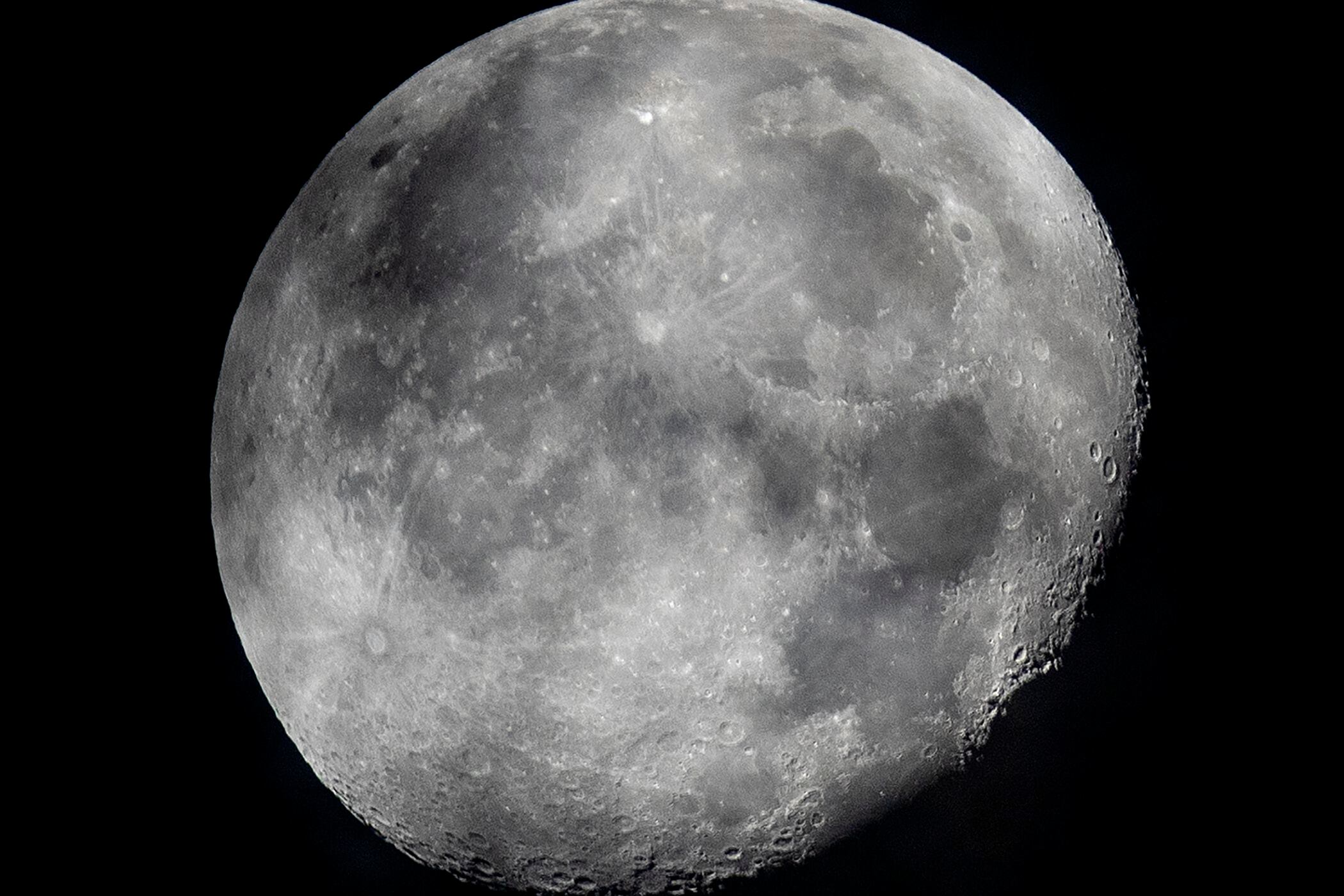
The waning moon is seen at the sky over Frankfurt, Germany, early Monday, Oct. 5, 2020. (AP Photo/Michael Probst)
By Marcia Dunn
The moon’s shadowed, frigid nooks and crannies may hold frozen water in more places and in larger quantities than previously suspected, good news for astronauts at future lunar bases who could tap into these resources for drinking and making rocket fuel, scientists reported Monday.
While previous observations have indicated millions of tons of ice in the permanently shadowed craters of the moon’s poles, a pair of studies in the journal Nature Astronomy take the availability of lunar surface water to a new level.
More than 15,400 square miles (40,000 square kilometers) of lunar terrain have the capability to trap water in the form of ice, according to a team led by the University of Colorado’s Paul Hayne. That’s 20% more area than previous estimates, he said.
These ice-rich areas are near the moon’s north and south poles. Temperatures are so low in these so-called cold traps — minus 261 degrees Fahrenheit (minus 163 degrees Celsius) — that they could hold onto the water for millions or even billions of years.
“We believe this will help expand the possible landing sites for future lunar missions seeking water, opening up real estate previously considered ‘off limits’ for being bone dry,” Hayne said in an email to The Associated Press.
Using data from NASA’s Lunar Reconnaissance Orbiter, the researchers identified cold traps as small as a few yards (meters) across and as wide as 18 miles (30 kilometers) and more and used computer models to get all the way down to micrometers in size.
“Since the little ones are too small to see from orbit, despite being vastly more numerous, we can’t yet identify ice inside them,” Hayne said. “Once we’re on the surface, we will do that experiment.”
For a second study, scientists used NASA's airborne infrared observatory Sofia to conclusively identify water molecules on the sunlit portions of the moon, just outside the polar regions. Most of these molecules are likely stored in the voids between moon dust and other particles or locked inside glassy volcanic material.
Scientists believe all this water on the moon came from comets, asteroids, interplanetary dust, solar wind, or even lunar volcanic eruptions. They'll have a better idea of the sources “if we can get down on the surface and analyze samples of the ice,” Hayne said.
The lead researcher, Casey Honniball, a postdoctoral fellow at NASA’s Goddard Space Flight Center, said at a news conference that she wanted to make it clear the Sofia study had not found puddles on the moon. Rather, the identified hydrogen and oxygen molecules are so far apart, they are neither in liquid or solid form, she noted.
NASA is under White House direction to put astronauts back on the moon by 2024. The space agency wants its new Artemis moon-landing program to be sustainable, unlike the Apollo program a half-century ago.
___
The Associated Press Health and Science Department receives support from the Howard Hughes Medical Institute’s Department of Science Education. The AP is solely responsible for all content.
On this episode of Cheddar Innovates: President of The Pillow Bar breaks down how everyone can benefit from a pillow customized to their unique way of sleeping; CEO of H2Pro explains how to bring environmentally friendly hydrogen to scale; Cheddar gets a look at Curiosity Stream's 'Suppressed Science.'
On this episode of Cheddar Innovates: Gardenuity CEO breaks down how gardening can improve your wellbeing; Augmedix CEO discusses how this technology is helping doctors fight burnout; Cheddar gets a look at Curiosity Stream's 'Suppressed Science.'
On this episode of Cheddar Innovates: Atom Limbs CEO breaks down how the Atom Touch prosthetic is different from other prosthetics on the market; CEO & Chief Scientific Officer of MyMD explains how the MYMD-1 is on track to be the first FDA-approved drug to treat aging and age-related diseases; A look at Curiosity Stream's 'The Future of Warfare.'
On this episode of Cheddar Innovates: SkilsVR CEO explains how virtual reality is being used to train frontline workers to handle difficult customers; Rubicon CEO breaks down how technology and sustainability will go hand in hand in the future; Cheddar gets a look at 'Our Infinite Universe.'
A UN report is warning that relying on seawalls and other engineering fixes will not be enough to keep communities safe from rising sea levels and climate change consequences. Dr. Steve Rose, a senior research economist at the Electric Power Research Institute, joins Cheddar News to discuss.
As gas prices surge amid the Russian invasion of Ukraine, other nations could potentially transition faster to using clean energy than previously expected. Philip K. Verleger, a senior fellow at the Niskanen Center, joined Cheddar News to explain how this could be a possibility in the near future. "Part of the reason I think we have this invasion and the tantrum that's being thrown by Russia, terrible tantrum, is because the Russians were trying to slow down the transition," he said. "Ironically they speeded it up."
As Russia intensifies its war on Ukraine, President Biden announced a ban on oil imported from the aggressor nation. Critics of Russia have said this would be the best way to force Putin to pull back, but curbs on Russian oil exports are expected to send already skyrocketing oil and gas prices even higher, further impacting consumers, businesses, financial markets, and the global economy. Leslie Beyer, CEO of the Energy Workforce and Technology Council, joined Cheddar News' Closing Bell to discuss. "It's certainly going to increase pricing, but it is the right thing to do," she said. "The industry itself has already pulled out of the significant portion of its operations in Russia."
On this episode of Cheddar Innovates: Vision Marine Technologies CEO discusses how e-boats will play a role in the fight against the climate crisis; Lasso CEO breaks down how the design behind these compression socks can prevent injuries and improve performance; Cheddar gets a look at Curiosity Stream's 'The Tombs Of Egypt.'
Vaccine maker Pfizer delayed its COVID shot for kids allegedly due to a lack of data on how it would perform against the omnicron variant, according to the Wall Street Journa. Peter Pitts, professor and founder of the Center for Medicine in the Public Interest and a former FDA associate commissioner, joined Cheddar News Wrap to break down why the authorization can't be rushed. "Going forward, the FDA wants to look at data specifically against omicron, and it looks like that's going to be a three-shot regimen versus two, which was efficient against delta but not omicron because obviously omicron is more infectious," said Pitts.
Walker Ross, Assistant Professor of Sports Business Management at Florida Southern College, joins Business of Sports: The Beijing Winter Olympics 2022, where he says that actions Beijing and other Olympic host sites have been implementing to combat climate change has simply not been enough to offset their carbon footprint.