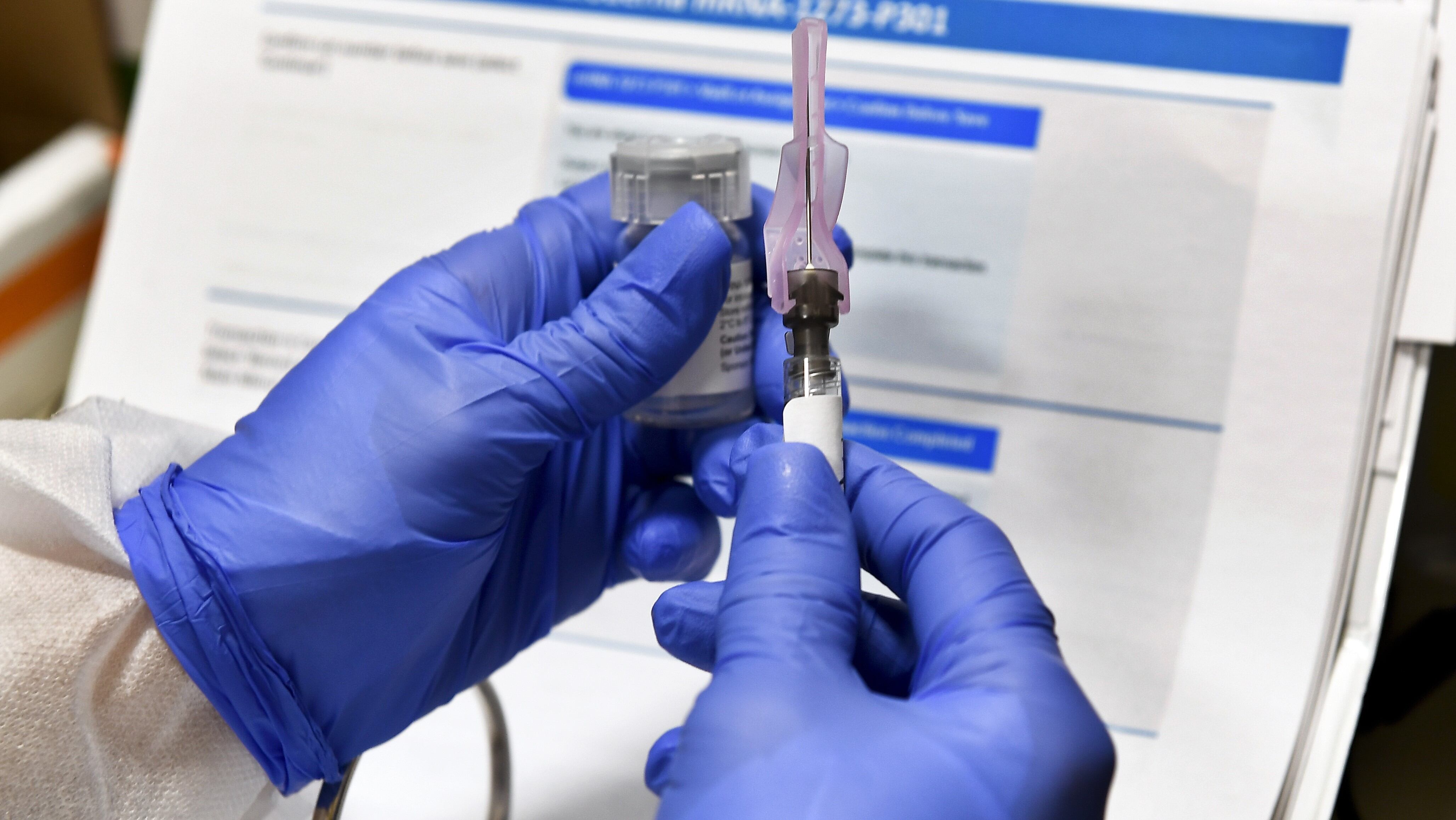
In this July 27, 2020, file photo, nurse Kathe Olmstead prepares a shot that is part of a possible COVID-19 vaccine, developed by the National Institutes of Health and Moderna Inc., in Binghamton, N.Y. Moderna said Monday, Nov. 16, 2020, its COVID-19 shot provides strong protection against the coronavirus that's surging in the U.S. and around the world. (AP Photo/Hans Pennink, File)
For the second time this month, there's promising news from a COVID-19 vaccine candidate: Moderna said Monday its shots provide strong protection, a dash of hope against the grim backdrop of coronavirus surges in the U.S. and around the world.
Moderna said its vaccine appears to be 94.5% effective, according to preliminary data from the company’s still ongoing study. A week ago, competitor Pfizer Inc. announced its own COVID-19 vaccine appeared similarly effective — news that puts both companies on track to seek permission within weeks for emergency use in the U.S.
Dr. Stephen Hoge, Moderna’s president, welcomed the “really important milestone” but said having similar results from two different companies is what’s most reassuring.
“That should give us all hope that actually a vaccine is going to be able to stop this pandemic and hopefully get us back to our lives,” Hoge told The Associated Press.
“It won’t be Moderna alone that solves this problem. It’s going to require many vaccines” to meet the global demand, he added.
A vaccine can’t come fast enough, as virus cases topped 11 million in the U.S. over the weekend — 1 million of them recorded in just the past week. The pandemic has killed more than 1.3 million people worldwide, more than 245,000 of them in the U.S.
Still, if the Food and Drug Administration allows emergency use of Moderna’s or Pfizer’s candidates, there will be limited, rationed supplies before the end of the year. Both require people to get two shots, several weeks apart. Moderna expects to have about 20 million doses, earmarked for the U.S., by the end of 2020. Pfizer and its German partner BioNTech expect to have about 50 million doses globally by year’s end.
Moderna’s vaccine, created with the National Institutes of Health, is being studied in 30,000 volunteers who received either the real vaccination or a dummy shot. On Sunday, an independent monitoring board broke the code to examine 95 infections that were recorded starting two weeks after volunteers' second dose — and discovered all but five illnesses occurred in participants who got the placebo.
The study is continuing, and Moderna acknowledged the protection rate might change as more COVID-19 infections are detected and added to the calculations. Also, it’s too soon to know how long protection lasts. Both cautions apply to Pfizer’s vaccine as well.
But Moderna’s independent monitors reported some additional, promising tidbits: All 11 severe COVID-19 cases were among placebo recipients, and there were no significant safety concerns.
The main side effects were fatigue, muscle aches and injection-site pain after the vaccine’s second dose, at rates that Hoge characterized as more common than with flu shots but on par with others such as shingles vaccine.
Moderna shares rocketed higher on the announcement and appeared to be headed for an all-time high Monday. The Cambridge, Massachusetts, company's vaccine is among 11 candidates in late-stage testing around the world, four of them in huge studies in the U.S.
Both Moderna's shots and the Pfizer-BioNTech candidate are so-called mRNA vaccines, a brand-new technology. They aren’t made with the coronavirus itself, meaning there’s no chance anyone could catch it from the shots. Instead, the vaccine contains a piece of genetic code that trains the immune system to recognize the spiked protein on the surface of the virus.
The strong results were a surprise. Scientists have warned for months that any COVID-19 shot may be only as good as flu vaccines, which are about 50% effective.
Another steep challenge: distributing doses that must be kept very cold. Both the Moderna and Pfizer shots are frozen but at different temperatures. Moderna announced Monday that once thawed, its doses can last longer in a refrigerator than initially thought, up to 30 days. Pfizer's shots require long-term storage at ultra-cold temperatures.
The Associated Press Health and Science Department receives support from the Howard Hughes Medical Institute’s Department of Science Education. The AP is solely responsible for all content.
After the latest school shooting in Uvalde, Texas, it wouldn't be a surprise if the traumatic event takes a toll on your mental health — or that of your children. Amy Morin, the editor-in-chief of Verywell Mind and licensed psychotherapist, joined Cheddar News to share coping skills and offer advice about how to talk to your children about these increasingly common tragic events. “I think its important for parents to know what the school’s plan is, what the teacher's plan is, and then we can have our own plans with kids too," she noted. "It's so important for us to talk to kids about how they're feeling — guaranteed they've heard something about it, so ask them what they know already, use age-appropriate language, and rather than just dismissing their fears by saying don't worry about it or I'm sure you'll be safe, talk to them about their feelings."
An recently conducted AP-NORC poll found that majorities of the Black and Hispanic populations in the U.S. still find themselves either somewhat worried or extremely worried over the pandemic, while more than half of white Americans responded with either being not too worried or not worried at all. Dr. Chris Pernell, the chief strategic integration and health equity officer at University Hospital, joined Cheddar News to talk about how perceptions of COVID-19 differ between groups of Americans. "We’re still seeing people get infected, and because of the toll of the disproportionate impact, we have concerns among the Black and brown community about whether or not they have an increased risk of exposure because of where they work, because of the use of public transportation, because they live in homes that they may not be able to safely quarantine and or isolate in, and because they have at baseline chronic health conditions that may make coronavirus more severe in those persons," she said.
Judith Enck, a former regional administrator for the EPA and the president of Beyond Plastics, joined Cheddar News to talk about the role of plastics in the climate crisis and California's investigation of ExxonMobil and other oil companies for misleading the public on the ability to recycle plastics. "The reason why petrochemical companies like Exxon have gotten away with selling more and more plastic is that they've lied to the public and told us don't worry about all those negative upstream impacts and downstream impacts of plastics. Just be sure to recycle it. Well, guess what? Plastics largely are not recycled," Enck said.
Catching you up on what you need to know on April 29, 2022, with President Biden asking Congress for a $33 billion aid package for Ukraine, a shrinking GDP potentially leading to a recession, Beijing banning weddings and funerals while closings schools amid COVID, and more.
Virtual care and digital medicine provider Biofourmis recently raised $300 million in a Series D round led by General Atlantic and with participation from CVS Health. Biofourmis offers at-home care and digital therapies backed by artificial intelligence, which can remotely monitor patients while they are at home. The company says it hopes its technology can improve patient outcomes while reducing the cost and burden of care. Kuldeep Signh Rajput, Founder and CEO of Biofourmis, joins Cheddar News' Closing Bell to discuss.
Moderna is asking the FDA to consider emergency use authorization for its COVID vaccine to be used with children under 6 years old. Dr. Christina Johns, a senior medical advisor at PM Pediatrics, joined Cheddar News to talk about the pharmaceutical company's research into the safety and efficacy of the vaccine for the very youngest of children. "This is very exciting news because children met that goal in their neutralizing antibody response in this age group — means that we really can extrapolate a lot from what we know about data in adults," she said. "I will say that there's a caveat that we have not seen yet the full dataset released, so I'm waiting for that and my fingers are crossed for next week."
Mental health platform Real recently raised $37 million in a Series B round led by Owl Ventures. Through its mobile app, Real says it provides mental health care at a lower cost than traditional therapy and aims to make mental wellness a part of everyone's daily routine. The company also announced that U.S. soccer star Megan Rapinoe will serve as an adviser to the company. Ariela Safira, Founder & CEO of Real, joins Cheddar News' Closing Bell to discuss.
Catching you up on what you need to know on April 28, 2022, with Elon Musk mocking Twitter's top legal exec Vijaya Gadde on the platform itself, a probe in George Floyd's death finding discrimination within the Minneapolis police force, the latest California drought leading to new water restrictions, and more.