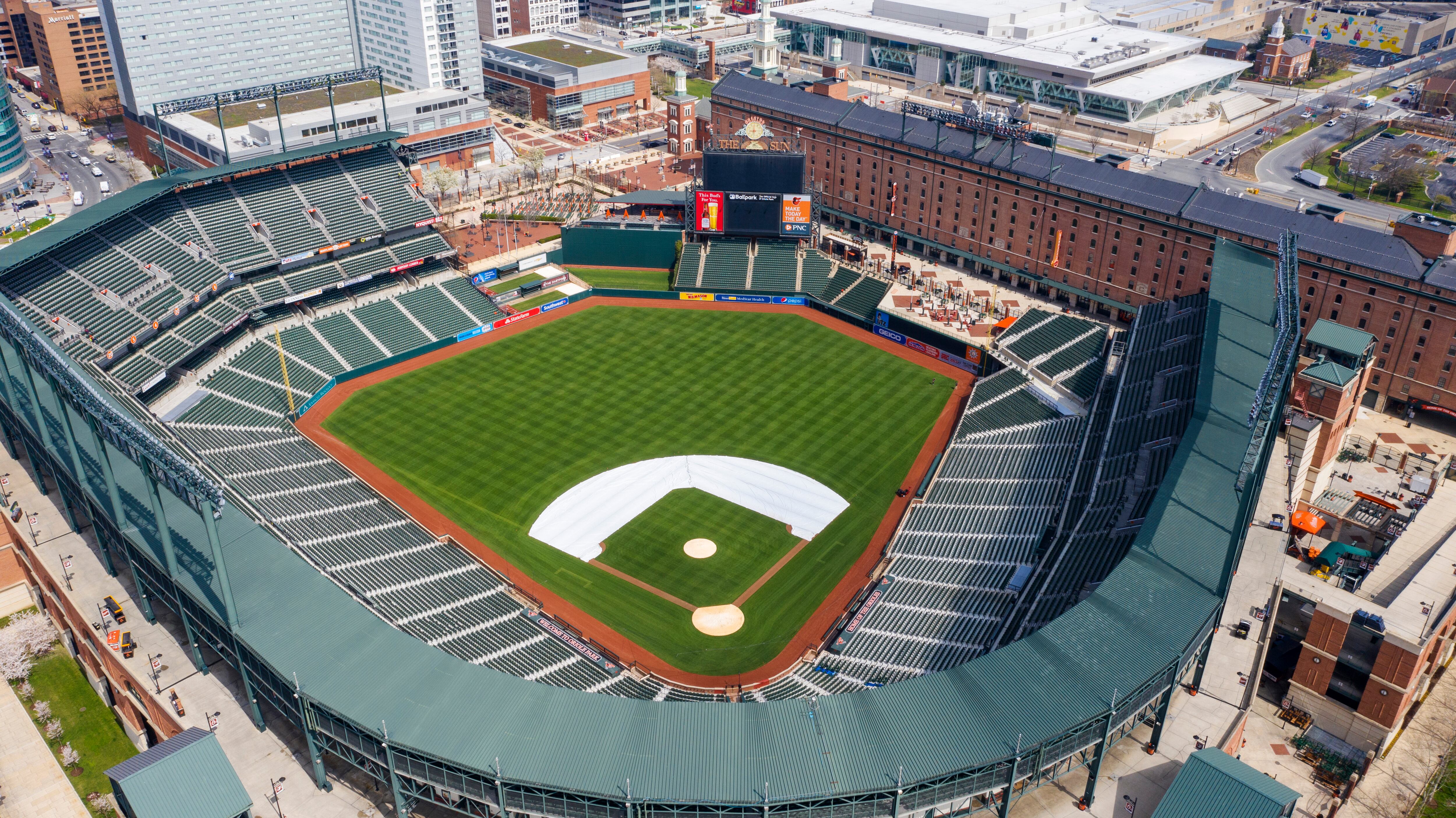
In this Thursday, March 26, 2020, file photo, Oriole Park at Camden Yards is closed on what would've been Opening Day in Baltimore, Md. Whenever baseball returns because of the coronavirus pandemic, there's an element that might come into play like never before: the sound of silence. (AP Photo/Steve Helber, File)
By Ronald Blum
Major League Baseball owners gave the go-ahead Monday to making a proposal to the players’ union that could lead to the coronavirus-delayed season starting around the Fourth of July weekend in ballparks without fans, a plan that envisioned expanding the designated hitter to the National League for 2020.
Spring training would start in early to mid-June, a person familiar with the decision told The Associated Press. The person spoke on the condition of anonymity because details of the plan were not announced.
MLB officials are slated to make a presentation to the union on Tuesday. An agreement with the players' association is needed, and talks are expected to be difficult — especially over a proposal for a revenue split that would be unprecedented for baseball.
Each team would play about 82 regular-season games: against opponents in its own division plus interleague matchups limited to AL East vs. NL East, AL Central vs. NL Central and AL West vs. NL West.
Teams would prefer to play at their regular-season ballparks but would switch to spring training stadiums or neutral sites if medical and government approvals can’t be obtained for games at home. Toronto might have to play home games in Dunedin, Florida.
The All-Star Game, scheduled for Dodger Stadium in Los Angeles on July 14, likely would be called off.
Teams will propose that players receive the percentage of their 2020 salaries based on a 50-50 split of revenues MLB receives during the regular-season and postseason, which likely will be among the most contentious aspects of the proposal during negotiations with the players’ association.
That proposal would take into account fans being able to return to ballparks at some point, perhaps with a small percentage of seats sold at first and then gradually increasing.
Baseball players have refused to consider even the frameworks for the type of revenue splits that have been agreed to by unions in the NFL, NBA, and NHL. The last attempt by baseball owners to gain a salary cap with a revenue split led to a 7 1/2-month strike in 1994-95 that wiped out the World Series for the first time in 90 years.
Rosters would be expanded from 26 to around 30. With minor leagues shuttered, there likely will be the addition of about 20 players per club akin to the NFL’s practice squad.
Players and teams agreed to a deal on March 26 that called for each player to receive only a portion of salary, determined by what percentage of a 162-game schedule is played. As part of that deal, if no season is played each player would receive 2020 service time matching what the player earned in 2019.
But that deal is contingent there being no restrictions on mass gatherings at the federal, state, city and local level; no relevant travel restrictions in the U.S. and Canada; and Commissioner Rob Manfred after consulting the union and medical expects, determines there is no risk to playing in front of fans at regular-season ballparks.
Players and teams committed to “discuss in good faith the economic feasibility of playing games in the absence of spectators or at appropriate neutral sites.” Manfred has said about 40% of MLB revenue is tied to gate, including concessions, parking, ballpark advertising, luxury suites and programs.
Union officials and players have cited the March 26 agreement as setting economic terms and say they have no inclination for additional cuts. Players are more interested in medical protocols and testing designed to protect them from and detect the new coronavirus. The proposal will detail the plan for dealing with players and staff who test positive.
Because players accrue salaries for the regular season only and not for spring training or the postseason, the union may counter by asking for more regular-season games during negotiations that could significantly alter or possibly even scuttle the restart plan.
The DH was adopted by the American League for the 1973 season but has been resisted by National League owners. The players’ union has favored it because it would create more jobs for high-paying hitters in their 30s, by MLB has looked at it as an economic issue.
Money, however, has disappeared as an issue at this stage for 2020 because nearly all veteran players have agreed to contracts. Yasiel Puig is the most notable exception.
Earlier this week, digital investment advisor Betterment announced that it has hired Makara, a company known for its management of cryptocurrency portfolios. Sarah Levy, CEO of Betterment, joins Cheddar News' Closing Bell, where she explains why crypto represents such a promising long-term play and how her company stands to benefit from this latest move.
At-home medical labs company Getlabs raised $20 million in a Series A round, led by Emerson Collective and the Minderoo Foundation. Getlabs aims to be the boots-on-the-ground partner to telehealth. The company says more than 70% of medical decisions still require collecting diagnostic tests in person, and that it fills that void by delivering health care directly to their patients' homes. Founder & CEO of Getlabs Kyle Michelson joined Cheddar News' Closing Bell to discuss.
The White House laid out plans for a $5 billion investment into a national network of charging stations to ease EV driving anxiety. Bruce Brimacombe, CEO of EV infrastructure GOe3 joined Cheddar News to discuss how much needs to be done for drivers to get over the fear of running out of energy. "People need to be able to do what they're doing now," he said. "But that is the way that if you're going to buy an electric car, you got to feel like you're not changing your world." Brimacombe noted that building out the infrastructure between cities was GOe3's own focus.
U.S. automakers are saying that the blockade of the Ambassador Bridge, a crucial border crossing between the U.S. and Canada, is affecting their production lines. Michelle Krebs of Cox Automotive warns that the disruption "couldn't come at a worst time," amid chip and labor shortages in Detroit.
AND DETROIT-BASED AUTO MAKERS SAY THEY ARE SHUTTING DOWN PLANTS OR SCALING BACK PRODUCTION BECAUSE OF PARTS SHORTAGES.
Sonos reported better than expected Q1 earnings amid chip shortage with the release of its Roam product. CFO Brittany Bagley joined Cheddar News to discuss the smart speaker maker's successful report and its plans to hit its 2024 targets as people leave their homes as pandemic restrictions ease. "Even as people head out in the world, it doesn't mean they don't like to listen to music at home or watch a streaming movie at home," she said. "So there's still a real role for us and our products in peoples lives, sort of, no matter what else they're doing."
Lynn Martin, president of the NYSE Group, explains why investors at the New York Stock Exchange should still feel confident despite the recent Wall Street volatility and discusses the landscape for 2022 when it comes to IPOs and retail investors.
The merger of WarnerMedia and Discovery received Justice Department approval on Wednesday, and Patty Hirsch, EVP of consumer and digital platforms at WarnerMedia, joined Cheddar News to discuss current and future offerings from the media conglomerate that will control both HBO Max and Discovery+. "Content really drives so much, and CNN has always had a very long history of creating an incredible documentaries, incredible content … and this service I think is going to ultimately provide the kind of content consumers want and the kind of content that consumers are going are going to pay for," she said. Hirsch also discussed NFTs in use through its Turner Sports and DC brands.
Black entrepreneurs lead the way in the creation of new businesses, but they often cannot get the necessary funding to get their business off the ground. The Fearless Fund is on a mission to change that, and help Black business owners get venture capital. The fund also offers a unique grant program meant to help entrepreneurs with growth, peer coaching, and more, including grants between $10,000 and $20,000. Arian Simone, Co-Founder and General Partner of Fearless Fund, joins Closing Bell to discuss the Fund's mission, how it helps Black entrepreneurs, and more.
Multinational food company Kellogg’s reported an earnings beat amid supply chain issues and an extended labor strike. Kellogg’s Chairman and CEO c joined Cheddar News to discuss overcoming the obstacles and what's to come for the company. "The first half of the year is really going to be one about rebuilding inventory, and into the second quarter, starting to reestablish promotional activity for our customers and our consumers," Cahillane said. "And then the back half of the year, obviously, we're really much more back in business, and we expect to exit the year with our business in cereal being just as strong as it's ever been."
Sting has sold his catalog of more than 600 songs for $300 million to Universal Music. The deal gives the label the rights to all of his work, including “Every Breath You Take," as well as all future royalties.