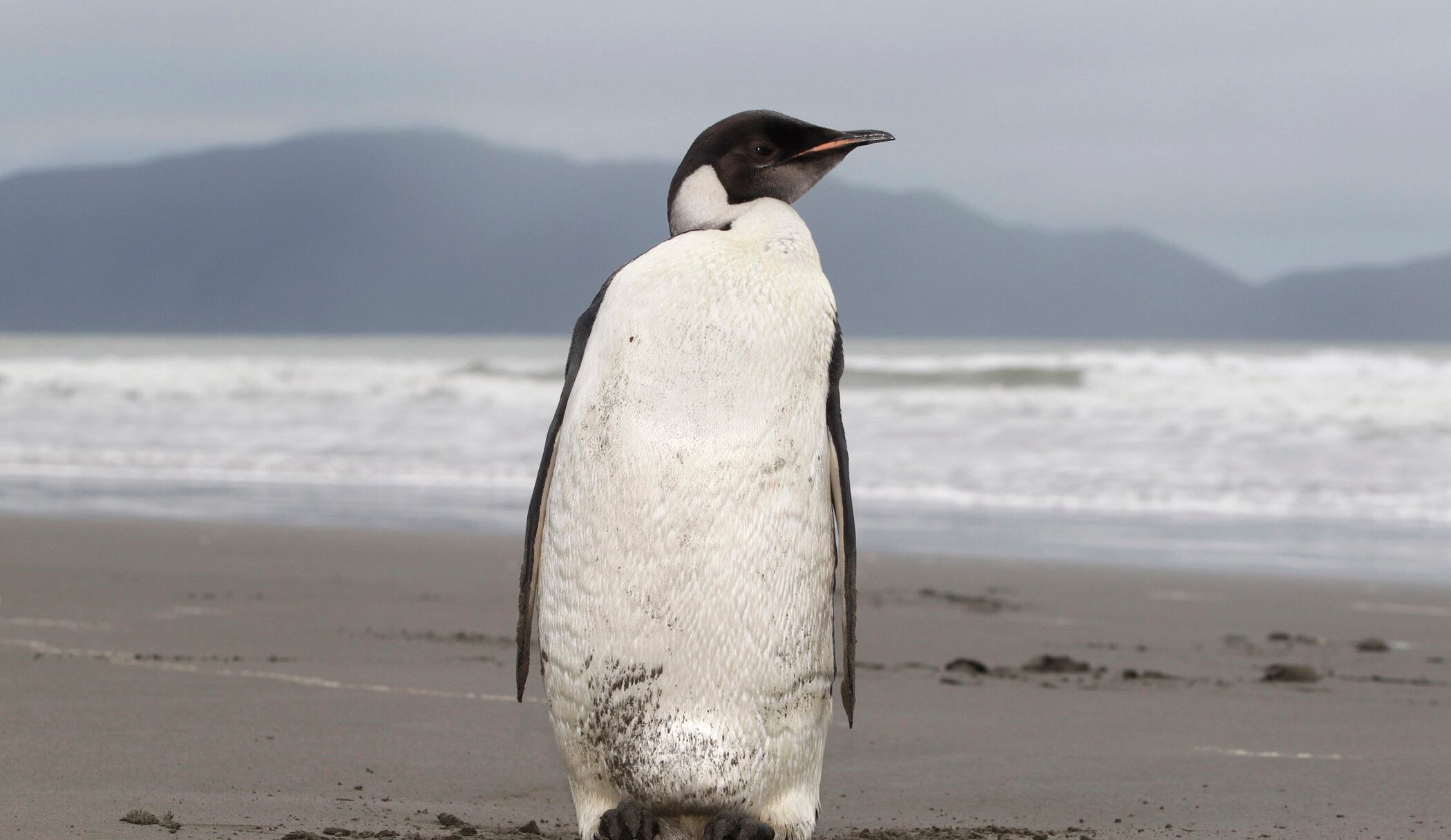
In this June 21, 2011 file photo, an Emperor penguin stands on Peka Peka Beach of the Kapiti Coast in New Zealand. With climate change threatening the sea ice habitat of Emperor penguins, the U.S. Fish and Wildlife Service on Tuesday, Aug. 3, 2021, announced a proposal to list the species as threatened under the Endangered Species Act. (Mark Mitchell/New Zealand Herald via AP, File)
By Christina Larson
With climate change threatening the sea ice habitat of Emperor penguins, the U.S. Fish and Wildlife Service on Tuesday announced a proposal to list the species as threatened under the Endangered Species Act.
“The lifecycle of Emperor penguins is tied to having stable sea ice, which they need to breed, to feed and to molt,” said Stephanie Jenouvrier, a penguin ecologist at the Woods Hole Oceanographic Institution.
Research published Tuesday in the journal Global Change Biology found that by 2100, 98% of Emperor penguin colonies may be pushed to the brink of extinction, if no changes are made to current rates of carbon emissions and climate change.
Around 70% of colonies will be in danger sooner, by 2050.
The new study looked at overall warming trends and the increasing likelihood of extreme weather fluctuations due to global warming. And it noted that extremely low levels of sea ice in 2016 led to a massive breeding failure of an Emperor penguin colony in Antarctica’s Halley Bay.
That year, seasonal sea ice broke up before penguin chicks had time to develop waterproof adult feathers, and about 10,000 baby birds drowned, Jenouvrier said. The colony did not recover afterward.
Emperor penguins breed exclusively in Antarctica during winter. They endure temperatures of minus 40 degrees Fahrenheit (minus 40 degrees Celsius) and wind speeds approaching 90 miles (144 kilometers) per hour by huddling together in groups of several thousand birds. But they can't survive without sufficient sea ice.
“These penguins are hard hit by the climate crisis, and the U.S. government is finally recognizing that threat,” said Sarah Uhlemann, international program director at the nonprofit Center for Biological Diversity.
The U.S. government has previously listed species outside the country as threatened, including the polar bear, which lives in Arctic regions and is also imperiled by climate change and sea ice loss.
Emperor penguins — the world's largest penguins — currently number about 270,000 to 280,000 breeding pairs, or 625,000 to 650,000 individuals. The proposed listing will be published in the Federal Register on Wednesday to open to a 60-day public comment period.
Listing the bird provides protections such as prohibition against importing them for commercial purposes. Potential impacts on penguins must also be evaluated by U.S. marine fisheries currently operating in Antarctica.
“Climate change, a priority challenge for this Administration, impacts a variety of species throughout the world," said Martha Williams, principal deputy director of the wildlife service. "The decisions made by policymakers today and during the next few decades will determine the fate of the Emperor penguin.”
Tensions from the Russia-Ukraine war have spilled into space. The head of Russia's space agency has threatened to pull the country out of the International Space Station if sanctions aren't lifted on the country — but that doesn't seem to be happening any time soon. What would it mean if Russia really did leave the ISS, who would it harm the most, and what would the consequences be both for the other ISS partners, and private space travel? Casey Dreier, Chief Advocate & Senior Space Policy Adviser at The Planetary Society, joins Closing Bell to discuss.
Almost every industry now uses online shopping and ordering, but some products require a different packing material, and many times, shipping products can be wasteful. TemperPack aims to solve both issues with its ClimaCell liners, which you might recognize if you have ever ordered a meal subscription kit. Brian Powers, co-founder and Chief Growth Officer at TemperPack, joins Closing Bell to discuss TemperPack's ClimaCell liners, the company's sustainability mission, its corporate customer base, and more.
Bees are responsible for the bulk of fruit and vegetable pollination — and they're negatively being affected by climate change. Tech startup Beewise is offering a solution with artificial intelligence to create robotic, autonomous hives to help the vulnerable bee populations. Saar Safra, co-founder & CEO, joined Cheddar News to talk about the company's recent $80 million to help make this project possible. "Our solution is not only hardware," he said. "Its software and biology all in one device. That's the challenge, and that's what sets us apart."
Space tourism continues to be generating buzz after the most recent Blue Origin launch. Two of its passengers made history as the first married couple to travel to space. The couple, Marc Hagle, CEO at Tricor, and Sharon Hagle, CEO at Spacekids Global, joined Cheddar News fresh off of their trip to talk about their experience and future space travel plans. "If there is a Santa Claus, we’ll have the opportunity to fly with Virgin Galactic, and maybe we'll have the opportunity to fly with SpaceX," said Marc Hagle, followed by Sharon explaining they had already signed up with Virgin Galactic about 15 years ago.
The metaverse may be the next big thing in the music world. Cheddar News’ Michelle Castillo sat down with Jon Vlassopulos, VP and head of music at Roblox, to discuss virtual concerts and more.
The head of Russia’s space program says the future of the ISS hangs in the balance after the U.S., EU, and Canadian space agencies missed a deadline to meet Russian demands for lifting sanctions on Russian enterprises and hardware.
Catching you up on what you need to know on April 4, 2022, with reports of Russian war crimes in Ukraine, a weekend shooting in Sacramento killing six and injuring 12, Mexico ending its gas subsidization for U.S. drivers, and the University of South Carolina winning the women's NCAA basketball championship, and more.
Peter Zalzal, associate vice president for clean air strategies at the Environmental Defense Fund, a nonprofit environmental advocacy group, joined Cheddar to discuss the Biden Administration's unveiling of stricter fuel-efficiency standards for new automobiles. "The administration estimated that these rules will reduce about 2.5 billion tons of climate pollution by 2050, and using less fuel also means that we have to go to the gas pump less often. And so it means we save money, thousands of dollars in avoided fuel costs each year for consumers," he noted.
A 60-year-old man allegedly had himself vaccinated against COVID-19 dozens of times in Germany in order to sell forged vaccination cards with real vaccine batch numbers.
Between Bells EP Conor White recaps some of the biggest stories of the week, while Baker Machado and Hena Doba test their knowledge, and maybe learn a thing or two. It's This Week in Trivia!