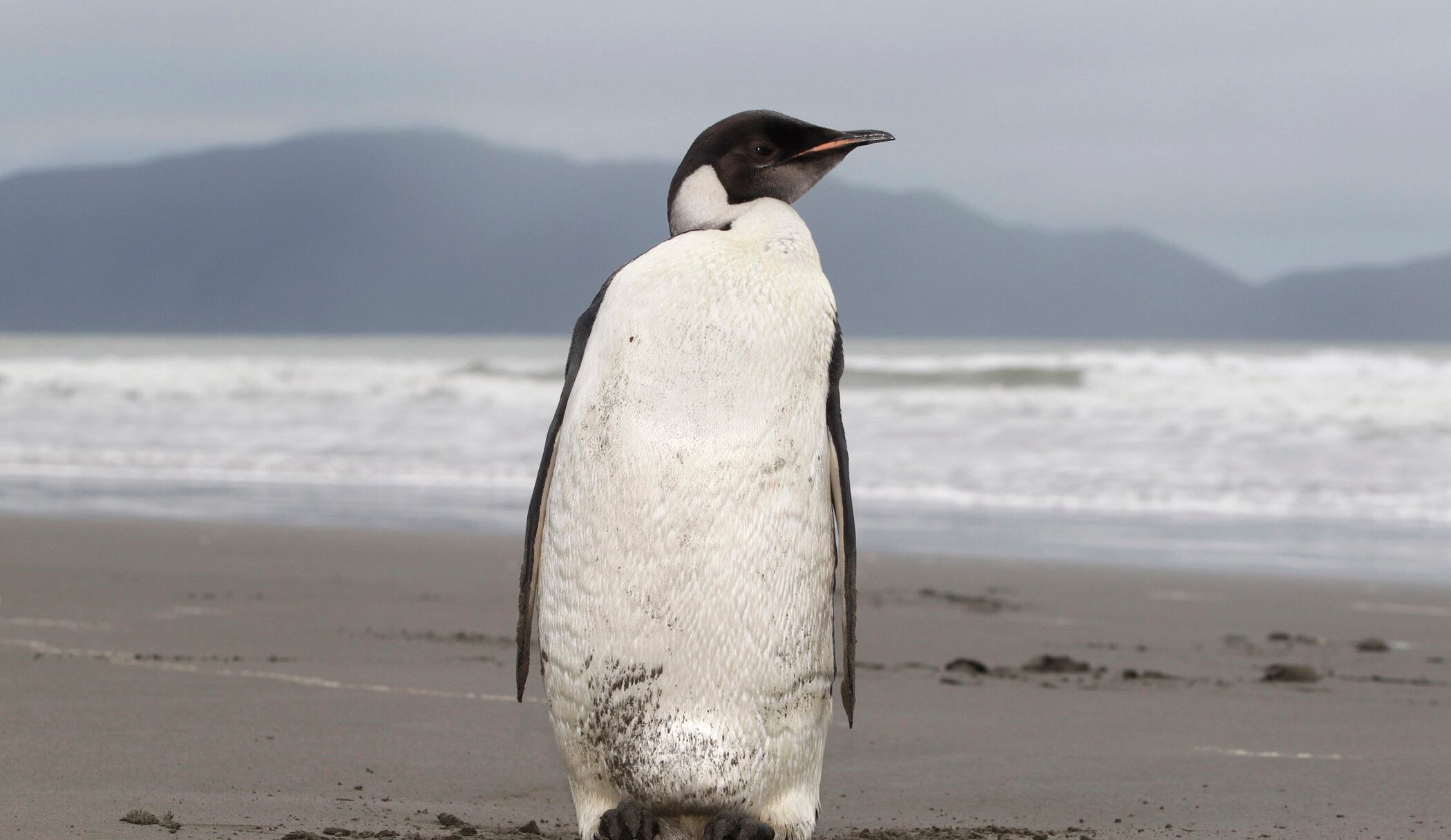
In this June 21, 2011 file photo, an Emperor penguin stands on Peka Peka Beach of the Kapiti Coast in New Zealand. With climate change threatening the sea ice habitat of Emperor penguins, the U.S. Fish and Wildlife Service on Tuesday, Aug. 3, 2021, announced a proposal to list the species as threatened under the Endangered Species Act. (Mark Mitchell/New Zealand Herald via AP, File)
By Christina Larson
With climate change threatening the sea ice habitat of Emperor penguins, the U.S. Fish and Wildlife Service on Tuesday announced a proposal to list the species as threatened under the Endangered Species Act.
“The lifecycle of Emperor penguins is tied to having stable sea ice, which they need to breed, to feed and to molt,” said Stephanie Jenouvrier, a penguin ecologist at the Woods Hole Oceanographic Institution.
Research published Tuesday in the journal Global Change Biology found that by 2100, 98% of Emperor penguin colonies may be pushed to the brink of extinction, if no changes are made to current rates of carbon emissions and climate change.
Around 70% of colonies will be in danger sooner, by 2050.
The new study looked at overall warming trends and the increasing likelihood of extreme weather fluctuations due to global warming. And it noted that extremely low levels of sea ice in 2016 led to a massive breeding failure of an Emperor penguin colony in Antarctica’s Halley Bay.
That year, seasonal sea ice broke up before penguin chicks had time to develop waterproof adult feathers, and about 10,000 baby birds drowned, Jenouvrier said. The colony did not recover afterward.
Emperor penguins breed exclusively in Antarctica during winter. They endure temperatures of minus 40 degrees Fahrenheit (minus 40 degrees Celsius) and wind speeds approaching 90 miles (144 kilometers) per hour by huddling together in groups of several thousand birds. But they can't survive without sufficient sea ice.
“These penguins are hard hit by the climate crisis, and the U.S. government is finally recognizing that threat,” said Sarah Uhlemann, international program director at the nonprofit Center for Biological Diversity.
The U.S. government has previously listed species outside the country as threatened, including the polar bear, which lives in Arctic regions and is also imperiled by climate change and sea ice loss.
Emperor penguins — the world's largest penguins — currently number about 270,000 to 280,000 breeding pairs, or 625,000 to 650,000 individuals. The proposed listing will be published in the Federal Register on Wednesday to open to a 60-day public comment period.
Listing the bird provides protections such as prohibition against importing them for commercial purposes. Potential impacts on penguins must also be evaluated by U.S. marine fisheries currently operating in Antarctica.
“Climate change, a priority challenge for this Administration, impacts a variety of species throughout the world," said Martha Williams, principal deputy director of the wildlife service. "The decisions made by policymakers today and during the next few decades will determine the fate of the Emperor penguin.”
Experts say that at some point next year, the pandemic will officially drop its pandemic status, becoming endemic. While this is a milestone to acknowledge, it does not mean we're free of infections, illnesses, and deaths. Dr. Rajeev Fernando, infectious disease specialist, Beth Israel Hospital and fellow, joins Cheddar News' Closing Bell to discuss.
Chicago-based Internist Dr. Vivek Cherian joined Wake Up With Cheddar to break down the unprecedented surge in U.S. COVID-19 as many prepare to celebrate the new year.
Dr. Soumi Eachempati, co-founder and CEO of Cleared4 and former professor of surgery and public health at Weill Cornell Medical College, joined Cheddar to breakdown what people should know about the recently FDA-approved emergency use of Merck and Pfizer's COVID-19 treatment pills. He noted that not only do people need to be aware of other medications they are taking that could cause adverse effects if coupled with COVID-19 pill treatments, he also talked about the intense in-take regiment. "The Merck pills are actually about 40 pills over five days. The Pfizer ones are three pills over five days, so people have to be prepared for that because it is a lot of pills you'll have to take to get full value from these drugs," Eachempati told Cheddar.
Twitter is exploding with a new meme after the CDC revised its Covid-19 guidelines, shortening the recommended isolation period to five days instead of 10 for when you test positive and are asymptomatic. The change came amid a skyrocketing surge of new cases is the U.S. due to the Omicron variant, drawing criticism from experts and Twitter --with users claiming the government agency is giving funny advise on a variety of issues. But what does the meme say about the public’s trust in the agency? Cheddar News speaks with political strategist Hastie Afkhami.
The list of questions should be getting shorter as we enter the pandemic's third year, but that isn't the case. There's another question to add to that list: is the U.S. doing enough to track the virus and its variants? Lawrence Gostin, faculty director of the O'Neill Institute for national and global health law at Georgetown University, joins Cheddar News.
As we prepare to ring in the new year, COVID cases are hitting an all-time high. Dr. Anthony Fauci has said the safest way to celebrate would be a small gathering with vaccinated family members only... far from the large, flashy parties from a few years ago. Dr. Christina Johns, senior medical advisor at PM Pediatrics, joins Cheddar News to discuss how to celebrate safely.