By Bassem Mroue and Zeina Karam

Updated 11:30 am ET

Investigators began searching the wreckage of Beirut's port Wednesday for clues to the cause of the massive explosion that ripped across the Lebanese capital as the government ordered port officials put under house arrest.

International aid flights began to arrive, as Lebanon's leaders struggled to deal with the aftermath of Tuesday's blast, crippled by an economic crisis and facing a public where many already blame chronic mismanagement and corruption among the ruling elite for the disaster.

The explosion at the port killed at least 100 people and wounded thousands. Hospitals were overwhelmed — one that was damaged in the blast had to evacuate all its patients to a nearby field for treatment. Buildings were damaged for miles around the city, and Beirut's governor said Wednesday that hundreds of thousands might not be able to return to their homes for two or three months.

Meanwhile, an official letter surfaced online showing that the head of the customs department had warned repeatedly over the years that a huge stockpile of ammonium nitrate stored in a hangar in the port was a danger and asked for a way to remove it.

Ammonium nitrate is a component of fertilizer that is potentially explosive. The 2,750-ton cargo had been stored at the port since it was confiscated from a ship in 2013, and on Tuesday it is believed to have detonated after a fire broke out nearby.

The resulting explosion — hitting with the force of a 3.5-magnitude earthquake — was the biggest ever seen in Beirut, a city blasted by a 1975-1990 civil war, bombarded in conflicts with Israel and hit by periodic terror attacks.

The 2017 letter from the custom's chief to a judge could not be immediately confirmed. If authentic, it could deepen the belief already expressed by some Lebanese that widespread mismanagement, negligence, and corruption among the country's ruling class is to blame for the explosion.

President Michael Aoun vowed before a Cabinet meeting on Wednesday that the investigation would be transparent and that those responsible will be punished.

"There are no words to describe the catastrophe that hit Beirut last night," he said.

After the meeting, the Cabinet ordered an unspecified number of Beirut port officials put under house arrest pending an investigation into how the ammonium nitrate came to be stored at the port for years. The government also declared a two-week state of emergency, effectively giving the military full powers during this time.

State prosecutor Ghassan Oueidat ordered security agencies to start an immediate investigation and collect all reports and letters related to the materials stored at the port as well as lists of people in charge of maintenance, storage, and protection of the hangar.

In the letter, the customs chief warns of the "dangers if the materials remain where they are regarding the safety of (port) employees" and asked the judge for guidance on what to do with it. He said five similar letters were sent in 2014, 2015, and 2016. The letter proposes the material be exported or sold to a Lebanese explosives company. It is not known if there was ever a response.

The government also said public schools will be opened to host those who lost their homes and the minister of tourism will also work on opening some hotels for use by those who lost their homes. It also promised compensation for the victims.

With the Port of Beirut destroyed, the government said imports and exports will be secured through other ports in the country, mostly in the northern city of Tripoli and the southern port city of Tyre.

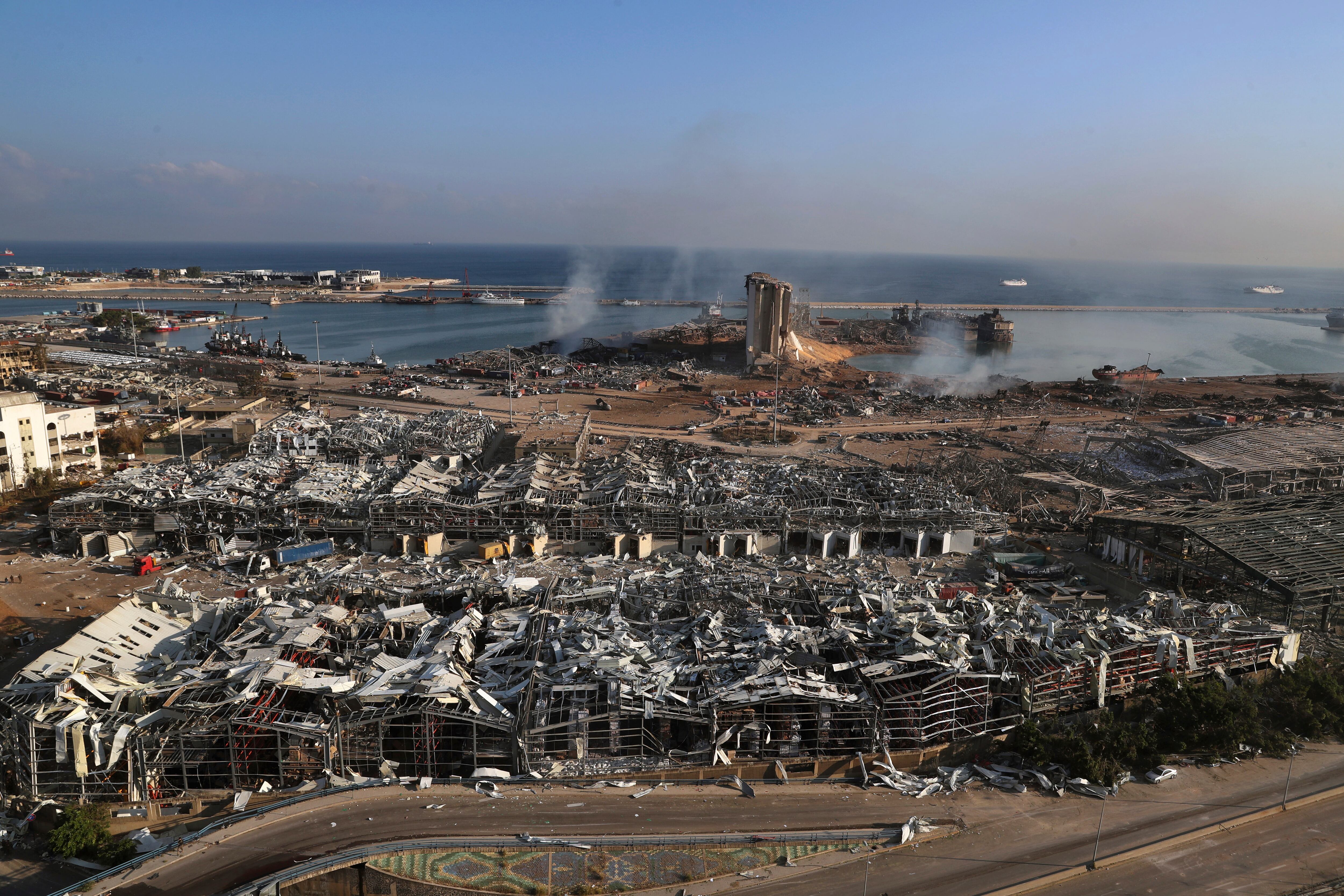
Residents of Beirut confronted a scene of utter devastation Wednesday. Smoke still rose from the port, where a towering building of silos was half destroyed, spilling out grain. Hangars around it were completely toppled. The blast knocked out a crater some 200 meters (yards) across that filled with seawater — it was as if the sea had taken a bite out of the port, swallowing buildings with it.

Much of downtown was littered with damaged vehicles and debris that had rained down from the shattered facades of buildings.

Lebanon was already on the brink of collapse amid a severe economic crisis. Many have lost their jobs and seen their savings evaporate because of a currency crisis. Food security is a worry since Lebanon imports nearly all its vital goods and its main port is devastated. The government is strapped for cash.

Lebanon's economic crisis is rooted in decades of systemic corruption by political factions that exploit public institutions for the benefit of their supporters. Decades after the civil war, residents endure frequent power outages and poor public services.

French President Emmanuel Macron was to traveling to Beirut on Thursday to offer support and meet with Lebanese leaders. Lebanon is a former French protectorate and the countries retain close political and economic ties.

___

Associated Press writers Sarah El Deeb and Hassan Ammar in Beirut, Jon Gambrell in Dubai, United Arab Emirates, and Joseph Krauss in Jerusalem contributed to this report.

Share:
More In Culture
Amazon Funds Amogy to Commercialize Ammonia-Powered Cargo-Shipping Vessels, Decarbonize Transportation
Amazon is betting that ammonia could be the fuel of the future, participating in a Series A round for the Brooklyn-based company Amogy in December. Amogy aims to de-carbonize transportation with a clean energy system that uses ammonia as a renewable fuel. Amogy is partnering with Amazon on its first commercial product - an ammonia-powered cargo-shipping vessel. Amogy CEO Seonghoon Woo joins Cheddar Climate to discuss.
FedEx Announces Student Ambassador Program With Historically Black Colleges & Universities
One of the world's largest transport companies is kicking off Black History Month with a new initiative aimed at the next generation of business leaders. Today, FedEx announced the launch of its Student Ambassador Program. Participants selected from eight historically black colleges and universities will receive career guidance from FedEx executives. The program is part of FedEx's ongoing commitment to HBCUs and will also help the company expand its pipeline for diverse talent. Cheddar News welcomes senior vice president at FedEx, Jenny Robertson, and Jerryl Briggs, President of Mississippi Valley State University, to discuss.
'Sing 2' Takes Top Spot From 'Spider-Man' at UK Box Office
"Sing 2" has overthrown "Spider-Man: No Way Home" as the number one film at the UK box office. The animated sequel brought in $8.1 million, in just its two first weekends. However, "No Way Home" is still on track to beat "Avatar" as the number one grossing movie of all time.
First Black CEO of Big Brothers Big Sisters of America on Empowering Youth With NFL
Big Brothers Big Sisters of America has been a driving force for youth mentorship since 1904. The nonprofit organization is launching its annual Big Draft campaign this month in partnership with the NFL, and Artis Stevens, the first Black CEO of Big Brothers Big Sisters of America, joined Cheddar to discuss the push for adding more "Bigs" as mentors on his one-year anniversary leading the non-profit organization. "While the NFL is recruiting and drafting more players, they're also helping us to draft more mentors and, particularly, men all the way from across February to all the way to April of this year," Stevens explained.
Supreme Court To Hear Challenge To Affirmative Action
The Supreme Court will reconsider race-based affirmative action in college admissions. The court will examine admissions policies at Harvard University and The University of North Carolina Chapel Hill, which count the race of applicants as a factor in admissions. The court has upheld affirmative action policies in the past, saying it helps to create more diverse student bodies. However, the conservative Supreme Court could be skeptical and even possibly hostile to such policies. Nick Anderson, Higher Education Writer, Washington Post joined Cheddar's Opening Bell to discuss.
Crypto Prices Plummet, Wiping Out $1 Trillion In Global Value
The value of most cryptocurrencies have plummeted in recent months since reaching all-time highs in November, wiping out more than $1 trillion in value globally. The steep crash has some talking about the possibility of a crypto winter, a term referring to a prolonged bearish period where asset prices persistently fall over many months. This all comes as the Fed is expected to raise interest rates, and the Biden administration is working on an executive order to regulate Bitcoin and other assets. Josh Goodbody, COO of Qredo, joined Cheddar's Opening Bell to discuss the crypto crash, and how the industry might recover from it.
Streaming Giants Struggle to Retain Subscribers Following Big Releases
Recent data reveals that streaming giants are struggling to retain subscribers in the months following a major release. According to data from Antenna, subscriber trends show that users will subscribe to a given streaming service just to watch a particular show, and then cancel those subscriptions shortly after. This comes as the streaming space continues to heat up as new entrants crowd the space. Jon Christian, Founding Partner + Digital Supply Chain Leader at OnPrem joined Cheddar's Opening Bell to discuss.
EU Relaxes Travel Restrictions Within Bloc
The EU relaxed its Covid travel restrictions for vaccinated individuals among the union's 27 member states, doing away with testing or quarantine requirements for travelers. This comes soon after the World Health Organization said the omicron variant could help make the pandemic more manageable. The new rules take effect February 1st. Bryce Conway, Founder, 10xTravel joined Cheddar's Opening Bell to discuss.
China Blocking Off Scenes From Hollywood Films
If you're in China you may have noticed that the 1999 film "Fight Club" which features Brad Pitt has somehow got itself a new ending. In the new ending on the streaming service Tencent, the narrator is killed and the explosions are replaced with a black screen saying "the police arrested criminals".It's unclear as to exactly why the changes were made. However, it is the latest example of China playing by its own rules when it comes to entertainment and attempting to control everything its citizens watch. Media Reporter at Axios, Sarah Fisher, joined Cheddar to discuss more.
Load More