Voting in the 2020 election kicks off today, exactly nine months before Election Day, as Iowans gather at more than 1,600 caucus sites to pick their favorite candidate.
Candidates have been criss-crossing the Hawkeye State for more than two months (Andrew Yang and Amy Klobuchar have clocked in the most Iowa-time, spending 71 and 67 day there, respectively). The Iowa Caucuses are famous for person-to-person campaigning. It’s not just about making your picks inside a private voting booth — citizens can be swayed by their neighbors throughout the night to ditch their initial pick for nominee and go with a different candidate.
Many young voters will enter politics for the first time tonight, and during the day Cheddar caught up with a precinct captain at the University of Iowa.
While those in Iowa waited all day for tonight’s main events, caususes were also held overseas and Senator Elizabeth Warren got off to an early lead in Paris — one of three global sites where, for the first time, Iowans who are out of the country be able to participate in the Democratic caucuses.
Back in Iowa tonight the caucuses are underway and some caucusgoers brought their talking points to support their favorite candidates. Others brought liquid courage.
Now that the doors have closed across gymnasiums, community centers and libraries across the state, voters will pick their top choice. But some voters came in planning to vote for one candidate, only to meet another and change before the caucus even started.
So how does it work? This about sums it up.
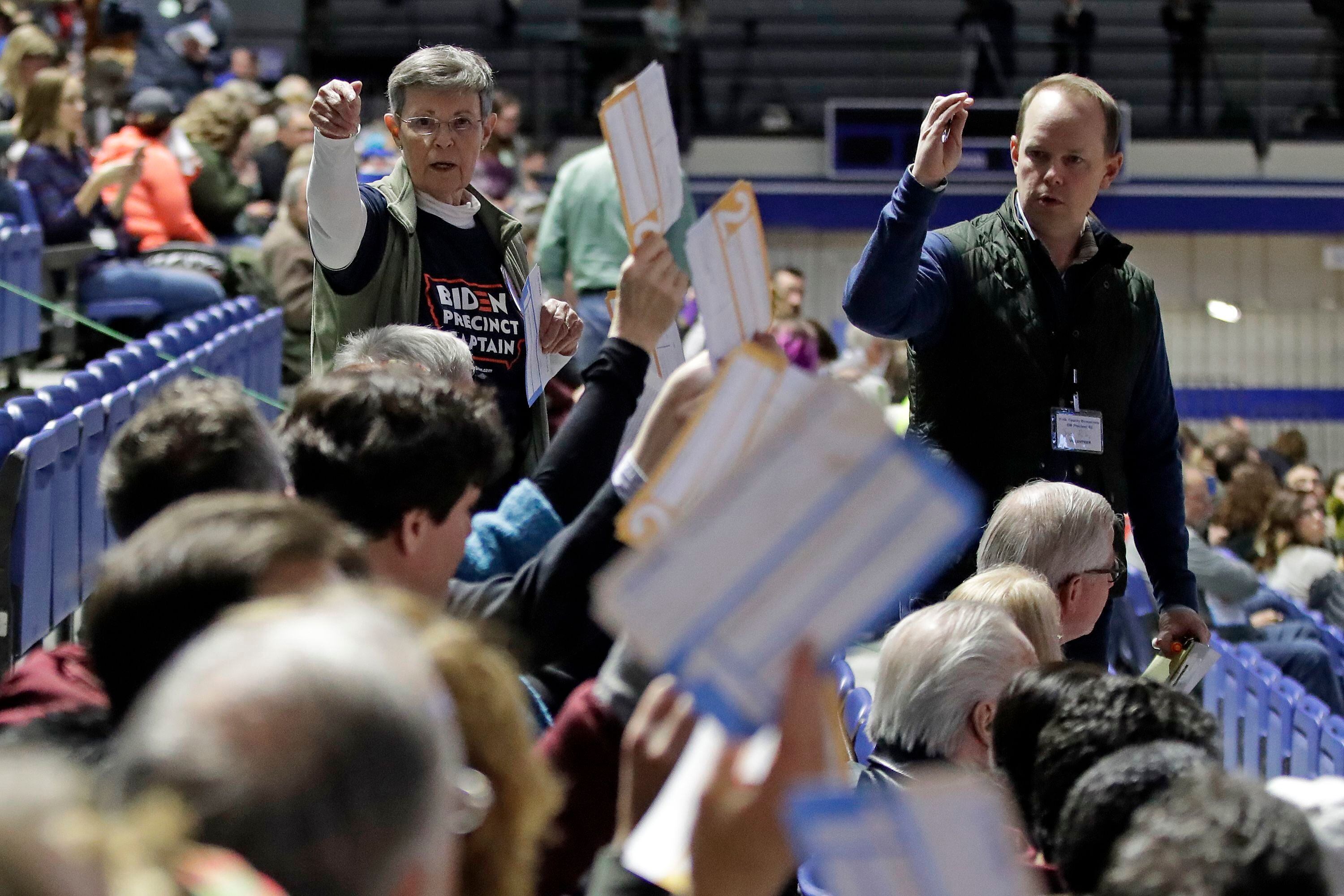
At the Des Moines Knapp Center, Iowans are making moves into candidate corners. For those who have never seen how a caucus works, it's literally people moving to their respective corners.
Any candidate who gets at least 15 percent in most cases is considered a “viable” candidate and their supporters are locked into their choice.
But if a candidate gets less than 15 percent of the caucus, they are considered “not viable” and their supporters can opt to either move to another candidate’s corner or convince fellow caucusgoers to join them.
Of course, that begs the question: Is it humane or harsh that voters have to ditch their pick if they’re not viable?
Of course, only Americans over 18 can caucus today (or those who will be 18 by Election Day), but it's never too early to get a civics lesson!
The caucus has moved into the realignment phase — when citizens try to talk neighbors into switching camps. And when all else fails, there’s always a good ol’ fashioned coin toss.
Moving into the 11pm ET hour, it looks like there’s been a hitch in the caucuses’ giddyup.
Iowa appears to be reporting more results than in elections past, adding to the delay.
Although Iowa results are still forthcoming, Sen. Amy Klobuchar decided to go ahead and speak to her supporters around 11:30pm ET. So, with only 41 delegates of the required 1,991 needed to win the Democratic nomination up for grabs tonight, the ability shape her narrative tonight may count for something.
Yet Sen. Bernie Sanders remains confident...the results will come eventually.
Former VP Joe Biden says he’s feeling good...but he’s ready to move on to the next big event: New Hampshire!
But as the clock struck midnight (ET) on Iowa Caucus night, and the results escaped our grasp, many in the Twitter-verse agreed:
Stock trading app Robinhood already has been offering cryptocurrency investments but seems further excited about the asset class following President Biden's recent announcement of an executive order. Dan Gallagher, the chief legal and corporate affairs officer for Robinhood, joined Cheddar News to talk about the White House's tentative vision for digital currency. "I think this executive order firmly states that, yes, crypto is here to stay, which it talks about the important competitive issues around crypto and how the United States needs to be a leader, a global leader, in innovation and technology regarding crypto," he said. Gallagher also discussed having clarity around meme stocks going forward but worried about overregulation slowing down innovation.
As Russia’s attack on Ukraine, the latest inflation report showed the consumer price index rose 7.9 percent — a 40-year high. Heather Boushey, a member of the White House Council of Economic Advisers, joined Cheddar News to discuss what American consumers might be in store for as prices keep rising. "Forecasters at this point believe that the American economy will be resilient," she said. "They’re still predicting that the unemployment rate will continue to be lower at the end of the year than it is today, and we are still seeing folks believe that over time prices will come back down." Boushey did note that it would be dependent on how long the current situation lasts.
Simon Shuster, TIME's Moscow correspondent joins Cheddar to discuss how Ukraine could become part of the EU and what it would mean for politics in Europe.
President Biden has banned imports of Russian oil to the U.S. in retaliation for its invasion of Ukraine. The president warned of higher prices at the gas pump, leading some analysts to think it could propel the transition to clean, renewable energy. Michael Jones, chairman and CEO of investment solutions company Caravel Concepts, discussed how the ban is hitting green energy stocks as gas prices continue to surge. "I think the 10-year prospects for renewables just got a whole lot better because ultimately this is going to force a transition into renewables," he said.
Amid ongoing tensions in the Russia-Ukraine region, many American travelers are nervous about traveling to Europe.
It comes at a time when international travel was set to make a comeback, but uncertainty surrounding the conflict may delay the overall recovery. Francesca Page, Travel Expert, joined Cheddar's Opening Bell to discuss.
Russia's invasion of Ukraine is coming for the global food supply. Ongoing tensions in the region are threatening the supply of various agricultural products including wheat, barley and corn. Vladik Rikhter, CEO & Cofounder of Zenput joined Cheddar's Opening Bell to discuss how this could impact food prices overseas.
Chris Natividad, CIO of EquBot, joins Cheddar News' Closing Bell, where he elaborates on what ultimately dragged the Dow, S&P, and Nasdaq lower on Tuesday and discusses how investors are reacting to rising oil prices and February CPI data coming out later this week.
Adam Johnson, Portfolio Manager at Adviser Investments, joins Cheddar News' Closing Bell, where he explains why he believes we saw markets jump during Wednesday's session, and adds that investors have already priced in 'every possible kind of bad news we could have.'
Jennifer Klein, the White House Gender Policy Council's co-chair and executive director, spoke to Cheddar News about the economic impact of the pandemic showing the need for a group like the Gender Policy Council, and the need to address issues that have affected women the most,