By HUNTER WOODALL and NICHOLAS RICCARDI/Associated Press
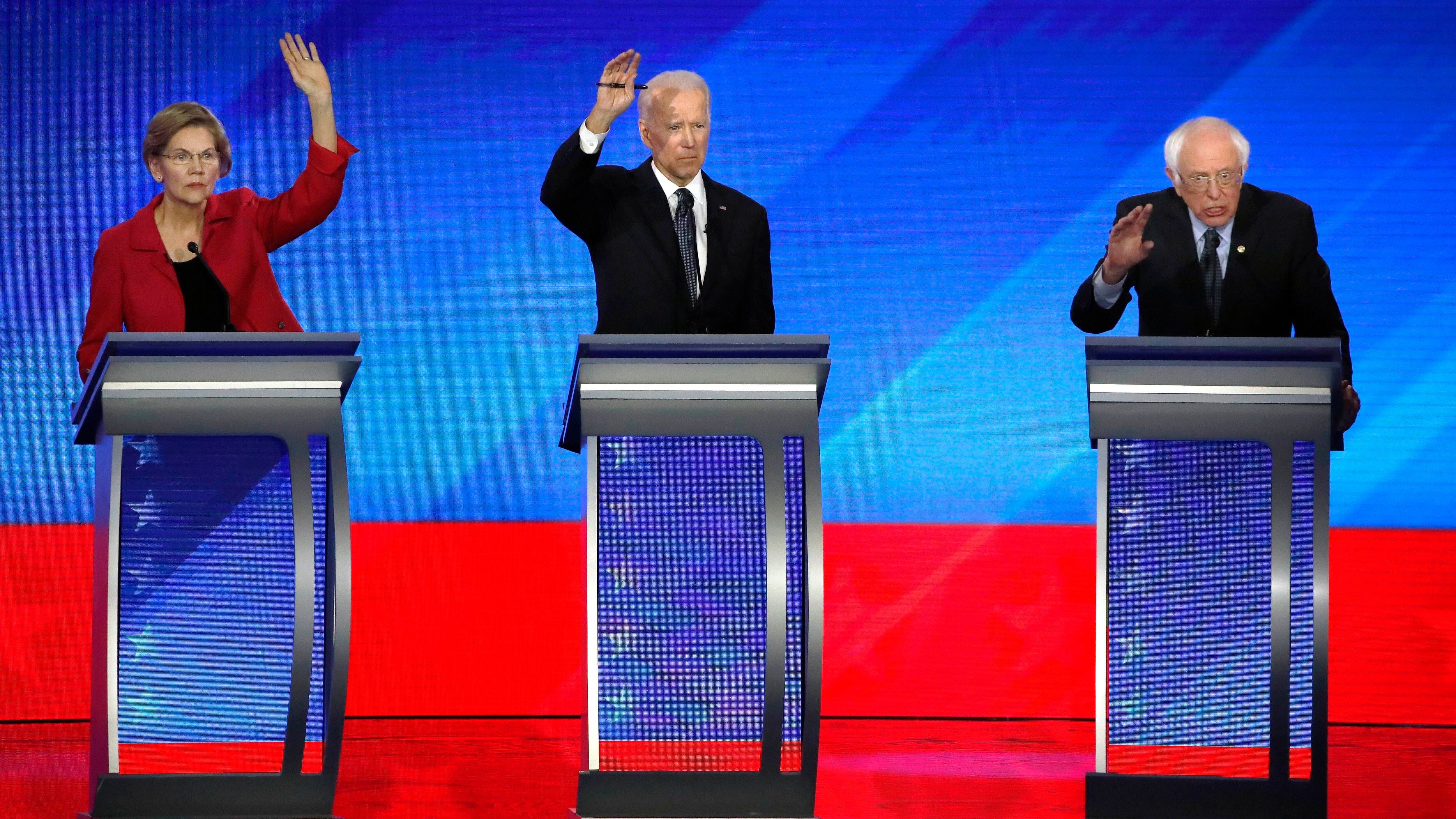
MANCHESTER, N.H. — Three days before the critical New Hampshire Primary, seven Democratic presidential candidates debated, with many of them fighting to survive in the race to challenge President Donald Trump.
Here are some key takeaways.
MAYOR PETE MAKES HIS CASE
Pete Buttigieg, the 38-year-old former mayor of South Bend., Ind., was the candidate of the moment Friday. All eyes were on him Friday night to see if he could make his case.
And he did — with one significant stumble.
Attacked for his thin resume, Buttigieg shot back, “If you’re looking for the person with the most years of Washington, D.C., experience under their belt, that candidate is not me.” He promoted his youth compared with the lawmakers onstage talking about their achievements from decades ago.
“We cannot solve the problems before us by looking back,” Buttigieg said. “We have to be ready to turn the page.”
A former military intelligence officer, Buttigieg seemed comfortable discussing foreign affairs, such as the Trump administration’s killing of Iranian General Qassem Soleimani. “There is no evidence that that made our country safer,” he said, adding later, “This is not an episode of ‘24.’” But Buttigieg's trouble spot has long been race. Asked about a spike in arrests of black people for marijuana possession in his city after he became mayor, Buttigieg began to decry systemic racism but seemed to acknowledge he couldn't escape it in the city that he ran.
SANDERS UNDER ATTACK
It didn’t take long for the candidates to make clear whom they saw as the front-runner. Sen. Bernie Sanders of Vermont was piled on by competitors fighting to become the moderate alternative to the self-declared democratic socialist.
There were two lines of attack — Sanders’ uncompromising liberal positions and, specifically, his proposal to immediately have the federal government take over the entire health care system.
The most notable punch was thrown by Buttigieg, who said Democrats will have a problem working to “unite this country at a moment when we need unification when our nominee is dividing people.” Asked if he meant Sanders, he said yes.
Minnesota Sen. Amy Klobuchar scoffed at Sanders’ health care proposal. Former Vice President Joe Biden noted that Sanders says he has no idea how much his proposal could cost, though experts have put it at at least $30 trillion.
But he showed a characteristic durability. In the deeply divided field, Sanders is now leading in many polls by virtue of that following.
BIDEN BOUNCE BACK?
After his disappointing showing in Iowa, Biden was fighting to survive. Sometimes it didn’t seem like it, but Biden also displayed flashes of the fire and emotion that have traditionally endeared him to Democratic voters.
Offered a chance early to swing at his two main rivals — Sanders and Buttigieg — Biden opened by basically admitting he was going to lose New Hampshire.
“Bernie won by 20 points last time,” Biden said softly. His criticisms of Sanders and Buttigieg weren’t nearly as sharp as those offered by other candidates. Biden's had difficulty talking about the GOP investigation into his own son that triggered Trump's impeachment and has coincided with the former vice president's slide in the polls.
The former vice president was left asking the crowd to give a standing ovation to Lt. Col. Alexander Vindman, who was led out of the White House hours earlier. Vindman had testified in December before Democrats investigating Trump’s dealings with Ukraine.
Biden, 77, was more energized in the later hours of the debate. He was visibly enraged at Trump’s dismissive comments on U.S. casualties during the Iranian retaliation for the U.S. killing of an Iranian general. He sharply attacked Sanders over the Vermont senator's prior support for gun rights, defended his long record on the Supreme Court and promoted his historic support from African-Americans.
But it’s not clear whether his performance will quell worries.
WARREN DIDN'T HAVE A PLAN FOR BREAKING THROUGH
Massachusetts Sen. Elizabeth Warren invested deeply in neighboring New Hampshire as a key part of her 2020 run, but she struggled to find a standout moment as she begins to make her final case to the state’s voters.
Warren skipped a chance to differentiate herself more from Sanders, a fellow progressive whom she calls a longtime friend. Given the chance to create some distance, Warren said, "We have a lot of things in common, we have a lot of things that we differ on."
She quickly shifted to making a party unity plea and echoing her stump speech lines about big money in politics and corruption.
"We bring our party together, it's an issue we can all agree on and fight to end the corruption," Warren said. "We're the Democrats. We should be the party on the side of hardworking people and we can bring in independents and Republicans on that. They hate the corruption as well."
Warren also did little to explicitly come to Sanders defense as her Vermont rival was attacked by the more moderate candidates over his prized Medicare for All policy goal, an idea Warren supports.
KLOBUCHAR MADE A MARK
Klobuchar was quick with the quips as she tried gain an edge in the primary’s moderate lane. She repeatedly made a virtue of her ability to compromise and work with Republicans. There was an urgency to her presentation, with good reason: She needs an upset in New Hampshire.
She hit familiar notes of criticizing Medicare for All as she touted her Midwestern appeal and legislative success in the Senate. Klobuchar’s plea boiled down to making a case for Democratic sensibility as a break from the smash-mouth nature of Trump’s presidency.
"I didn't come from money," Klobuchar said, insisting voters "want to have someone that they can understand" in the White House.
STEYER'S FIERY PLAY ... FOR SOUTH CAROLINA
Billionaire activist Tom Steyer does not have much of a chance in New Hampshire. So he used the debate to make a strong appeal to African American voters in South Carolina, where his campaign has invested heavily and black voters make up two-thirds of the primary electorate. The billionaire noted that well into the debate, "we have not said one word tonight about race."
"Are you kidding me?" he asked as a discussion of race ensued.
He added later, "I am for reparations to African Americans in this country and anyone who thinks that racism is a thing of the past and not an ongoing problem is not dealing with reality."
YANG NOT BURDENED
Businessman Andrew Yang was not burdened by low expectations. He was at ease and having fun on the debate stage Friday night, even though his chances to win New Hampshire, let alone the Democratic nomination, are minuscule.
He bounced onto the stage without a tie, in stark contrast to his more buttoned-up male rivals. But Yang was largely left out of the heated exchanges that simmered through the debate, focusing instead on stepping back and looking at the larger picture.
“Donald Trump is not the cause of all of our problems," Yang said. “And we are making a mistake when we act like he is. He is a symptom of a disease that has been building up in our communities for years and decades.”
THE ELEPHANT NOT IN THE ROOM
Two words were spoken Friday night that have rarely come up on the trail or in prior debates: Mike Bloomberg.
The former New York mayor and multibillionaire is skipping the early nominating states and instead spending hundreds of millions on Super Tuesday states with far more delegates at stake.
A viewer-submitted question asked why the candidates were better than Bloomberg.
“I don’t think anyone ought to be able to buy their way into a nomination or to be president of the United States,” Warren said.
“I just simply don’t think people look at the guy in the White House and say, ‘Can we get someone richer?’” Klobuchar said.
“There are millions of people who can desire to run for office but I guess if you’re worth $60 billion and you can spend several hundred millions of dollars on advertising you have a slight advantage,” Sanders said.
The responses were clear signals that they take Bloomberg seriously.