As Breast Cancer Awareness Month nears its end and the election looms, healthcare is top of people's minds. It became a focal point during Amy Coney Barrett's Supreme Court hearings as the Affordable Care Act waits for another day in court.
As the CEO of Susan G. Komen, Paula Schneider, a breast cancer survivor herself, told Cheddar's Opening Bell, "People need to care that their healthcare is one of the most important rights that they should have."
During the same interview, journalist Katie Couric, founder of Katie Couric Media, also called healthcare an essential right saying, "if you have a system that isn't open to people, it's just blatantly, terribly, un-American."
The National Cancer Institute estimates that as of January 2019, there are 16.9 million cancer survivors in the United States. This represents approximately 5 percent of the population, and that number of cancer survivors is projected to increase by nearly 30 percent, to nearly 22 million, by 2029.
Now amid the pandemic, people are delaying screening and routine care with a sharp drop in screenings and cancer diagnoses this year. According to a recent JAMA study, breast cancer diagnoses alone saw a 51.8 percent dip in March and April compared to previous years. According to Schneider, some reports show that drop being as large as 80 percent when it comes to breast cancer. "That doesn't mean it's not happening," she said. "It just means it's not being diagnosed, and therefore it's not being treated."
"Ladies get your mammograms."
As for Couric, she has faced the heartbreak of cancer within her own family. Her first husband Jay and her sister Emily both died following their battles with cancer. She said that one of the most important things a support system can do for a cancer patient is just to be there. "When Jay was sick he said having cancer is the loneliest experience in the world," Couric said.
That's part of the reason she partnered with pharmaceutical giant Merck for a new project called Your Cancer Story. The program provides information and support to cancer patients from diagnosis to treatment to survivorship. Couric said she wishes she had access to this kind of program for her own family years ago.
"You can see people talking about what they're going through. You can get advice. You can get guidance. You can get support," she explained. "Other survivors and other caregivers can talk about some of the things they wish they had known."
On December 25, 2021, NASA got into the holiday spirit by launching the James Webb Space Telescope, the largest and most powerful space science observatory in history.
It is intended to succeed the Hubble Space Telescope as NASA's flagship mission in astrophysics and is able to view objects too old and distant for Hubble. Gregory Robinson, director of NASA's James Webb Space Telescope program, joins Cheddar News' Closing Bell to discuss the mission. "I think a lot of what we don't know today is what I'm expecting to find and certainly really understand what took place more than 13.5 billion years ago and see the formation of some of the first galaxies in our universe," said Robinson.
Every few years, the Olympics roll around to prove that, yes, the world’s best athletes can jump farther, swim faster, and generally crush records that would’ve been impossible just a few decades ago. Take ski jumping - the world record has increased by well over 200 meters in fewer than 100 years. Responsible for this is a lot of intentional engineering of equipment and hills, but perhaps the biggest change is thanks to one act of human daring. Watch to find out how!
YouTube creator platform Spotter recently announced $200 million in Series D financing at a valuation of $1.7 billion, led by SoftBank Vision Fund 2. Spotter allows YouTubers to license the rights to their video catalogs in exchange for large sums of cash paid upfront. The company's clients include some of YouTube's most popular personalities, with a combined total of more than 1.2 billion subscribers. Aaron Debevoise, founder and CEO of Spotter, joins Cheddar News' Closing Bell to discuss.
What if we added the equivalent of over 1300 football fields to the tip of Manhattan? This was the proposal of a recent op-ed in The New York Times - increasing the size of the borough by about 12% in order to mitigate two of its most pressing problems. There’s evidence from all over the world that doing this can be a useful technique for crowded ocean-side cities. But the process to do so - reclaiming land from the ocean - is rife with potential downsides. So is this a proportional response to gigantic problems? Or a zany harebrained scheme that’ll do more harm than good?
Marti Bledsoe Post, executive director of On Our Sleeves, joins Cheddar News to discuss the latest study finding the impact children's mental health can have on working parents.
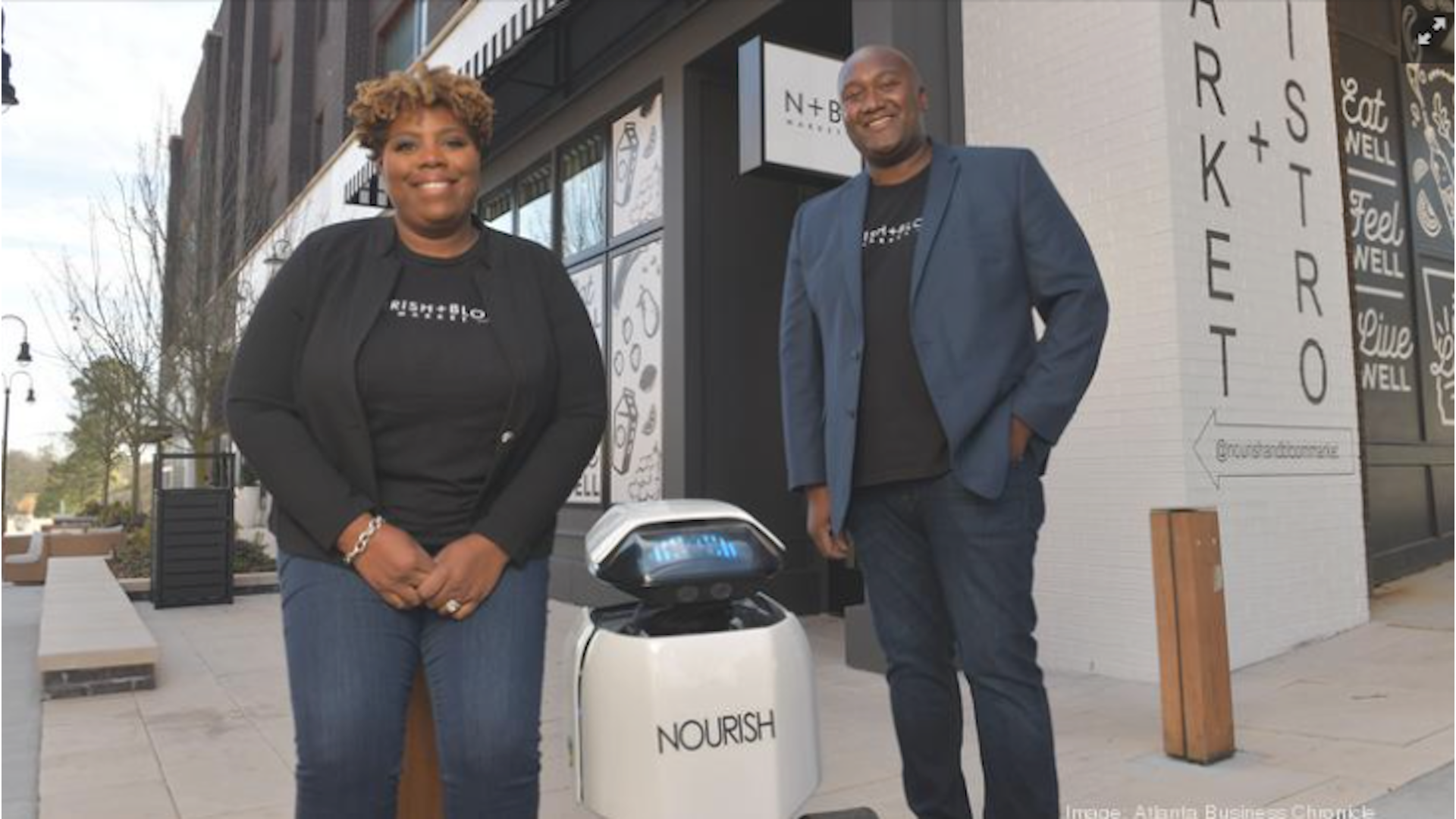
Jamie Hemmings and Jilea Hemmings, owners and founders of Nourish + Bloom Market, join Cheddar News to talk about the inspiration behind creating their cashierless grocery store.
Bartholomew Jones and Renata Henderson, co-owners of Cxffeeblack, join Cheddar News to discuss how they are merging Black culture with coffee in Memphis.
Dr. Daniel Bober, psychiatrist and certified addiction medicine physician, joins Cheddar News to offer tips on how parents and guardians can talk to their children about what's happening in Ukraine.