Among the more ambitious parts of Joe Biden's policy agenda, announced to little fanfare just before the pandemic hit back in February, is a relatively straightforward idea: make the federal housing voucher program — known as Section 8 — universal, available to every low-income family who qualifies.
That policy alone, the focal point of Biden's $640 billion housing plan, would go a long way toward solving this country's affordable housing crisis, according to Julian Castro, the former HUD secretary under President Obama.
The crisis has been exacerbated by COVID-19; an estimated 20 million people are at risk of eviction over the next several months, as state and local moratoriums enacted in March begin to expire along with the federal enhanced unemployment benefits. But even in the absence of an event like coronavirus, expanding Section 8 might be the single best — and most realistic — policy that a Biden administration could pass that would close the delta between families who need access to affordable housing, and families who actually get it, according to Castro. (Right now, an estimated 11 million people are left out).
While homelessness had been on the decline, it has ticked back up in recent years, partially, Castro said, because the Trump administration has not prioritized action on affordable housing
Education is clearly important, Castro said, but it gives a pass to the federal government's responsibility to invest in housing.
"There's no commitment in this administration to actually make those investments," he said, noting that there has been no action in the Republican-controlled Senate on the HEROES Act, which would provide $100 billion in emergency rental assistance for those affected by the pandemic.
But the root problem — spiking rents, not enough inventory, a general decline in the welfare state — long preceded coronavirus.
"The scale of the problem we have...requires significant federal government investment in more affordable housing," Castro said.
Russian forces escalated their attacks on populated urban areas Tuesday, bombarding the central square in Ukraine’s second-largest city and Kyiv’s main TV tower.
A bipartisan group of 43 representatives joined forces in a letter to President Joe Biden to remind the executive branch that it must seek the approval of Congress before authorizing a war — whether or not its in Ukraine as Russia continues its invasion. Rep. Peter DeFazio (D-Ore. 4th District) led the effort and joined Cheddar News Wrap to explain. "It's time for Congress to get back the authority, which is vested to us in the constitution, not in the executive branch," he said. "The president. once we're at war, we speak with one voice with the commander in chief. But before that, it's up to the American people and Congress whether or not we're going to become engaged in a war."
Chris Konstantinos, Chief Investment Strategist at RiverFront Investment Group, explains why he remains encouraged about the S&P and the state of the market despite the major indexes closing mostly lower on Monday.
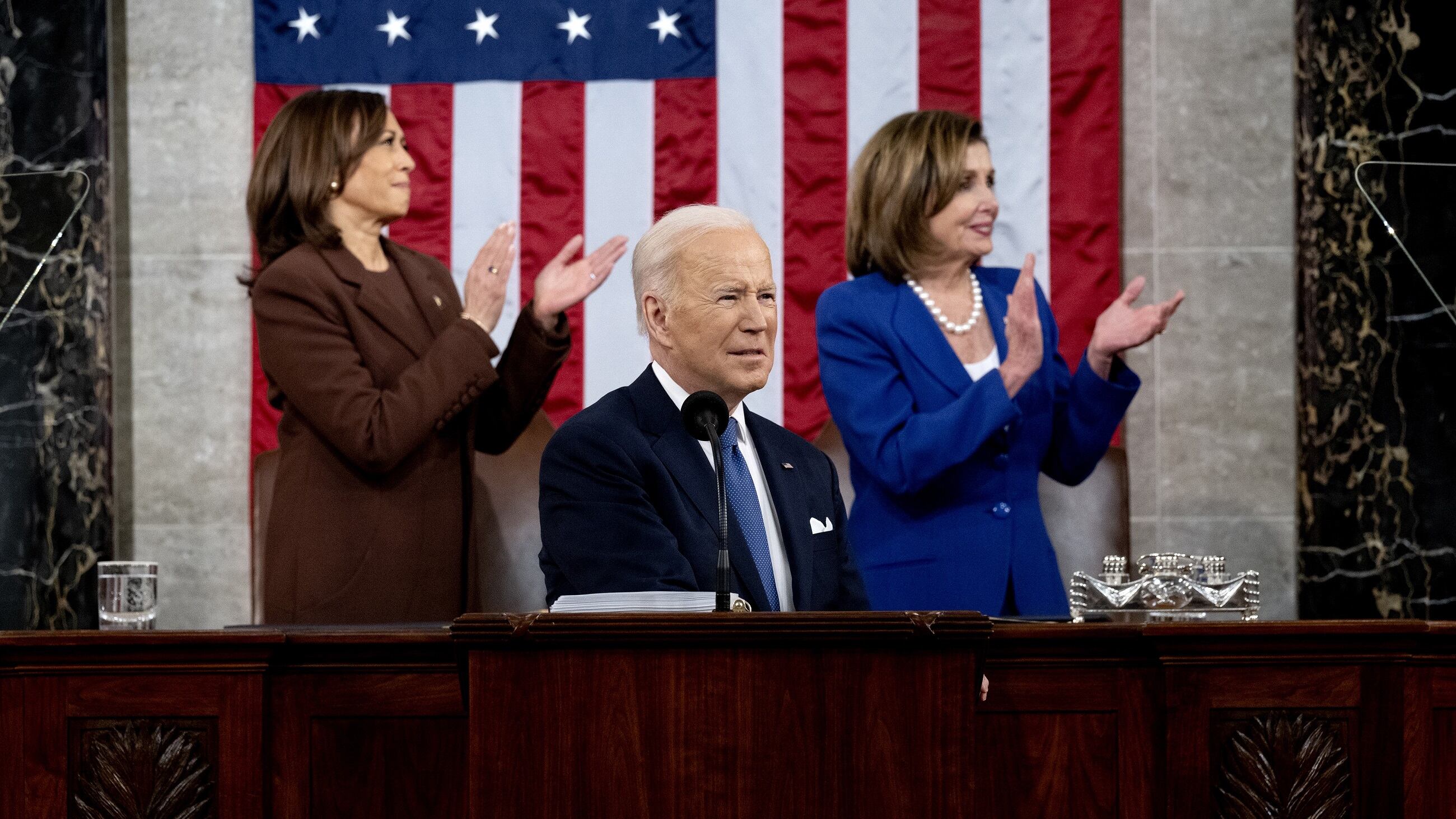
President Joe Biden will be delivering his first State of the Union address on Tuesday night, and with so many issues from Ukraine to inflation, everyone will be focused on what he might say. Rep. Nicole Malliotakis (R-N.Y. 11th District) joined Cheddar News to discuss what she thinks the president should address. "I think what he hasn't done yet is go after the gas, the oil, the minerals, the mining industries, that is incredibly important," she said. "There's still some banks there that are not sanctioned. He needs to go after all the banks, but I also think that providing the equipment that Ukraine needs to continue to protect its capital and its country are incredibly important."
As Russia’s attack on Ukraine continues, one of its few big allies remaining appears to be China. Gordon Chang, Asian affairs expert and author of "The Coming Collapse of China," joined Cheddar News to discuss what might be behind China's support for Putin's current strategy. “I think China is looking at what Putin did yesterday, which is to raise his nuclear forces on a higher alert level,” Chang stated, “If they see that Putin gets away with his nuclear threats, which he's been making over the last three or four days, then I'm sure that Beijing is going to ramp up its threats as well, and it could ramp them up against any number of different countries with which it perceives it has a problem with"
Joel Rubin, president of the Washington Strategy Group and former Deputy Assistant Secretary of State, joins Cheddar News to discuss the Russia-Ukraine tensions and the new sanctions President Biden placed on Russia.