By Jonathan Mattise and Kimberlee Kruesi

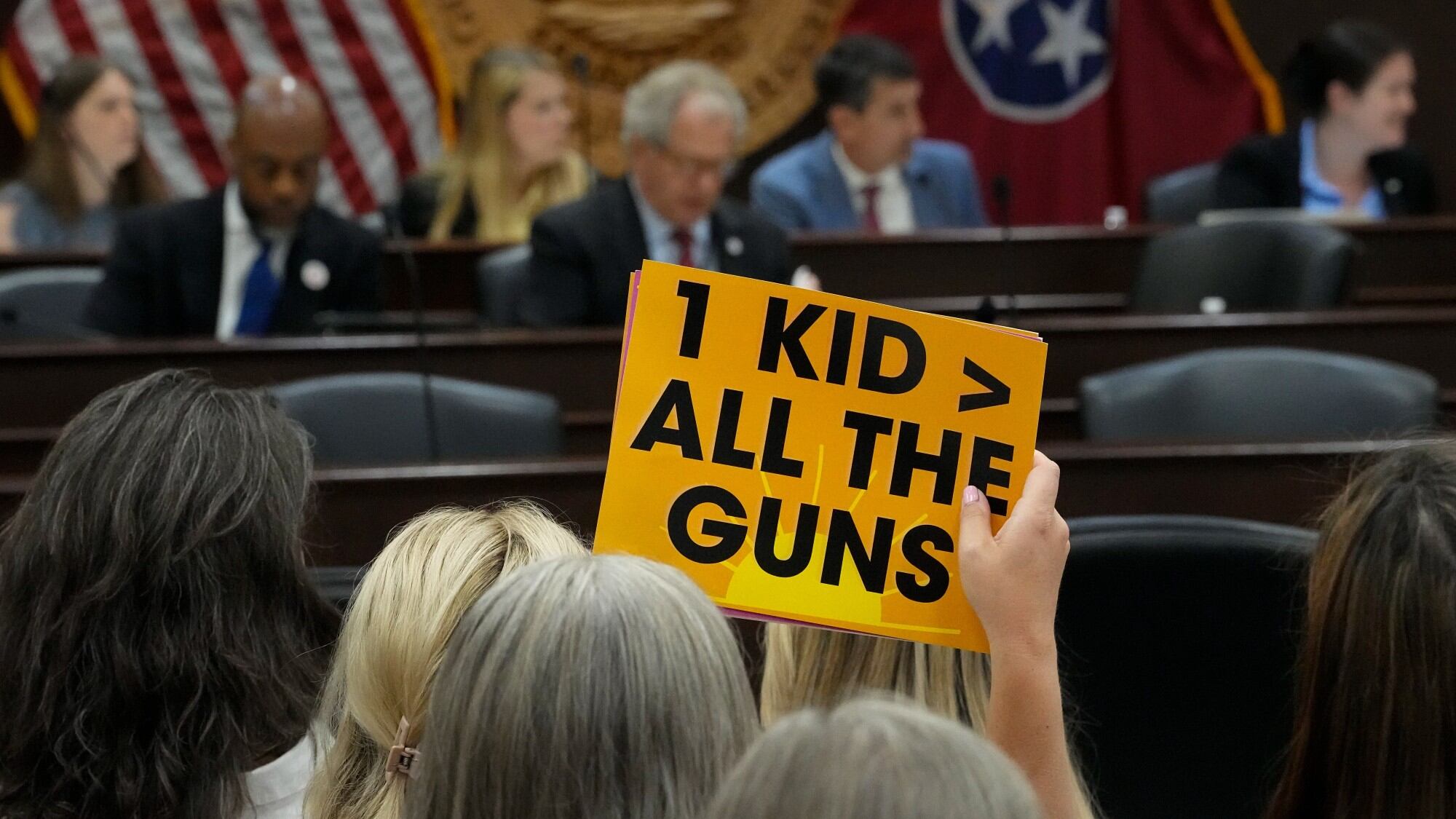
A Tennessee judge agreed Wednesday to temporarily block a new rule advanced by state House Republicans that banned the public from holding signs during floor and committee proceedings. The ruling came after state troopers removed three people who held small signs urging gun control were kicked out of a hearing Tuesday.

The removal came at the order of a GOP subcommittee chair, who later instructed state troopers to remove the rest of the public from the committee room after deeming the crowd too unruly. That included grieving parents closely connected to a recent Nashville school shooting, who broke down in tears at the decision.

The emotional and chaotic scene sparked widespread outrage from both Republican and Democratic lawmakers, while others pointed out that while signs were banned, the public could still freely carry firearms inside the legislative office building.

Nashville Chancellor Anne Martin's ruling came within hours of the filing of a lawsuit by the American Civil Liberties Union of Tennessee on behalf of the three women who were removed because of their signs: Allison Polidor, Maryam Abolfazli and Erica Bowton.

Republicans, who have a supermajority control in the House, signed off on a new slate of strict rules this week during a special session that was called by Gov. Bill Lee in reaction to the Nashville school shooting in March. GOP leaders are not expected to take up gun control, but they have approved severely limiting the public from accessing the Senate and House galleries where people have traditionally been allowed to watch their government in action.

A hearing on the temporary injunction has been scheduled for Sept. 5. However, lawmakers are expected to adjourn by Thursday.

A spokesperson for House Speaker Cameron Sexton, who is named as a defendant, did not immediately respond to a request for comment.

“These rules are unreasonable,” Stella Yarbrough, ACLU of Tennessee legal director, said in a news release. “The Tennessee House’s ban on silently holding signs in House galleries directly undermines Tennesseans’ First Amendment right to express their opinions on issues that affect them and their families.”

On the first day of the special session Monday, House Republicans approved a new set of procedural rules that carried harsh penalties for lawmakers deemed too disruptive or distracting, and they banned visitors from carrying signs inside the Capitol and in legislative hearing rooms. While House GOP leaders have defended rules on disruptions by lawmakers, they've been largely silent on why they also went after signs.

The actions come after the Tennessee Republicans attracted national attention for expelling two young Black Democratic lawmakers this year for breaking House rules during a demonstration in support of gun control. Reps. Justin Jones and Justin Pearson have since been reinstated and reelected to their positions, but the actions sent shock waves about the Republican supermajority’s ability to hand down strict punishments to opponents.

Polidor, a gun control advocate from Nashville, was escorted out of a hearing room because she was holding a sign that said, “1 KID” is greater than “ALL THE GUNS.”

“I joined with so many other moms from across Tennessee to urge our lawmakers to enact common sense gun laws,” Polidor said in the news release. "I was removed for peacefully holding a small sign, and exercising my First Amendment rights. What started as a debate on gun safety has morphed into a blatant violation of my First Amendment rights.”

While firearms have long been allowed inside Tennessee’s legislative building, hand-held signs have faced strict criticism from lawmakers as being a potential safety hazard and too distracting to proceedings.

In 2017, signs were briefly prohibited from Cordell Hull — the building that contains both legislative committee rooms and offices for lawmakers and staffers — following demonstrations over refugee resettlements, Medicaid expansion and gas taxes.

That policy was then altered to allow the public to hold small letter-size signs inside Cordell Hull, but banned any signs on sticks or poles.

In the years since, the public has repeatedly shown up with signs that reflect a wide range of policy stances.

Share:
More In Politics
US tariffs are having an uneven effect on holiday prices and purchases
Many U.S. consumers say they’ve noticed higher than usual prices for holiday gifts in recent months, according to a a December poll from The Associated Press-NORC Center for Public Affairs Research. A contributing factor is the unusually high import taxes the Trump administration put on foreign goods. While the worst-case consumer impact that many economists foresaw from the administration’s trade policies hasn’t materialized, some popular gift items have been affected more than others. Most toys and electronics sold in the U.S. come from China. So do most holiday decorations. Jewelry prices have risen due to the cost of gold.
Serbia organized crime prosecutors charge minister, others in connection with Kushner-linked project
Serbia’s prosecutor for organized crime has charged a government minister and three others with abuse of position and falsifying of documents related to a luxury real estate project linked to U.S. President Donald Trump’s son-in-law Jared Kushner. The charges came on Monday. The investigation centers on a controversy over a a bombed-out military complex in central Belgrade that was a protected cultural heritage zone but that is facing redevelopment as a luxury compound by a company linked to Kushner. The $500 million proposal to build a high-rise hotel, offices and shops at the site has met fierce opposition from experts at home and abroad. Selakovic and others allegedly illegally lifted the protection status for the site by falsifying documentation.
Trump signs executive order to block state AI regulations
President Donald Trump has signed an executive order to block states from regulating artificial intelligence. He argues that heavy regulations could stifle the industry, especially given competition from China. Trump says the U.S. needs a unified approach to AI regulation to avoid complications from state-by-state rules. The order directs the administration to draw up a list of problematic regulations for the Attorney General to challenge. States with laws could lose access to broadband funding, according to the text of the order. Some states have already passed AI laws focusing on transparency and limiting data collection.
New York Times, after Trump post, says it won’t be deterred from writing about his health
The New York Times and President Donald Trump are fighting again. The news outlet said Wednesday it won't be deterred by Trump's “false and inflammatory language” from writing about the 79-year-old president's health. The Times has done a handful of stories on that topic recently, including an opinion column that said Trump is “starting to give President Joe Biden vibes.” In a Truth Social post, Trump said it might be treasonous for outlets like the Times to do “FAKE” reports about his health and "we should do something about it.” The Republican president already has a pending lawsuit against the newspaper for its past reports on his finances.
Trump approves sale of more advanced Nvidia computer chips used in AI to China
President Donald Trump says he will allow Nvidia to sell its H200 computer chip used in the development of artificial intelligence to “approved customers” in China. Trump said Monday on his social media site that he had informed China’s leader Xi Jinping and “President Xi responded positively!” There had been concerns about allowing advanced computer chips into China as it could help them to compete against the U.S. in building out AI capabilities. But there has also been a desire to develop the AI ecosystem with American companies such as chipmaker Nvidia.
Swing district Republicans brace for political fallout if health care subsidies expire
House Republicans in key battleground districts are working to contain the political fallout expected when thousands of their constituents face higher bills for health insurance coverage obtained through the Affordable Care Act. For a critical sliver of the GOP majority, the impending expiration of the enhanced premium tax credits after Dec. 31 could be a major political liability as they potentially face midterm headwinds in a 2026 election critical to President Donald Trump’s agenda. For Democrats, the party’s strategy for capturing the House majority revolves around pinning higher bills for groceries, health insurance and utilities on Republicans.
Load More