By Bill Barrow, Alexandra Jaffe, and Will Weissert
Updated 5:28 pm ET
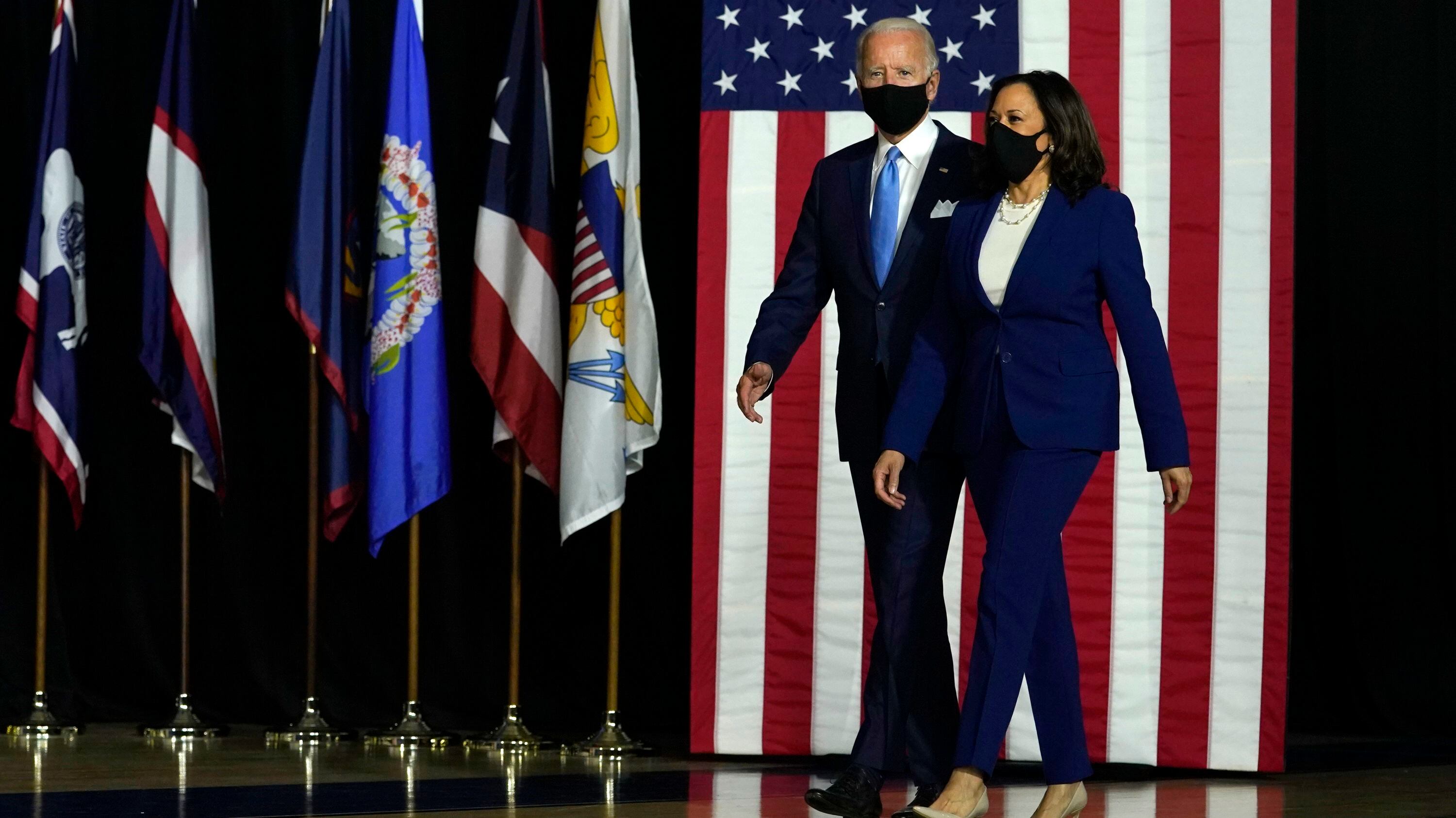
Democratic presidential candidate Joe Biden and his newly chosen running mate Kamala Harris campaigned together for the first time Wednesday, as the former primary rivals sought to solidify their advantage over President Donald Trump and secure their place in American history.
Biden, a 77-year-old white man, embraced the significance of naming the first Black woman to a major party's presidential ticket, but he focused on other attributes Harris brings to the ticket. He hailed the California senator, the 55-year-old former prosecutor who a year ago excoriated Biden on a primary debate stage, as the right woman to help him defeat Trump and then lead a nation facing crises in triplicate: a pandemic, wounded economy and long-simmering reckoning with systemic racism.
Harris, Biden said at a high school gymnasium in his hometown of WIlmington, Delaware, is "smart, she's tough, she's experienced, she's a proven fighter for the backbone of this country."
"Kamala knows how to govern. She knows how to make the hard calls. She's ready to do this job on day one," he continued.
Harris, the daughter of immigrants from India and Jamaica, sat feet away from Biden, listening with her mask off.
The event began an hour late. A momentous candidacy aside, the surreal nature of the scene was not only a woman of color stepping into the role of would-be national executive but doing so in a mostly empty high school gym. Masked reporters nearly outnumbered campaign aides and the candidates' families members in a grim reminder of a coronavirus pandemic that has killed 165,000 Americans, while yielding Depression-level unemployment and World War II-level national deficits.
In any other presidential election, vice-presidential picks are greeted with adoring throngs, and Harris, given her profile, almost certainly could have expected an even more enthusiastic welcome to the ticket. On Wednesday, about 100 supporters stood outside the gymnasium waving signs prior to her arrival, with no hopes of being allowed inside.
The event was the first in a rollout that Biden aides say blends the historic nature of Harris' selection with the realities of the 2020 campaign and the gravity of the nation's circumstances. Later Wednesday, the pair will lead an online grassroots fundraiser; they will continue campaigning together though Democrats' virtual convention that runs next Monday through Thursday.
Harris was considered a favorite throughout Biden's search, and she's been a regular surrogate campaigner and fundraiser for him since he became the presumptive nominee.
They'll nonetheless have to paper over differences exposed during the primary campaign, from Harris' initial support for a single-payer health insurance system and the Green New Deal to her deeply personal debate-stage broadside against Biden over his opposition to federally mandated busing to integrate public schools in the 1970s.
Trump seized on those dynamics, tagging Harris as "Phony Kamala" and casting her as the latest evidence that Biden, a five-decade veteran of the Democratic establishment, is captive to his party's left flank.
White House adviser Kellyanne Conway on Wednesday insisted Harris is "very much part of the radical left" and suggested the senator will have a hard time not outshining Biden, whose age and fitness for office Conway frequently mocks. "He's overshadowed basically by almost everyone he comes in contact with," she said.
Biden's campaign seemed prepared for the counteroffensive, noting that just weeks ago, Trump said Harris would be a "fine choice." And campaign finance records show that Trump contributed as a private citizen to Harris' attorney general campaigns in California. Harris was elected to the Senate in 2016.
Further muddying the GOP message, national operatives on Wednesday highlighted progressives' criticism of Harris' record as a prosecutor and California attorney general, essentially criticizing her as part of the Democratic establishment.
Indeed, Harris no longer supports a single-payer health insurance system, aligning instead with Biden's proposal to add a public insurance option to compete alongside private plans. Still, Harris memorably raised her hand during one Democratic primary debate when candidates were asked whether they could back a system that scrapped private health insurance altogether.
She has broadly endorsed the Green New Deal, progressives' most ambitious set of proposals to combat the climate crisis, but she didn't make that an anchor of her presidential bid. Biden has moved left on his climate proposals during the 2020 campaign but has not fully embraced the Green New Deal.
In Washington, Harris has advocated overhauling the criminal justice system, intensifying her efforts since George Floyd's killing by a white Minneapolis officer in May. And she's called for sweeping domestic programs to benefit the working and middle class. But she has taken heat for some of her aggressive stances as a local prosecutor in the San Francisco area and for not prosecuting bank executives in the wake of the 2008 financial collapse.
That mixed record could have unpredictable effects in a national campaign.
Biden bets that, on balance, Harris has broad appeal that will shore up any weaknesses with Black women, an anchor of the Democratic Party, and other voters of color, while juicing turnout among white liberals and coaxing support from independents and Republican-leaning white voters who have soured on Trump.
Karen Finney, a prominent Black strategist in the Democratic Party, pointed to immediate fundraising success as evidence that Biden's take on Harris is better than Trump's. Act Blue, Democrats' online fundraising arm, reported taking in almost $11 million in the hours after Biden's announcement, and the Biden campaign expects a massive haul from Wednesday evening's grass-roots fundraiser, potentially rivaling previous events with former President Barack Obama and former 2020 rival Sen. Elizabeth Warren. Those virtual events raised about $11 million and $6 million, respectively.
"We won't get the visual," Finney said, referring to the realities of a coronavirus-era campaign. "But you can already feel the energy and excitement."
The ticket, she said, "makes clear that Biden is serious about having people who like the diversity of our country and our future at the highest decision-making tables. That gives people hope."
___
Barrow reported from Atlanta. Associated Press reporter Aamer Madhani contributed from Washington.