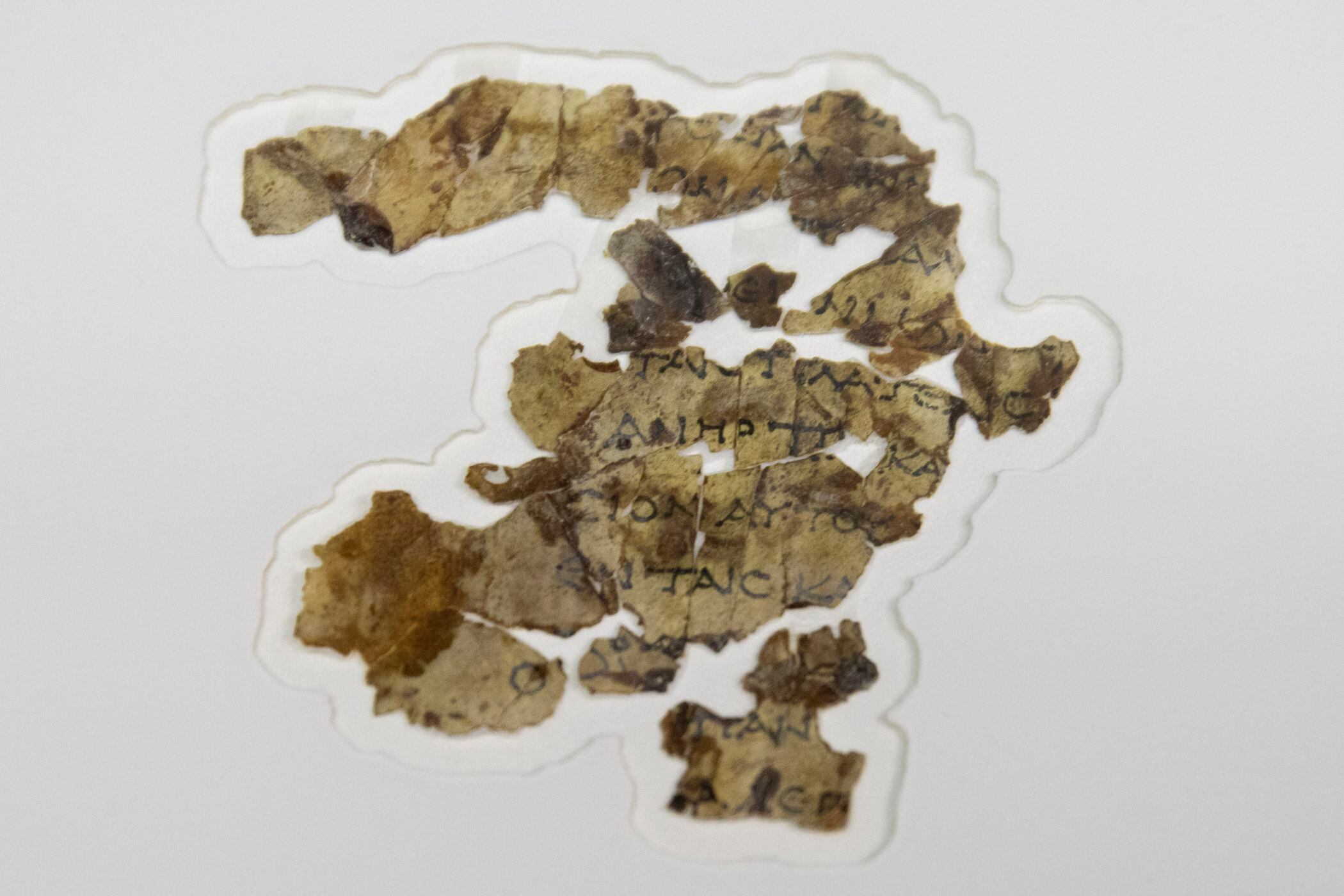
The Israel Antiquities Authority displays newly discovered Dead Sea Scroll fragments at the Dead Sea scrolls conservation lab in Jerusalem, Tuesday, March 16, 2021. Israeli archaeologists on Tuesday announced the discovery of dozens of new Dead Sea Scroll fragments bearing a biblical text found in a desert cave and believed hidden during a Jewish revolt against Rome nearly 1,900 years ago. (AP Photo/Sebastian Scheiner)
By Ilan Ben Zion
Israeli archaeologists on Tuesday announced the discovery of dozens of Dead Sea Scroll fragments bearing a biblical text found in a desert cave and believed hidden during a Jewish revolt against Rome nearly 1,900 years ago.
The fragments of parchment bear lines of Greek text from the books of Zechariah and Nahum and have been dated around the first century based on the writing style, according to the Israel Antiquities Authority. They are the first new scrolls found in archaeological excavations in the desert south of Jerusalem in 60 years.
The Dead Sea Scrolls, a collection of Jewish texts found in desert caves in the West Bank near Qumran in the 1940s and 1950s, date from the third century B.C. to the first century A.D. They include the earliest known copies of biblical texts and documents outlining the beliefs of a little understood Jewish sect.
The roughly 80 new pieces are believed to belong to a set of parchment fragments found in a site in southern Israel known as the “Cave of Horror” — named for the 40 human skeletons found there during excavations in the 1960s — that also bear a Greek rendition of the Twelve Minor Prophets, a book in the Hebrew Bible. The cave is located in a remote canyon around 40 kilometers (25 miles) south of Jerusalem.
The artifacts were found during an operation in Israel and the occupied West Bank conducted by the Israel Antiquities Authority to find scrolls and other artifacts to prevent possible plundering. Israel captured the West Bank in the 1967 war, and international law prohibits the removal of cultural property from occupied territory. The authority held a news conference Tuesday to unveil the discovery.
The fragments are believed to have been part of a scroll stashed away in the cave during the Bar Kochba Revolt, an armed Jewish uprising against Rome during the reign of Emperor Hadrian, between 132 and 136. Coins struck by rebels and arrowheads found in other caves in the region also hail from that period.
“We found a textual difference that has no parallel with any other manuscript, either in Hebrew or in Greek,” said Oren Ableman, a Dead Sea Scroll researcher with the Israel Antiquities Authority. He referred to slight variations in the Greek rendering of the Hebrew original compared to the Septuagint — a translation of the Hebrew Bible to Greek made in Egypt in the third and second centuries B.C.
“When we think about the biblical text, we think about something very static. It wasn’t static. There are slight differences and some of those differences are important,” said Joe Uziel, head of the antiquities authority's Dead Sea Scrolls unit. “Every little piece of information that we can add, we can understand a little bit better” how the Biblical text came into its traditional Hebrew form.
Alongside the Roman-era artifacts, the exhibit included far older discoveries of no lesser importance found during its sweep of more than 500 caves in the desert: the 6,000-year-old mummified skeleton of a child, an immense, complete woven basket from the Neolithic period, estimated to be 10,500 years old, and scores of other delicate organic materials preserved in caves’ arid climate.
In 1961, Israeli archaeologist Yohanan Aharoni excavated the “Cave of Horror” and his team found nine parchment fragments belonging to a scroll with texts from the Twelve Minor Prophets in Greek, and a scrap of Greek papyrus.
Since then, no new texts have been found during archaeological excavations, but many have turned up on the black market, apparently plundered from caves.
For the past four years, Israeli archaeologists have launched a major campaign to scour caves nestled in the precipitous canyons of the Judean Desert in search of scrolls and other rare artifacts. The aim is to find them before plunderers disturb the remote sites, destroying archaeological strata and data in search of antiquities bound for the black market.
Until now the hunt had only found a handful of parchment scraps that bore no text.
Amir Ganor, head of the antiquities theft prevention unit, said that since the commencement of the operation in 2017 there has been virtually no antiquities plundering in the Judean Desert, calling the operation a success.
“For the first time in 70 years, we were able to preempt the plunderers,” he said.
A 2021 report from UK Research and Innovation found that the shipping industry makes up at least 2.5 percent of the world's total CO2 emissions. It's a problem that energy solutions company, Leclanché, is trying to solve. Founded in 1909, the company has been developing and producing batteries for more than 100 years. Today, Leclanché's lithium-ion battery is used to electrify not just ships, but also railroad locomotives, trucks, and specialty vehicles. Cheddar News spoke with Pierre Blanc, chief technology and industrial officer of Leclanché, to discuss.
Amazon is betting that ammonia could be the fuel of the future, participating in a Series A round for the Brooklyn-based company Amogy in December. Amogy aims to de-carbonize transportation with a clean energy system that uses ammonia as a renewable fuel. Amogy is partnering with Amazon on its first commercial product - an ammonia-powered cargo-shipping vessel. Amogy CEO Seonghoon Woo joins Cheddar Climate to discuss.
One of the world's largest transport companies is kicking off Black History Month with a new initiative aimed at the next generation of business leaders. Today, FedEx announced the launch of its Student Ambassador Program. Participants selected from eight historically black colleges and universities will receive career guidance from FedEx executives. The program is part of FedEx's ongoing commitment to HBCUs and will also help the company expand its pipeline for diverse talent. Cheddar News welcomes senior vice president at FedEx, Jenny Robertson, and Jerryl Briggs, President of Mississippi Valley State University, to discuss.
"Sing 2" has overthrown "Spider-Man: No Way Home" as the number one film at the UK box office. The animated sequel brought in $8.1 million, in just its two first weekends. However, "No Way Home" is still on track to beat "Avatar" as the number one grossing movie of all time.
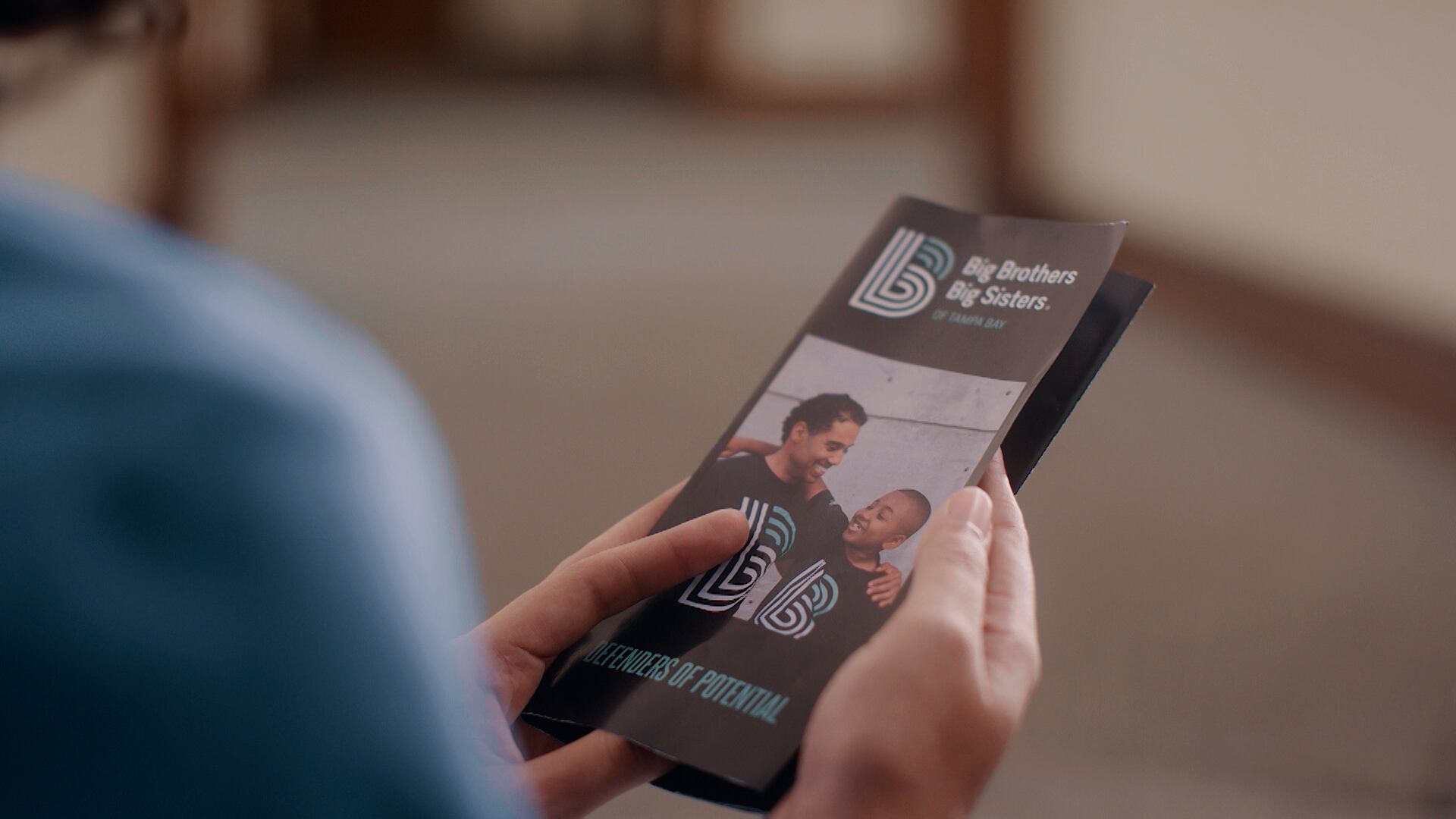
Big Brothers Big Sisters of America has been a driving force for youth mentorship since 1904. The nonprofit organization is launching its annual Big Draft campaign this month in partnership with the NFL, and Artis Stevens, the first Black CEO of Big Brothers Big Sisters of America, joined Cheddar to discuss the push for adding more "Bigs" as mentors on his one-year anniversary leading the non-profit organization. "While the NFL is recruiting and drafting more players, they're also helping us to draft more mentors and, particularly, men all the way from across February to all the way to April of this year," Stevens explained.
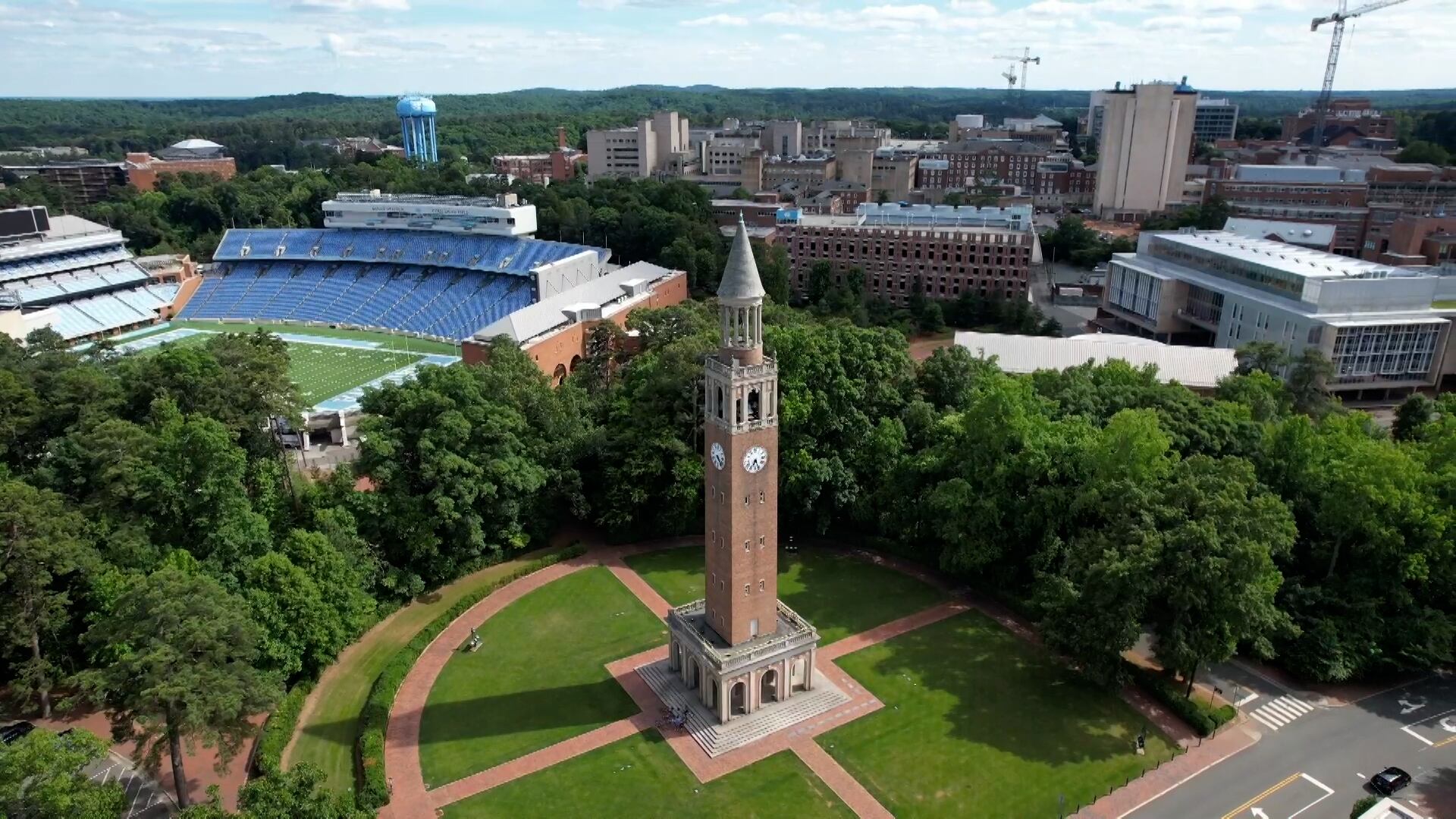
The Supreme Court will reconsider race-based affirmative action in college admissions. The court will examine admissions policies at Harvard University and The University of North Carolina Chapel Hill, which count the race of applicants as a factor in admissions. The court has upheld affirmative action policies in the past, saying it helps to create more diverse student bodies. However, the conservative Supreme Court could be skeptical and even possibly hostile to such policies. Nick Anderson, Higher Education Writer, Washington Post joined Cheddar's Opening Bell to discuss.
The value of most cryptocurrencies have plummeted in recent months since reaching all-time highs in November, wiping out more than $1 trillion in value globally. The steep crash has some talking about the possibility of a crypto winter, a term referring to a prolonged bearish period where asset prices persistently fall over many months. This all comes as the Fed is expected to raise interest rates, and the Biden administration is working on an executive order to regulate Bitcoin and other assets. Josh Goodbody, COO of Qredo, joined Cheddar's Opening Bell to discuss the crypto crash, and how the industry might recover from it.
Recent data reveals that streaming giants are struggling to retain subscribers in the months following a major release.
According to data from Antenna, subscriber trends show that users will subscribe to a given streaming service just to watch a particular show, and then cancel those subscriptions shortly after. This comes as the streaming space continues to heat up as new entrants crowd the space. Jon Christian, Founding Partner + Digital Supply Chain Leader at OnPrem joined Cheddar's Opening Bell to discuss.
The EU relaxed its Covid travel restrictions for vaccinated individuals among the union's 27 member states, doing away with testing or quarantine requirements for travelers. This comes soon after the World Health Organization said the omicron variant could help make the pandemic more manageable. The new rules take effect February 1st. Bryce Conway, Founder, 10xTravel joined Cheddar's Opening Bell to discuss.