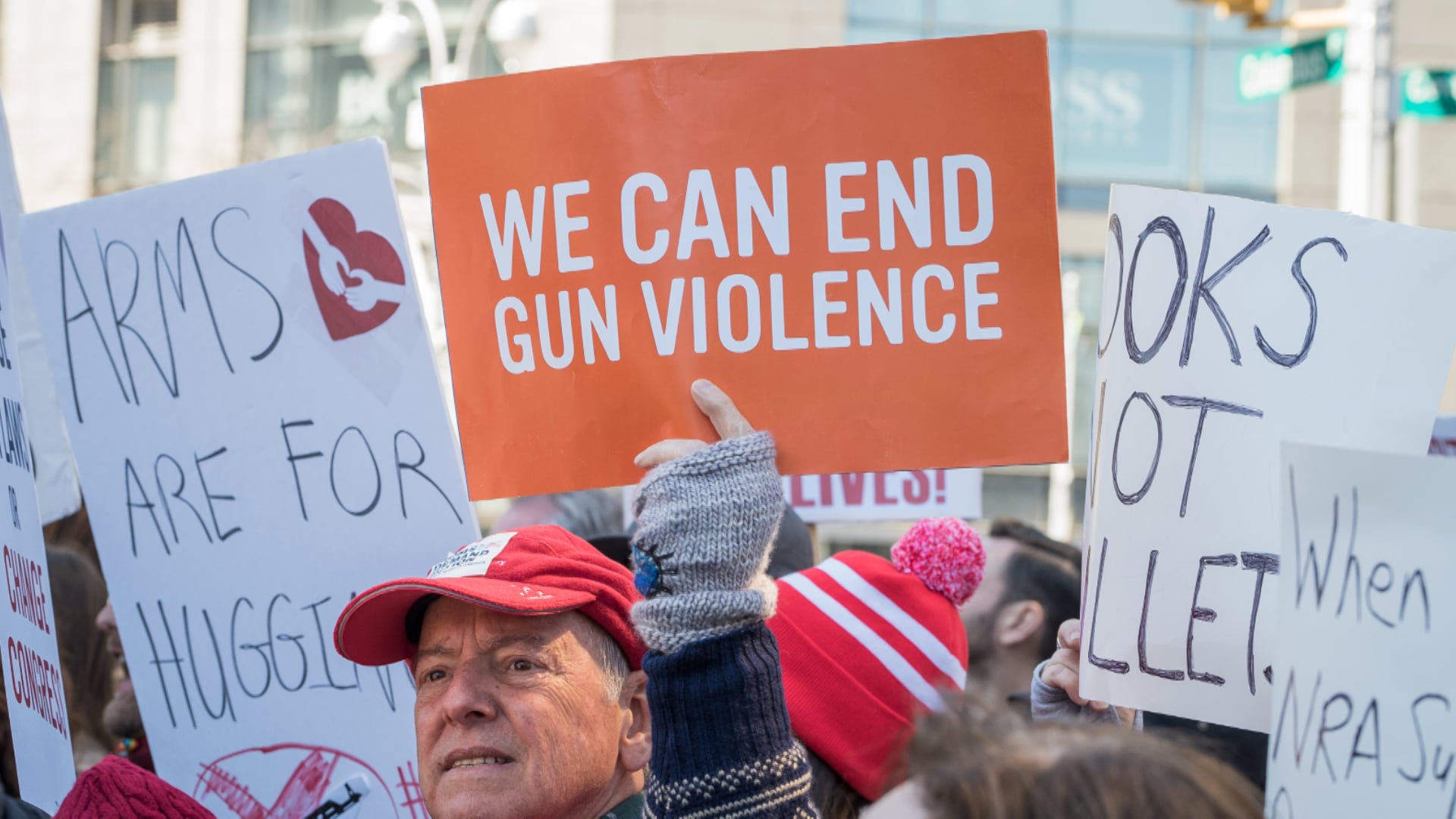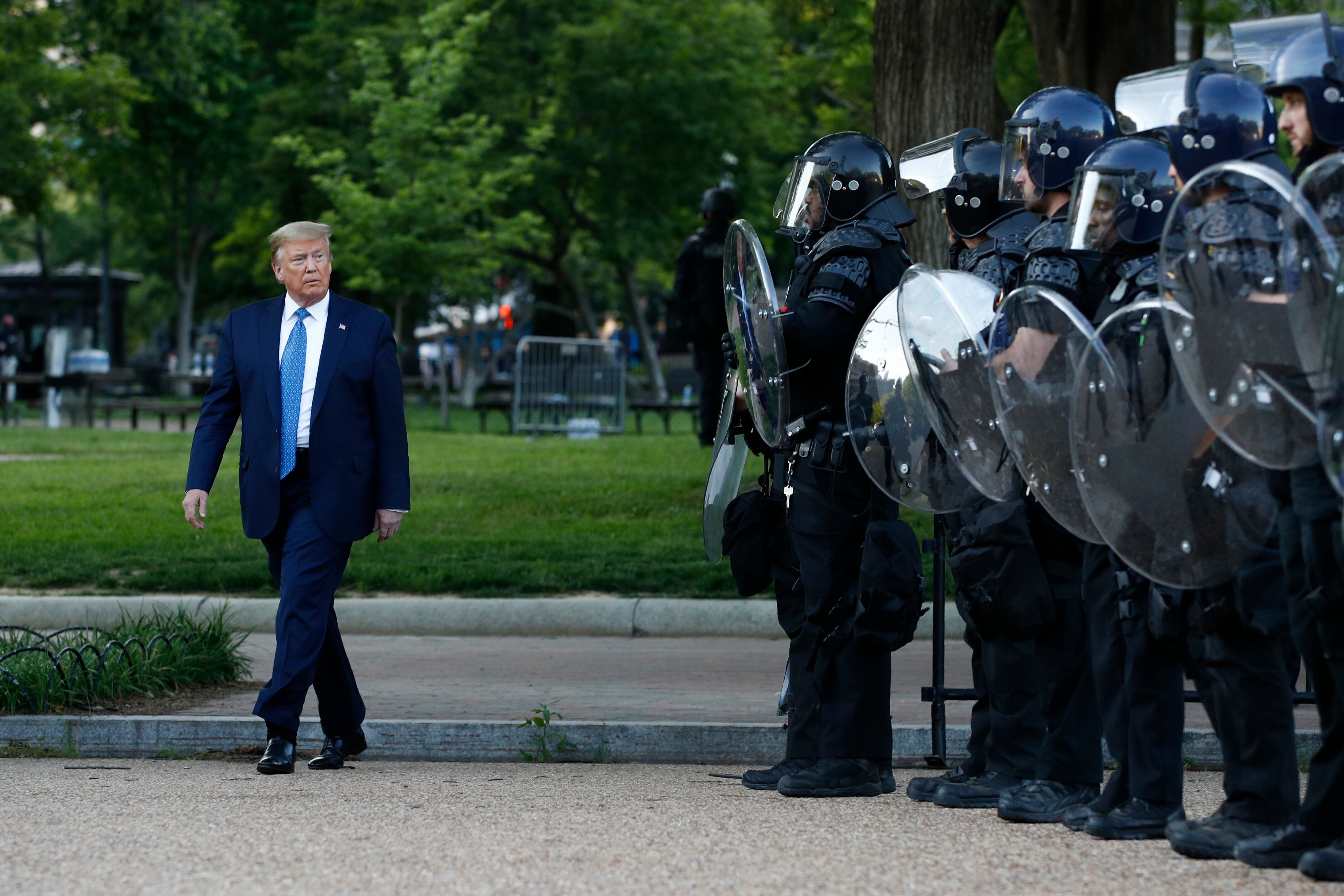
In late May, Minneapolis erupted in protests after the death of George Floyd at the hands of the police. President Trump, who called the death "sad and tragic" just a day earlier, turned on demonstrators after marches grew violent and began his alienation of the new and growing movement.
"These THUGS are dishonoring the memory of George Floyd, and I won't let that happen," he wrote on Twitter. "Any difficulty and we will assume control but, when the looting starts, the shooting starts."
Then came the tear gas.
As the president gave a speech in which he threatened cities with military intervention if they did not control the protests, police and an alphabet soup of other forces cleared protesters from Lafayette Square near the White House so the president could walk to a church for a photo-op, Bible in hand.
Since then, the president has only leaned into divisive rhetoric. Just last week, in response to a question about Black people killed at the hands of police, Trump said, "So are white people," and followed that with grievances about the Black Lives Matter movement.
Since the unrest around Floyd's death began, much has been made of how past presidents responded to civil unrest over the last century. Americans each have their own notion of what presidential leadership looks like in moments like these: maybe something like a feel-good, forward-looking speech calling us to join together or upholding the ideals of the founders and charting a path forward toward a more perfect union.
Curiosity, Compassion, Courage
Experts and scholars studying the presidency as an institution say history has shown a blueprint for how presidents can handle civil unrest and interact with social movements.
Lara Brown, a professor at the George Washington University Graduate School of Political Management, argues in her new book "Amateur Hour: Presidential Character and the Question of Leadership" that presidents have three dispositions from which they can lead: curiosity, compassion and courage.
Curiosity comes from trying to fully understand a problem, consulting experts and making a decision. Compassion comes from acknowledging the emotions in a given moment and addressing them. Courage comes from responding with forceful action.
Brown says that the most effective presidents can lead from all three frames and decide which one suits the moment at hand. But she does not believe Trump is among the presidents that can make such a switch since he relies almost solely on the "courage" aspect of her analysis.
"I do think what Trump consistently misses is the compassion piece, and other politicians are able to show that," Brown said. "And they're able to show it even with a constituency that isn't necessarily theirs. The president [showing compassion] acknowledges that the emotions need to be handled before any logical inquiry."
"Compassion is just not in [Trump's] script. Empathy is not a leadership component he is comfortable displaying."
Ability to Connect
Sid Milkis, professor of politics at the University of Virginia and author of "Rivalry and Reform: Presidents, Social Movements and the Transformation of American Politics," said that Trump is capable of at least some connection with social movements, given his relationship with his base and the Christian right. But those groups are not largely aligned with the Black Lives Matter movement and affiliated groups, which have enjoyed broader public support in recent months.
"It's not that Trump doesn't have a connection with social movements, it's just that those connections are on the other side of the political spectrum," Milkis said.
Presidents past, particularly John F. Kennedy and Lyndon B. Johnson in the 1960s, began in a similar spot to Trump now. Though not explicitly opposed to the civil rights movement, both men started the decade moving slowly on the civil rights issue.
But riots in Birmingham in 1963 spurred Kennedy to court Martin Luther King, Jr. and act more urgently on the issue. Johnson picked up the torch after his predecessor's assassination.
Milkis said presidents draw a degree of legitimacy for how they handle pushes for reform, particularly when the push has public support and a response would mean an end to the unrest.
"Presidents can be reformers. They have to maintain some sense of consensus or some sense of order in the country," Milkis said.
Social movements do not just help prop up a president, though. They also derive a certain amount of legitimacy from being recognized by the president. Milkis said the recognition from the president lends stature to the demonstrations.
But it can also be the case that an adversarial president can engender support for a movement. Milkis argues that is what we see now with Trump's opposition to Black Lives Matter.
Meaningful Policy Response
If history holds any solace for the president, it's that there is precedent for what a solution looks like: a meaningful, or at least seemingly meaningful, policy response.
During the summer of 1967, 83 people were killed during 164 protests or demonstrations that took place in the span of three months. It was the height of the so-called "ghetto riots" that had been going on for years and finally drove Johnson to establish the Kerner Commission in July.
As summer turned to fall that year, the demonstrations shrank and became less destructive. Johnson notably rejected the commission's final report in February 1968, and massive demonstrations picked up again after the death of Martin Luther King, Jr., less than two months after the report's release.
Jack Pitney, professor of politics at Claremont McKenna College, points out that these responses are not localized to Democratic presidents. President Richard Nixon ended the Vietnam War draft and began the pullout of U.S. troops in January 1973. Granted, the California Republican ran a campaign in 1968 based around "law and order" and only ended the draft after his re-election in 1972.
"Once that happened, the student demonstrations and accompanying violence effectively vanished," Pitney said.
Such a response seems unlikely now, however. While President Trump did sign an executive order in June to address some concerns of the protesters, critics decried it as inadequate and not likely to have any practical impact. Efforts by lawmakers in Congress also stalled on a potential police reform bill.
On top of that, his rhetoric and actions on the continued demonstrations have only sown more distrust among those that want to see change. President Trump announced this week he would send federal law enforcement into Chicago to help quell unrest, mirroring the actions of federal agents in Portland, Ore., who have come under scrutiny after reports emerged late last week that agents were taking protesters into custody in unmarked vehicles without identifying themselves.
"The distrust is very deep," Pitney said. "It's like the line from Star Wars, 'It's a trap!' People wouldn't trust his sincerity or depth of his commitment."
Even if he were to flip a switch and become more outwardly compassionate, or introduce some new policy response as he's claimed he would on other issues, experts say the president has fostered so much distrust over the past few months that few would see such a pivot as genuine.
"It would've been hard before, I think it's impossible now," Milkis said. "The only option he really has now is to mobilize his base."