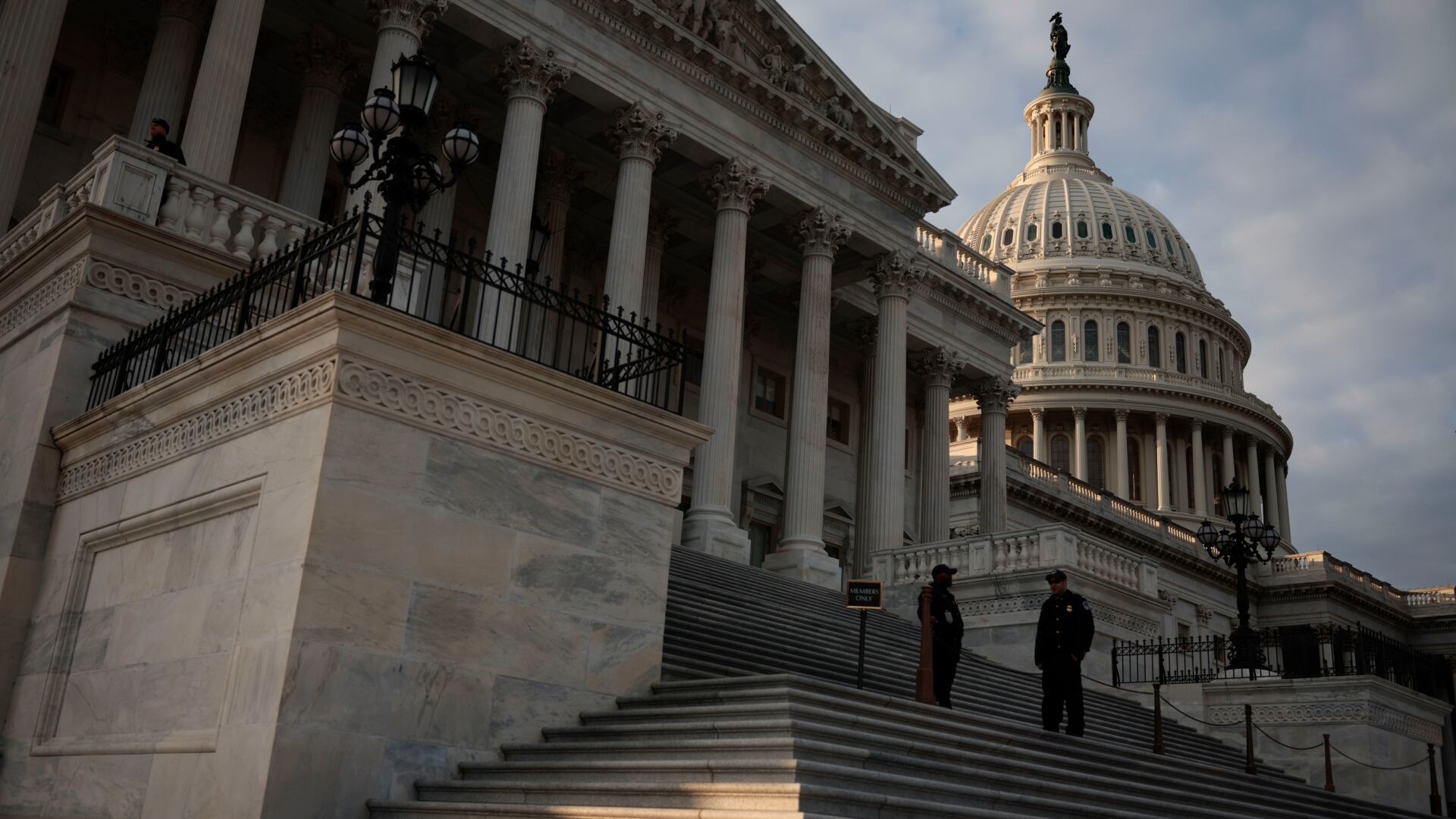
The Democratic-led House passed a bill Thursday that would enshrine LGBTQ protections in the nation's labor and civil rights laws, a top priority of President Joe Biden, though the legislation faces an uphill battle in the Senate.
The bill passed by a vote of 224-206 with three Republicans joining Democrats in voting yes.
The Equality Act amends existing civil rights law to explicitly include sexual orientation and gender identification as protected characteristics. The protections would extend to employment, housing, loan applications, education, public accommodations and other areas. Supporters say the law before the House on Thursday is long overdue and would ensure that every person is treated equally under the law.
“The LGBT community has waited long enough," said Rep. David Cicilline, D-R.I., who is gay and the bill's lead sponsor. “The time has come to extend the blessings of liberty and equality to all of Americans regardless of who they are and who they love."
Republicans broadly opposed the legislation. They echoed concerns from religious groups and social conservatives who worry the bill would force people to take actions that contradict their religious beliefs. They warned that faith-based adoption agencies seeking to place children with a married mother and father could be forced to close, or that private schools would have to hire staff whose conduct violates tenets of the school's faith.
“This is unprecedented. It's dangerous. It's an attack on our first freedom, the first freedom listed in the Bill of Rights, religious liberty," said Rep. Mike Johnson, R-La.
The House passed the Equality Act in the last Congress with unanimous Democratic support and the backing of eight Republicans, but Donald Trump's White House opposed the measure and it was not considered in the Senate, where 60 votes will be needed to overcome procedural hurdles. Democrats are trying to revive it now that they have control of Congress and the White House, but passage still appears unlikely in the evenly divided Senate.
The Supreme Court provided the LGBTQ community with a resounding victory last year in a 6-3 ruling that said the Civil Rights Act of 1964 applied to LGBTQ workers when it comes to barring discrimination on the basis of sex. Civil rights groups have encouraged Congress to follow up that decision and ensure that anti-bias protections addressing such areas as housing, public accommodations and public services are applied in all 50 states.
Biden made clear his support for the Equality Act in the lead-up to last year's election, saying it would be one of his first priorities.
Democratic Rep. Mary Gay Scanlon, D-Penn., said the Equality Act is needed to end “the patchwork of state laws” around gay rights and create “uniform nationwide protection.”
“It's been personal since my baby sister came out to me almost 40 years ago," Scanlon said. “For many people all across this country and across this House, that is when the fight hits home."
The debate among lawmakers on Capitol Hill also become personal. Rep. Marie Newman, D-Ill., whose daughter is transgender, tweeted a video of herself placing a transgender flag outside her office. Her office is across the hall from Rep. Marjorie Taylor Greene, R-Ga., who was recently blocked from serving on two committees because of past comments and tweets.
“Our neighbor, @RepMTG, tried to block the Equality Act because she believes prohibiting discrimination against trans Americans is “disgusting, immoral, and evil.” Thought we’d put up our Transgender flag so she can look at it every time she opens her door.," Newman tweeted.
Greene responded with a video of her own in which she puts up a sign that reads: “There are Two genders: MALE and FEMALE. “Trust The Science!"
“Our neighbor, @RepMarieNewman, wants to pass the so-called “Equality” Act to destroy women’s rights and religious freedoms. Thought we’d put up ours so she can look at it every time she opens her door," Greene tweeted.
House Speaker Nancy Pelosi, D-Calif., pointed to the exchange to advocate for the bill Thursday.
“It breaks my heart that it is necessary, but the fact is, and in fact we had a sad event here even this morning, demonstrating the need for us to have respect," Pelosi said, at one point pausing and taking a deep sigh. “Not even just respect, but take pride, take pride in our LGBT community."
Gay and lesbian members of Congress spoke about how meaningful the bill is for them.
“Look, we're not asking for anything that any other American doesn't already enjoy," said Rep. Chris Pappas, D-N.H. “We just want to be treated the same. We just want politicians in Washington to catch up with the times and the Constitution."
Leaders at the U.S. Conference of Catholic Bishops wrote lawmakers this week to say they had grave concerns about the bill. Among the concerns they raised is that the bill would expand the government's definition of public places, forcing church halls and equivalent facilities to host functions that violate their beliefs, which could lead to closing their doors to the broader community.
Republicans cited an array of consequences they said could occur if the bill passed into law, from eliminating the existing ban on the use of government funds for abortion, to allowing transgender people into women's shelters and transgender youth into girls sports. Democrats likened the effort to past civil rights battles in the nation's history.
Cicillini challenged Republicans, “I hope you will bear in mind how your vote will be remembered years from now."
Some of the nation's largest corporations are part of a coalition in support of the legislation, including Apple Inc., AT&T, Chevron and 3M Co., just to name a few of the hundreds of companies that have endorsed it.