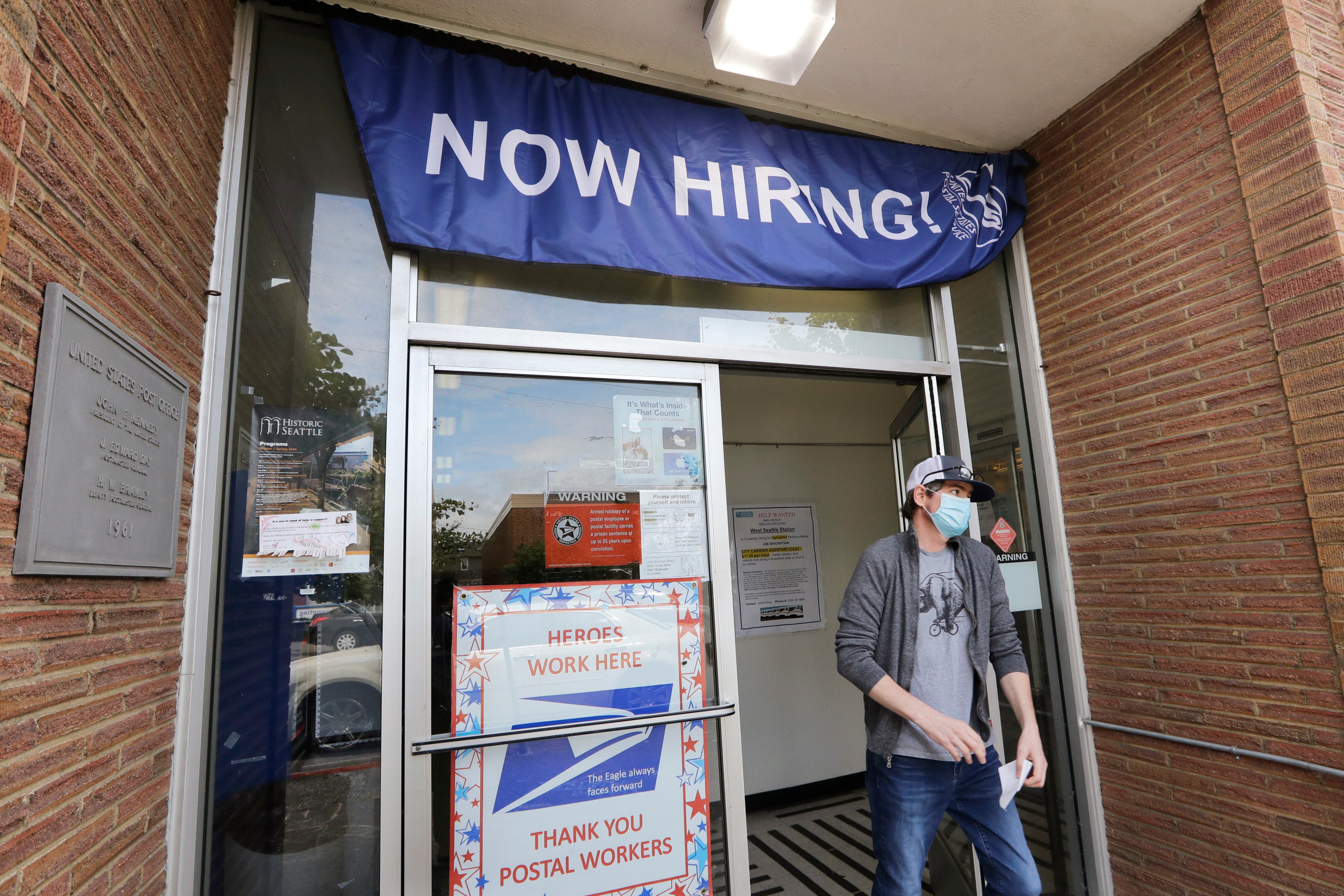
In this Thursday, June 4, 2020 file photo, a customer walks out of a U.S. Post Office branch and under a banner advertising a job opening, in Seattle. The job market took a big step toward healing in May 2020, though plenty of damage remains, as a record level of hiring followed record layoffs in March and April. The Labor Department reported Tuesday, July 7, 2020 that the number of available jobs rose sharply as well, but remained far below pre-pandemic levels. (AP Photo/Elaine Thompson, File)
By Christopher Rugaber
The job market took a big step toward healing in May, though plenty of damage remains, as a record level of hiring followed record layoffs in March and April.
The Labor Department reported Tuesday that the number of available jobs rose sharply as well, but remained far below pre-pandemic levels.
The figures, from the government's Job Openings and Labor Turnover Survey, or JOLTS, illustrate the whiplash the economy has experienced since the pandemic intensified in mid-March. Layoffs soared in March to a stunning 11.5 million, roughly four times the peak during the 2008-2009 recession. They remained extraordinarily high in April, at 7.7 million, but in May they fell back to pre-pandemic levels of 1.8 million.
Hiring, meanwhile, plunged in April to 4 million, the lowest level since 2011, but jumped to 6.5 million in May. While that is the most hires on records dating back to 2000, it wasn't nearly enough to offset the roughly 19 million layoffs in March and April.
And whatever ground has been recaptured to this point is now being imperiled by a resurgence of COVID-19 cases throughout the South and West. Despite a solid rebound in employment, the job market remains badly damaged, both by mandatory lockdowns and the reluctance of people to again visit restaurants, theaters, or to travel freely, at least until a vaccine or an effective treatment for the virus is available.
The JOLTS report provides gross totals of hiring and layoffs, while the monthly jobs report, which also includes the unemployment rate, is a net figure of total jobs gained or lost.
On Thursday, the jobs report showed that employers added a net total of 4.8 million jobs in June, after a gain of 2.7 million in May. Even those huge net gains recaptured only one-third of the jobs lost in March and April and the unemployment rate is 11.1 percent, down from its April and May levels but otherwise higher than at any time since the Depression.
Employers advertised 5.4 million jobs in May, about 10 percent higher than in April, but still below pre-pandemic levels of about 7 million.
At 100 years old, the Goodyear Blimp is an ageless star in the sky. The 246-foot-long airship will be in the background of the Daytona 500 — flying roughly 1,500 feet above Daytona International Speedway, actually — to celebrate its greatest anniversary tour. Even though remote camera technologies are improving regularly and changing the landscape of aerial footage, the blimp continues to carve out a niche. At Daytona, with the usual 40-car field racing around a 2½-mile superspeedway, views from the blimp aptly provide the scope of the event.
You'll just have to wait for interest rates (and prices) to go down. Plus, this deal's a steel, the big carmaker wedding is off, and bribery is back, baby!
It’s a chicken-and-egg problem: Restaurants are struggling with record-high U.S. egg prices, but their omelets, scrambles and huevos rancheros may be part of the problem. Breakfast is booming at U.S. eateries. First Watch, a restaurant chain that serves breakfast, brunch and lunch, nearly quadrupled its locations over the past decade to 570. Fast-food chains like Starbucks and Wendy's added more egg-filled breakfast items. In normal times, egg producers could meet the demand. But a bird flu outbreak that has forced them to slaughter their flocks is making supplies scarcer and pushing up prices. Some restaurants like Waffle House have added a surcharge to offset their costs.
William Falcon, CEO and Founder of Lightning AI, discusses the ongoing feud between Elon Musk and Sam Altman, and how everyday people can use AI in their lives.
U.S. tariffs on steel and aluminum “will not go unanswered,” European Union chief Ursula von der Leyen vowed on Tuesday, adding that they will trigger toug
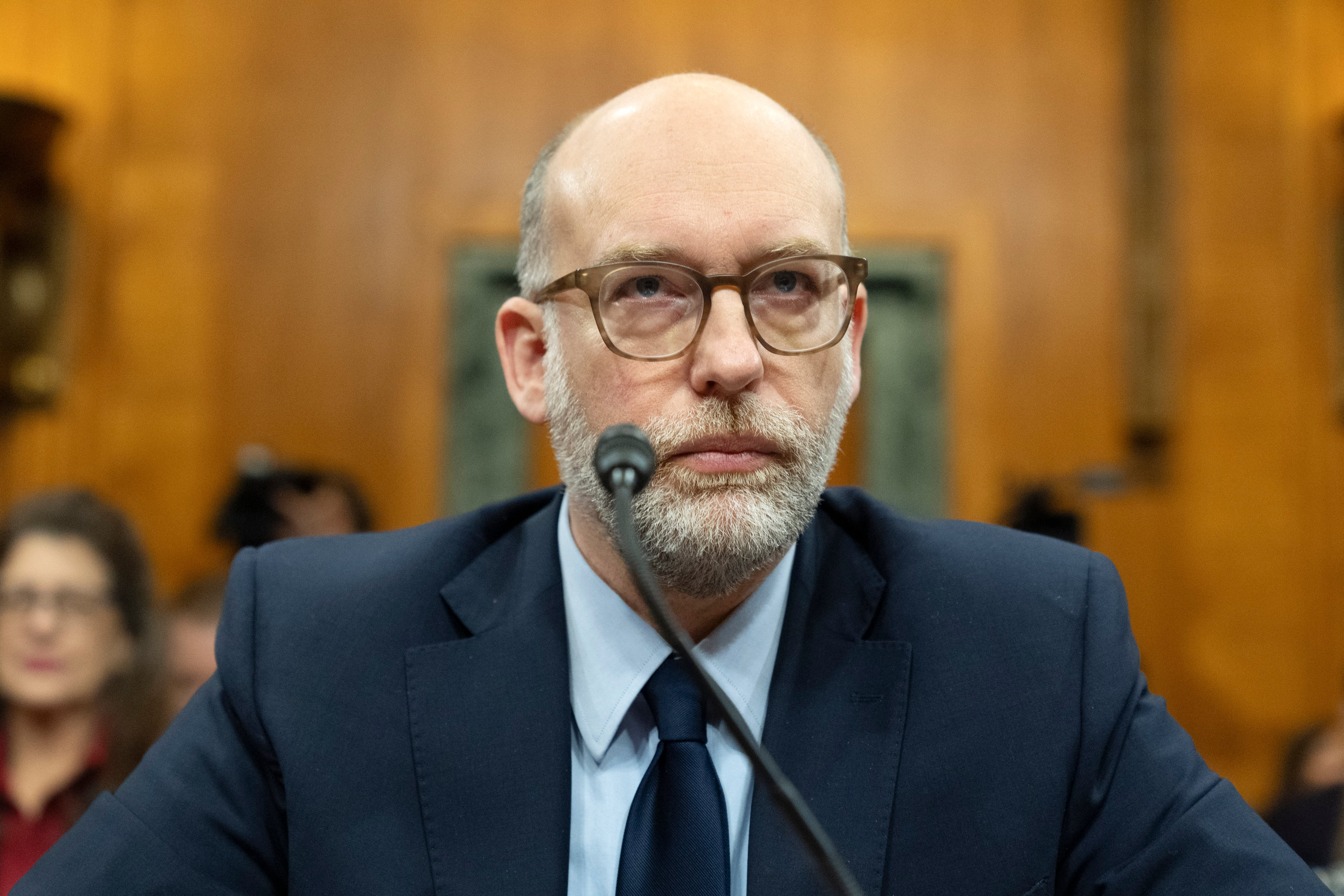
The Trump administration has ordered the Consumer Financial Protection Bureau to stop nearly all its work, effectively shutting down the agency that was created to protect consumers after the 2008 financial crisis and subprime mortgage-lending scandal. Russell Vought is the newly installed director of the Office of Management and Budget. Vought directed the CFPB in a Saturday night email to stop work on proposed rules, to suspend the effective dates on any rules that were finalized but not yet effective, and to stop investigative work and not begin any new investigations. The agency has been a target of conservatives since President Barack Obama created it following the 2007-2008 financial crisis.