By Marcia Dunn
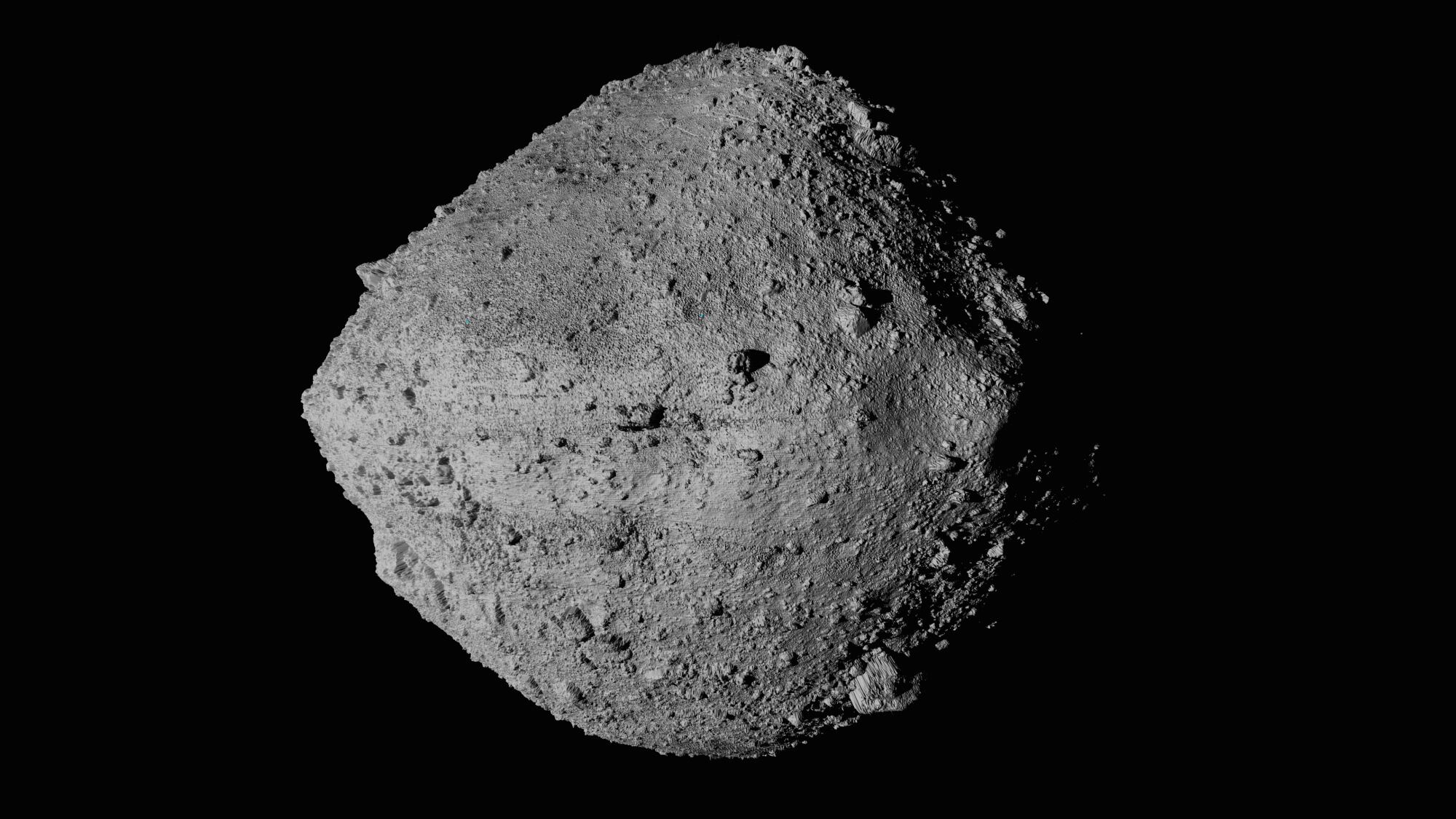
The good news is that scientists have a better handle on asteroid Bennu’s whereabouts for the next 200 years. The bad news is that the space rock has a slightly greater chance of clobbering Earth than previously thought.
But don’t be alarmed: Scientists reported Wednesday that the odds are still quite low that Bennu will hit us in the next century.
“We shouldn't be worried about it too much,” said Davide Farnocchia, a scientist with NASA's Center for Near Earth Object Studies at the Jet Propulsion Laboratory in Pasadena, California, who served as the study's lead author.
While the odds of a strike have risen from 1-in-2,700 to 1-in-1,750 over the next century or two, scientists now have a much better idea of Bennu's path thanks to NASA's Osiris-Rex spacecraft, according to Farnocchia.
“So I think that overall, the situation has improved," he told reporters.
The spacecraft is headed back to Earth on a long, roundabout loop after collecting samples from the large, spinning rubble pile of an asteroid, considered one of the two most hazardous known asteroids in our solar system. The samples are due here in 2023.
Before Osiris-Rex arrived at Bennu in 2018, telescopes provided solid insight into the asteroid, about one-third of a mile (one-half kilometer) in diameter. The spacecraft collected enough data over 2 1/2 years to help scientists better predict the asteroid’s orbital path well into the future.
Their findings — published in the journal Icarus — should also help in charting the course of other asteroids and give Earth a better fighting chance if and when another hazardous space rock heads our way.
Before Osiris-Rex arrived on the scene, scientists put the odds of Bennu hitting Earth through the year 2200 at 1-in-2,700. Now it's 1-in-1,750 through the year 2300. The single most menacing day is Sept. 24, 2182.
Bennu will have a close encounter with Earth in 2135 when it passes within half the distance of the moon. Earth's gravity could tweak its future path and put it on a collision course with Earth in the 2200s — less likely now based on Osiris-Rex observations.
If Bennu did slam into Earth, it wouldn’t wipe out life, dinosaur-style, but rather create a crater roughly 10 to 20 times the size of the asteroid, said Lindley Johnson, NASA's planetary defense officer. The area of devastation would be much bigger: as much as 100 times the size of the crater.
If an object Bennu’s size hit the Eastern Seaboard, it “would pretty much devastate things up and down the coast," he told reporters.
Scientists already are ahead of the curve with Bennu, which was discovered in 1999. Finding threatening asteroids in advance increases the chances and options for pushing them out of our way, Johnson said.
“One-hundred years from now, who knows what the technology is going to be?” he said.
In November, NASA plans to launch a mission to knock an asteroid off-course by hitting it. The experimental target will be the moonlet of a bigger space rock.
___
The Associated Press Health and Science Department receives support from the Howard Hughes Medical Institute’s Department of Science Education. The AP is solely responsible for all content.