By Jennifer Sinco Kelleher and Mark Thiessen
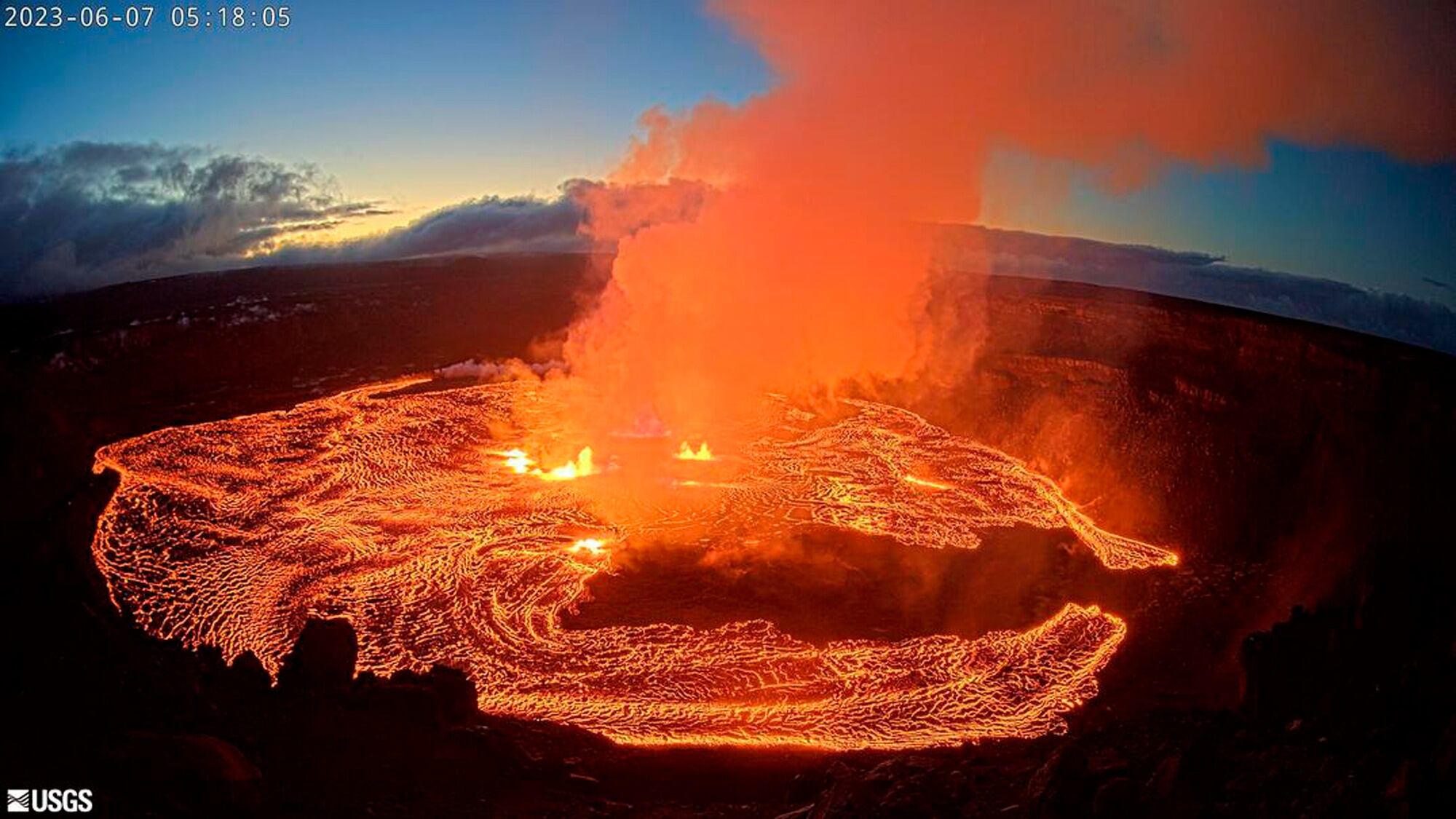
Kilauea, one of the most active volcanoes in the world, began erupting on Wednesday after a three-month pause, displaying spectacular fountains of mesmerizing, glowing lava that's a safe distance from people and structures in a national park on the Big Island.
The U.S. Geological Survey's Hawaiian Volcano Observatory said in a statement that a glow was detected in webcam images from Kilauea’s summit early in the morning, indicating that an eruption was occurring within the Halemaumau crater in the summit caldera.
The images show fissures at the base of the crater generating lava flows on the crater floor's surface, the observatory said.
Before issuing the eruption notice, the observatory said increased earthquake activity and changes in the patterns of ground deformation at the summit started Tuesday night, indicating the movement of magma in the subsurface.
“We’re not seeing any signs of activity out on the rift zones right now,” said Mike Zoeller, a geologist with the observatory. “There’s no reason to expect this to transition into a rift eruption that would threaten any communities here on the island with lava flows or anything like that.”
All activity was within a closed area of Hawaii Volcanoes National Park.
“The lava this morning is all confined within ... the summit caldera. So plenty of room for it still to produce more without threatening any homes or infrastructure,” said park spokesperson Jessica Ferracane. “So that’s the way we like our eruptions here.”
She said park officials are bracing for crowds to arrive because visitors can see the eruption from many overlooks.
“Kilauea overlook was spectacular this morning," she said of the vast lava lake. “It was molten red lava. There’s several areas of pretty robust fountaining. It’s just really, really pretty.”
The lava lake, covering the crater floor over lava that remained from previous eruptions, measured at about 371 acres (150 hectares) at about 6 a.m., Zoeller said. It measured about 4,300 feet (1,300 meters) wide.
Word was getting out and parking lots were starting to fill up at the park, she said, adding that she expected long lines getting into the park by evening.
Since the park is open 24 hours a day, visitors can beat the crowds by visiting between 9 p.m. and sunrise, Ferracane said.
She reminded visitors to stay out of closed areas and remain on marked trails for safety reasons, including avoiding gases from the eruption.
Two small earthquakes jolted Janice Wei, who lives in nearby town of Volcano. As a volunteer photographer for the park, she was able to see fountains she estimated to be 150 feet (46 meters) high at around 4:30 a.m.
She said she saw about 15 fountains, which were dying down by mid-morning.
The volcano’s alert level was raised to warning status and the aviation color code went to red as scientists evaluate the eruption and associated hazards.
Kilauea, Hawaii's second-largest volcano, erupted from September 2021 until last December. For about two weeks in December, Hawaii’s biggest volcano, Mauna Loa, also was erupting on Hawaii’s Big Island.
After a short pause, Kilauea began erupting again in January. That eruption lasted for 61 days, ending in March.
This eruption is looking very similar, Zoeller said: “This eruption is following a very similar playbook to the last three that we’ve seen here since 2020.”
A 2018 Kilauea eruption destroyed more than 700 homes.
Before the major 2018 eruption, Kilauea had been erupting since 1983, and streams of lava occasionally covered farms and homes. During that time, the lava sometimes reached the ocean, causing dramatic interactions with the water.
Thiessen reported from Anchorage, Alaska.