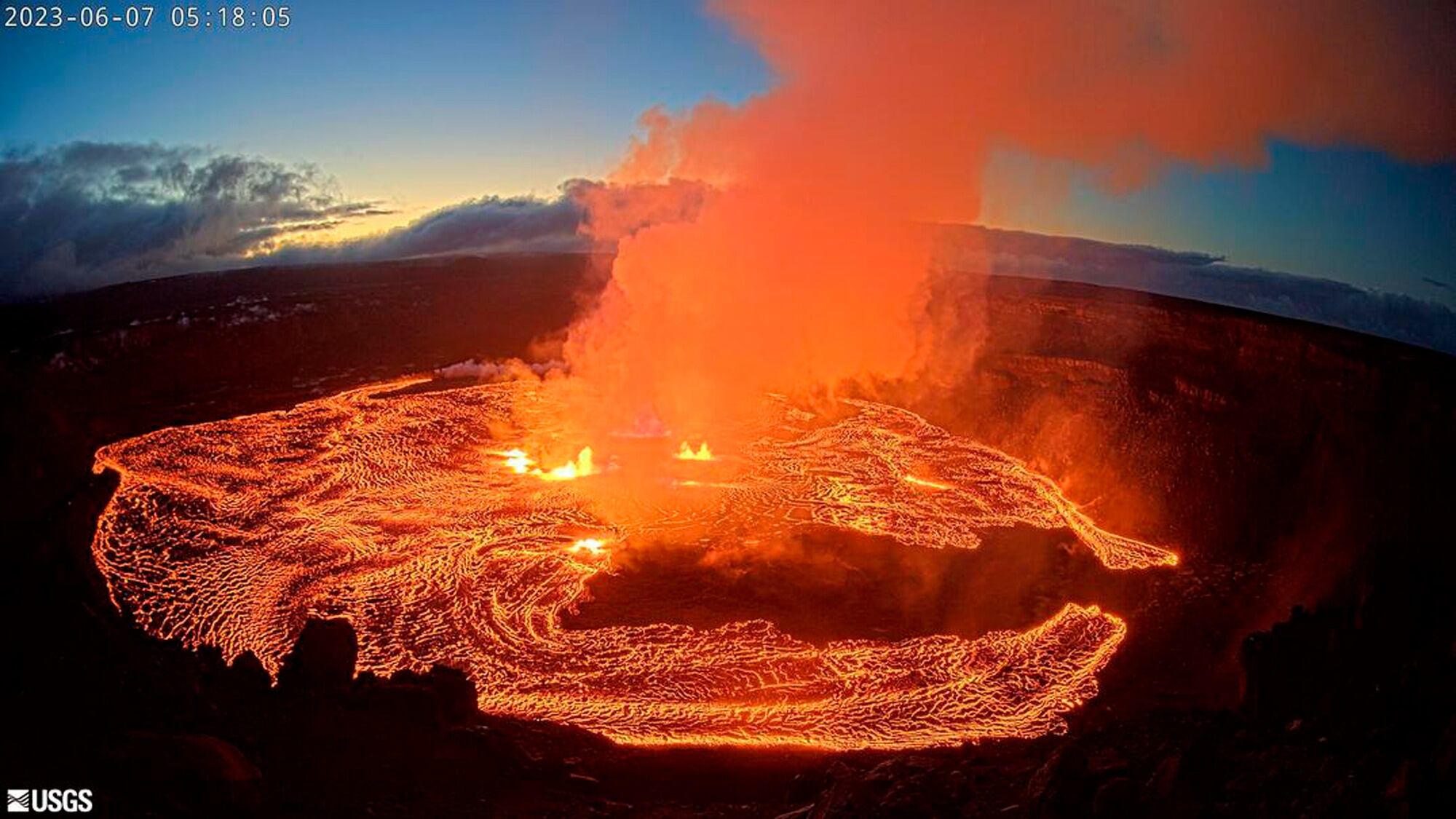
In this webcam image provided by the U.S. Geological Survey, an eruption takes place on the summit of the Kilauea volcano in Hawaii, Wednesday, June 7, 2023. (U.S. Geological Survey via AP)
By Jennifer Sinco Kelleher and Mark Thiessen
Kilauea, one of the most active volcanoes in the world, began erupting on Wednesday after a three-month pause, displaying spectacular fountains of mesmerizing, glowing lava that's a safe distance from people and structures in a national park on the Big Island.
The U.S. Geological Survey's Hawaiian Volcano Observatory said in a statement that a glow was detected in webcam images from Kilauea’s summit early in the morning, indicating that an eruption was occurring within the Halemaumau crater in the summit caldera.
The images show fissures at the base of the crater generating lava flows on the crater floor's surface, the observatory said.
Before issuing the eruption notice, the observatory said increased earthquake activity and changes in the patterns of ground deformation at the summit started Tuesday night, indicating the movement of magma in the subsurface.
“We’re not seeing any signs of activity out on the rift zones right now,” said Mike Zoeller, a geologist with the observatory. “There’s no reason to expect this to transition into a rift eruption that would threaten any communities here on the island with lava flows or anything like that.”
All activity was within a closed area of Hawaii Volcanoes National Park.
“The lava this morning is all confined within ... the summit caldera. So plenty of room for it still to produce more without threatening any homes or infrastructure,” said park spokesperson Jessica Ferracane. “So that’s the way we like our eruptions here.”
She said park officials are bracing for crowds to arrive because visitors can see the eruption from many overlooks.
“Kilauea overlook was spectacular this morning," she said of the vast lava lake. “It was molten red lava. There’s several areas of pretty robust fountaining. It’s just really, really pretty.”
The lava lake, covering the crater floor over lava that remained from previous eruptions, measured at about 371 acres (150 hectares) at about 6 a.m., Zoeller said. It measured about 4,300 feet (1,300 meters) wide.
Word was getting out and parking lots were starting to fill up at the park, she said, adding that she expected long lines getting into the park by evening.
Since the park is open 24 hours a day, visitors can beat the crowds by visiting between 9 p.m. and sunrise, Ferracane said.
She reminded visitors to stay out of closed areas and remain on marked trails for safety reasons, including avoiding gases from the eruption.
Two small earthquakes jolted Janice Wei, who lives in nearby town of Volcano. As a volunteer photographer for the park, she was able to see fountains she estimated to be 150 feet (46 meters) high at around 4:30 a.m.
She said she saw about 15 fountains, which were dying down by mid-morning.
The volcano’s alert level was raised to warning status and the aviation color code went to red as scientists evaluate the eruption and associated hazards.
Kilauea, Hawaii's second-largest volcano, erupted from September 2021 until last December. For about two weeks in December, Hawaii’s biggest volcano, Mauna Loa, also was erupting on Hawaii’s Big Island.
This eruption is looking very similar, Zoeller said: “This eruption is following a very similar playbook to the last three that we’ve seen here since 2020.”
A 2018 Kilauea eruption destroyed more than 700 homes.
Before the major 2018 eruption, Kilauea had been erupting since 1983, and streams of lava occasionally covered farms and homes. During that time, the lava sometimes reached the ocean, causing dramatic interactions with the water.
On this episode of Cheddar Innovates, Peggy Whitson, Director of Human Space Flight, Axiom Space, breaks down Axiom's involvement in the first fully-private mission to the ISS, and her experience spending 665 days in space; William Li and Danielle Chang, co-founders of The Hao Life, discuss how they're shaking up the $71 billion supplement industry by putting a modern spin on traditional natural Chinese remedies; Cheddar gets a look at Curiosity Stream's 'Sagrada Familia: Gaudi's Challenge.'
On this episode of Cheddar Innovates: President of The Pillow Bar breaks down how everyone can benefit from a pillow customized to their unique way of sleeping; CEO of H2Pro explains how to bring environmentally friendly hydrogen to scale; Cheddar gets a look at Curiosity Stream's 'Suppressed Science.'
On this episode of Cheddar Innovates: Gardenuity CEO breaks down how gardening can improve your wellbeing; Augmedix CEO discusses how this technology is helping doctors fight burnout; Cheddar gets a look at Curiosity Stream's 'Suppressed Science.'
On this episode of Cheddar Innovates: Atom Limbs CEO breaks down how the Atom Touch prosthetic is different from other prosthetics on the market; CEO & Chief Scientific Officer of MyMD explains how the MYMD-1 is on track to be the first FDA-approved drug to treat aging and age-related diseases; A look at Curiosity Stream's 'The Future of Warfare.'
On this episode of Cheddar Innovates: SkilsVR CEO explains how virtual reality is being used to train frontline workers to handle difficult customers; Rubicon CEO breaks down how technology and sustainability will go hand in hand in the future; Cheddar gets a look at 'Our Infinite Universe.'
A UN report is warning that relying on seawalls and other engineering fixes will not be enough to keep communities safe from rising sea levels and climate change consequences. Dr. Steve Rose, a senior research economist at the Electric Power Research Institute, joins Cheddar News to discuss.
As gas prices surge amid the Russian invasion of Ukraine, other nations could potentially transition faster to using clean energy than previously expected. Philip K. Verleger, a senior fellow at the Niskanen Center, joined Cheddar News to explain how this could be a possibility in the near future. "Part of the reason I think we have this invasion and the tantrum that's being thrown by Russia, terrible tantrum, is because the Russians were trying to slow down the transition," he said. "Ironically they speeded it up."
As Russia intensifies its war on Ukraine, President Biden announced a ban on oil imported from the aggressor nation. Critics of Russia have said this would be the best way to force Putin to pull back, but curbs on Russian oil exports are expected to send already skyrocketing oil and gas prices even higher, further impacting consumers, businesses, financial markets, and the global economy. Leslie Beyer, CEO of the Energy Workforce and Technology Council, joined Cheddar News' Closing Bell to discuss. "It's certainly going to increase pricing, but it is the right thing to do," she said. "The industry itself has already pulled out of the significant portion of its operations in Russia."
On this episode of Cheddar Innovates: Vision Marine Technologies CEO discusses how e-boats will play a role in the fight against the climate crisis; Lasso CEO breaks down how the design behind these compression socks can prevent injuries and improve performance; Cheddar gets a look at Curiosity Stream's 'The Tombs Of Egypt.'
Vaccine maker Pfizer delayed its COVID shot for kids allegedly due to a lack of data on how it would perform against the omnicron variant, according to the Wall Street Journa. Peter Pitts, professor and founder of the Center for Medicine in the Public Interest and a former FDA associate commissioner, joined Cheddar News Wrap to break down why the authorization can't be rushed. "Going forward, the FDA wants to look at data specifically against omicron, and it looks like that's going to be a three-shot regimen versus two, which was efficient against delta but not omicron because obviously omicron is more infectious," said Pitts.