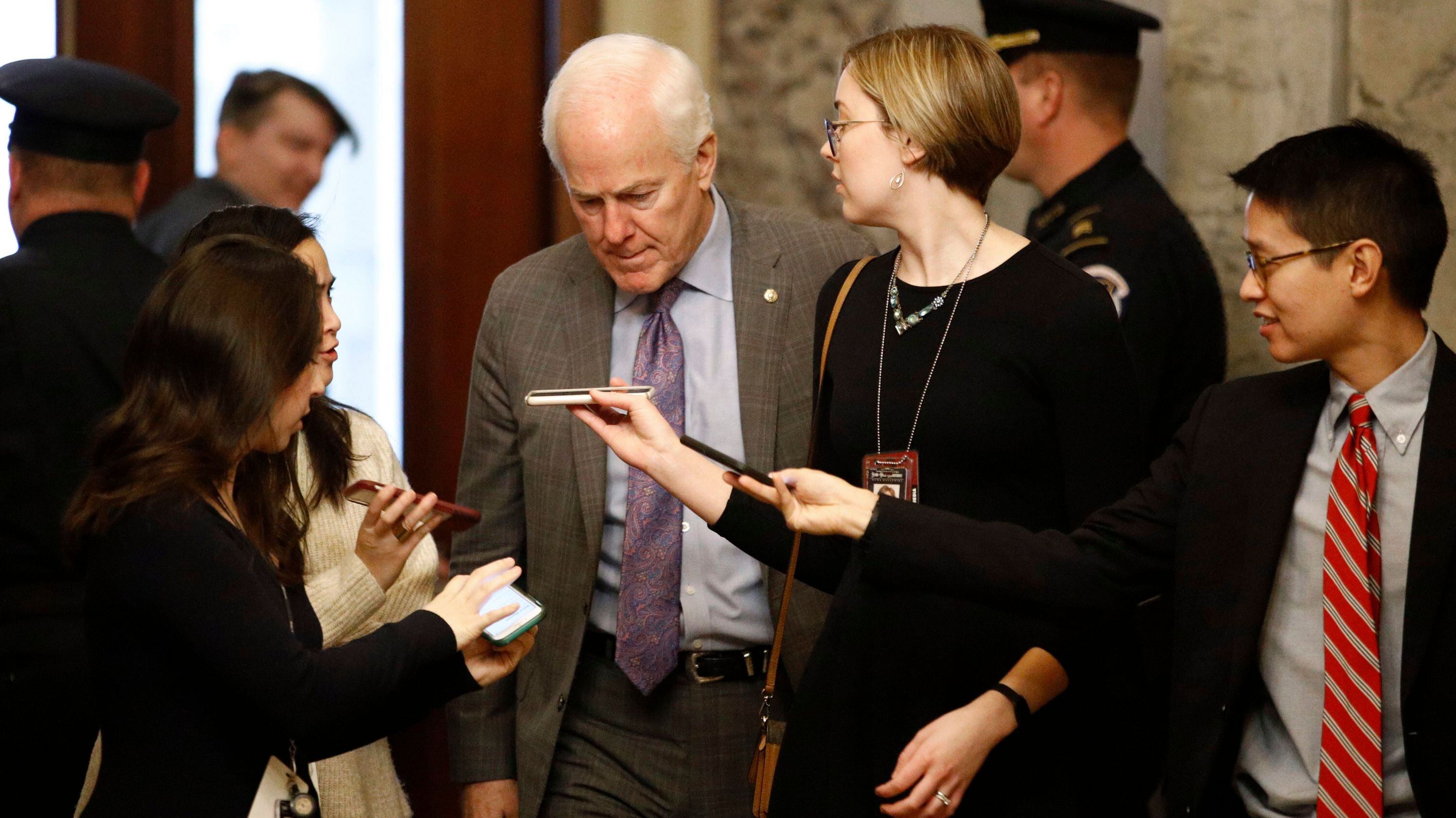
As day six of the impeachment trial headed into the evening hours, Republican Senator John Cornyn of Texas told Cheddar his experience as a judge and lawyer tells him "in every trial, there are sort of twists and turns, things we can't expect to be answered instantaneously, but will be answered by the time the trial will come to an end."
"I expect to give both sides an opportunity to put this in context. We don't even know what this book says," he said, referencing a book written by ex-national security advisor John Bolton. So far, President Trump's lawyers had yet to bring up Bolton's book in today's session, the manuscript of which was leaked over the weekend and left Republican senators reportedly "blindsided."
Sen. Cornyn added that though he believes The New York Times is biased against the Trump administration, he "frankly would like to see the book itself, but I'm sure the parties will have a chance to answer that." Bolton denied that he, his publisher, or his literary agent coordinated with the Times.
The president's defense team, which had 22 hours left in the trial schedule at the start of today's session, focused on what they described as the threat of the increased use of impeachment, questions of due process, and the ability of the president to withhold information from Congress through executive privilege. Across the way, the White House reportedly prepared for a split in the party that could lead to a request for testimony from Bolton.
Republicans did not bring Bolton up in the first five hours of the day. Defense lawyer Jane Raskin did spend time on the president's personal lawyer Rudy Giuliani and warned senators not to be "distracted" by how Democrats portrayed his involvement.
Executive privilege was brought up continuously throughout the afternoon as defense lawyers underscored the president's reasoning for barring aides from testifying in the name of "immunity."
At times, Senators appeared inattentive through the early portions of the day's sessions. Democratic Senators Bernie Sanders of Vermont and Cory Booker of New Jersey had their hands clasped under their chins for much of the time.
Some remained engaged throughout the session, such as Senator Amy Klobuchar of Minnesota, who, at one point, asked her neighbor Senator Chris Coons of Connecticut for what looked like a pocket copy of the U.S. Constitution, which she read from as the former independent counsel who investigated President Bill Clinton, Ken Starr, read from the preamble of the document. Most senators at the center of the debate for adding witnesses took down pages of notes, like Republican Senators Lisa Murkowski of Alaska and Susan Collins of Maine.
As the day wore on, the White House defense team focused on Hunter Biden, whose work in Ukraine was central to Trump's fateful July phone call with Ukraine President Volodymyr Zelensky.
But the reverberations from the John Bolton manuscript remained the day's main storyline with two Republican Senators, Mitt Romney and Susan Collins, saying that the disclosures could spur other Republicans to seek new evidence and hear witnesses, like Bolton.
If that happens, the fast acquittal that Donald Trump was hoping for will be much slower to arrive, and the president could face the prospect of delivering the State of the Union address with the threat of a trial still hanging over his head.
President Biden is looking at unlikely partners to buy oil, after banning all Russian energy imports. Among them is Venezuela, a regime that has been sanctioned by the U.S. since 2019. Ariel Cohen of the Atlantic Council explains to Cheddar News why that might not be a bad choice.
Stock trading app Robinhood already has been offering cryptocurrency investments but seems further excited about the asset class following President Biden's recent announcement of an executive order. Dan Gallagher, the chief legal and corporate affairs officer for Robinhood, joined Cheddar News to talk about the White House's tentative vision for digital currency. "I think this executive order firmly states that, yes, crypto is here to stay, which it talks about the important competitive issues around crypto and how the United States needs to be a leader, a global leader, in innovation and technology regarding crypto," he said. Gallagher also discussed having clarity around meme stocks going forward but worried about overregulation slowing down innovation.
As Russia’s attack on Ukraine, the latest inflation report showed the consumer price index rose 7.9 percent — a 40-year high. Heather Boushey, a member of the White House Council of Economic Advisers, joined Cheddar News to discuss what American consumers might be in store for as prices keep rising. "Forecasters at this point believe that the American economy will be resilient," she said. "They’re still predicting that the unemployment rate will continue to be lower at the end of the year than it is today, and we are still seeing folks believe that over time prices will come back down." Boushey did note that it would be dependent on how long the current situation lasts.
Simon Shuster, TIME's Moscow correspondent joins Cheddar to discuss how Ukraine could become part of the EU and what it would mean for politics in Europe.
President Biden has banned imports of Russian oil to the U.S. in retaliation for its invasion of Ukraine. The president warned of higher prices at the gas pump, leading some analysts to think it could propel the transition to clean, renewable energy. Michael Jones, chairman and CEO of investment solutions company Caravel Concepts, discussed how the ban is hitting green energy stocks as gas prices continue to surge. "I think the 10-year prospects for renewables just got a whole lot better because ultimately this is going to force a transition into renewables," he said.
Amid ongoing tensions in the Russia-Ukraine region, many American travelers are nervous about traveling to Europe.
It comes at a time when international travel was set to make a comeback, but uncertainty surrounding the conflict may delay the overall recovery. Francesca Page, Travel Expert, joined Cheddar's Opening Bell to discuss.
Russia's invasion of Ukraine is coming for the global food supply. Ongoing tensions in the region are threatening the supply of various agricultural products including wheat, barley and corn. Vladik Rikhter, CEO & Cofounder of Zenput joined Cheddar's Opening Bell to discuss how this could impact food prices overseas.
Chris Natividad, CIO of EquBot, joins Cheddar News' Closing Bell, where he elaborates on what ultimately dragged the Dow, S&P, and Nasdaq lower on Tuesday and discusses how investors are reacting to rising oil prices and February CPI data coming out later this week.