GOP Faces Existential Problem: How to Court Millennials Who Dislike Trump
*By Carlo Versano*
Millennials now comprise the largest voting bloc in the country, and the [majority](http://www.pewsocialtrends.org/2019/01/17/generation-z-looks-a-lot-like-millennials-on-key-social-and-political-issues/) of them do not approve of the sitting president.
That poses a problem for the GOP as it seeks to broaden its tent in anticipation of a future when Donald Trump is not on the ballot.
Trump's political calculus to appeal to his base ー an older, whiter, more conservative demographic ー is coming at the expense of his popularity among millennials, said Kristen Soltis Anderson, a Republican pollster and author of "The Selfie Vote: Where Millennials Are Leading America."
But Republicans' struggles to court younger voters predate Trump, and stem from the party being misaligned with younger generations on many cultural or social issues, Anderson said.
For millennials, who may already have been predisposed to favor more socially liberal candidates, the financial crisis became the defining moment that shaped their political ideologies, and many who lived through that event are now more open to the idea of big government and its role as problem-solver and regulator. That is in direct conflict with the long-held message of the GOP: the private sector solves the country's problems and creates wealth.
The irony, as Anderson noted, is that Trump could have been a president behind whom millennials could rally. His background as a non-ideological figure who once held some socially liberal views and came to Washington to shake things up may very well have scored him points with millennial voters, she said. "That kind of disruption could have been appealing to young people."
Instead, Trump took the opposite tack, making a hard right into divisive tribalism that does not appeal to such a diverse generation.
"Millennials like that America has become more diverse," Anderson said. "They're not afraid of social change."
To be fair, Trump's political strategy speaks to a larger problem for Republicans and Democrats alike in wooing moderate voters: the two-party primary system is built in such a way that any successful candidate has to play to the party's base in order to secure the nomination. That base is typically older and more set in its ways ー not leaving a lot of room for a message that would resonate with younger generations.
Anderson believes the GOP still has an opportunity to build a brand as the savvy, tech-forward party making government more efficient and accountable in an era when the internet has made speed, efficiency, and accountability qualities that voters value. But it is not a message that the Trump administration appears interested in advancing.
"That may be a Republican Party of days gone by," she said.
For full interview [click here](https://cheddar.com/videos/how-the-gop-could-win-over-millennial-voters-ahead-of-2020).
The memoir, "COMPROMISED: Counterintelligence and the Threat of Donald J. Trump", tells a familiar story from a bit of a different source: Peter Strzok himself, former FBI Counterintelligence Agents and Agency Veteran who spent most of his very long career investigating some of the most controversial inquiries, most notably in recent American history. Those inquiries were Hillary Clinton's email to even Trump Russia investigations. Former FBI Agent and Author of "Compromised" Peter Strzok, joined Cheddar to discuss more.
President Biden's first year did not come to the close that he had hoped after last night's Senate vote blocked the voting rights bill, a priority that Biden has promoted since his inauguration. Joining us to discuss the voting rights bill, and many others passing through congress is congresswoman Lori Trahan, representing Massachusett's 3rd district.
Members of Congress have voted to advance a bill meant to address antitrust concerns related to tech giants including Amazon, Apple, Google, and Meta. The 'American Innovation and Choice Online Act' is largely seen as one of the best chances for the government to reign in Big Tech's dominance
Seth Schachner, Managing Director StratAmericas; Digital Business Executive joined Cheddar's Opening Bell to discuss.
American semiconductor company, Intel officially announcing plans to build a new $20 billion chip manufacturing complex outside Columbus, Ohio. This comes as the global chip shortage continues to hamper production of everything from smart phones, to cars. Jennifer Smith - Logistics and Supply Chain Reporter, WSJ joined Cheddar's Opening Bell to discuss.
The U.S. has put more than 8,000 American troops on high alert for possible deployment to Eastern Europe as the West prepares for a potential Russian invasion of Ukraine. With Russia building up more than 100,000 troops near the Ukrainian border, concerns over the country's behavior are mounting. Joel Rubin, Former Deputy Assistant Secretary of State and President of the Washington Strategy Group, joined Cheddar to discuss what this means for U.S.-Russia relations, and where the conflict might be heading next.
As the midterm election looms, things aren't looking too promising for President Joe Biden. One year into his term as president, Biden is facing one of the lowest approval ratings of any modern-day president, threatening his party's control of the House in 2022. Brian Bennett, Senior White House Correspondent for TIME, joined Cheddar's Opening Bell to discuss.
A full one year into his term as President of The United States, President Biden addressed the nation on Wednesday, facing questions on everything from inflation to chip shortages and covid-19. As Biden enters his second year in office, he is facing one of the lowest approval ratings of any modern-day president. Kate Davidson, Reporter, POLITICO joined Cheddar's Opening Bell to discuss.
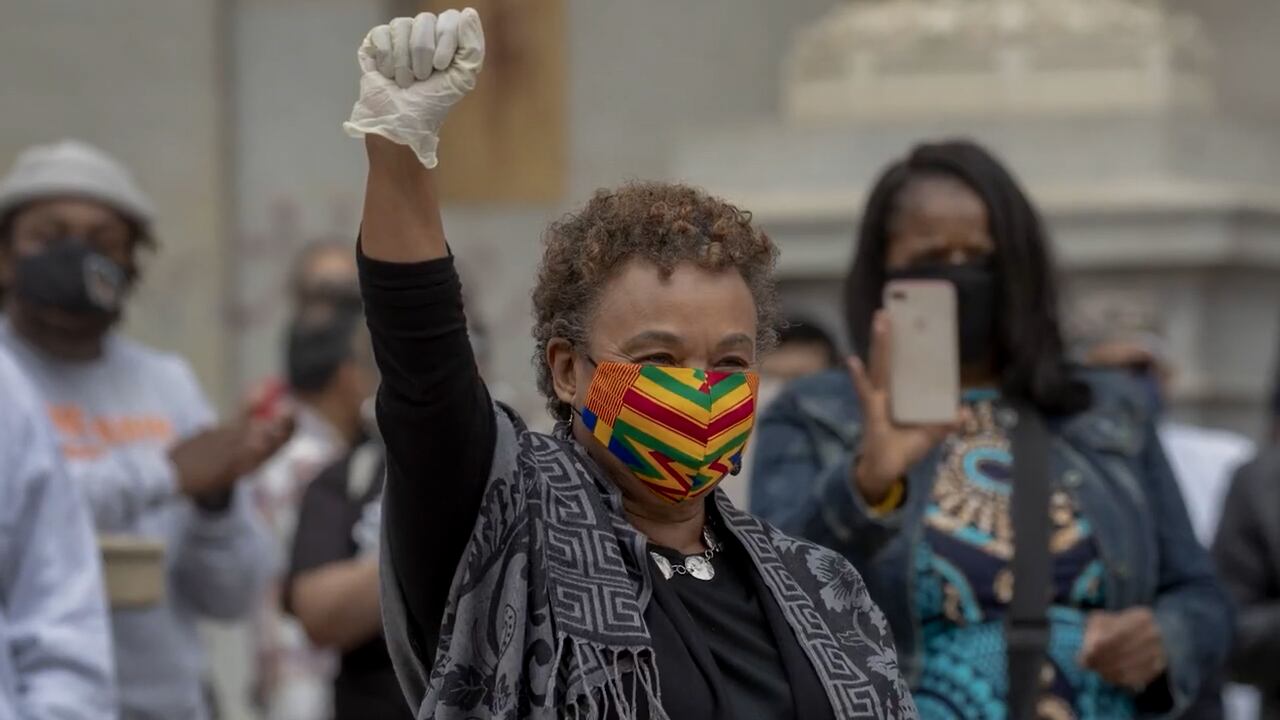
"Barbara Lee: Speaking Truth to Power" is the story of how the longtime House Democrat became, as she Is known to some, as "the Conscience of Congress." The film also
shows Representative Lee from her days working to fight community poverty to famously becoming the only member of Congress to vote "no" against the war in Afghanistan days after 9/11. The film is nominated for an NAACP Image Award, and Premieres on Starz on February 1. Film director Abby Ginzberg and Rep. Barbara Lee (D-Calif. 13th District), joined Cheddar to discuss more.
San Diego has just implemented a new law that could set the stage for how the country deals with food waste. This new law hopes to make a dent in that. Businesses and groceries stores out in San Diego will need to put a plan in place to *donate edible food rather than toss it straight to the trash. Food Rescue Manager at Feeding San Diego, Kate Garret