By Jill Colvin
Republicans gathered Monday to formally nominate President Donald Trump for reelection at a scaled-down convention kickoff in Charlotte that begins a weeklong effort to convince the American people that the president deserves a second term.
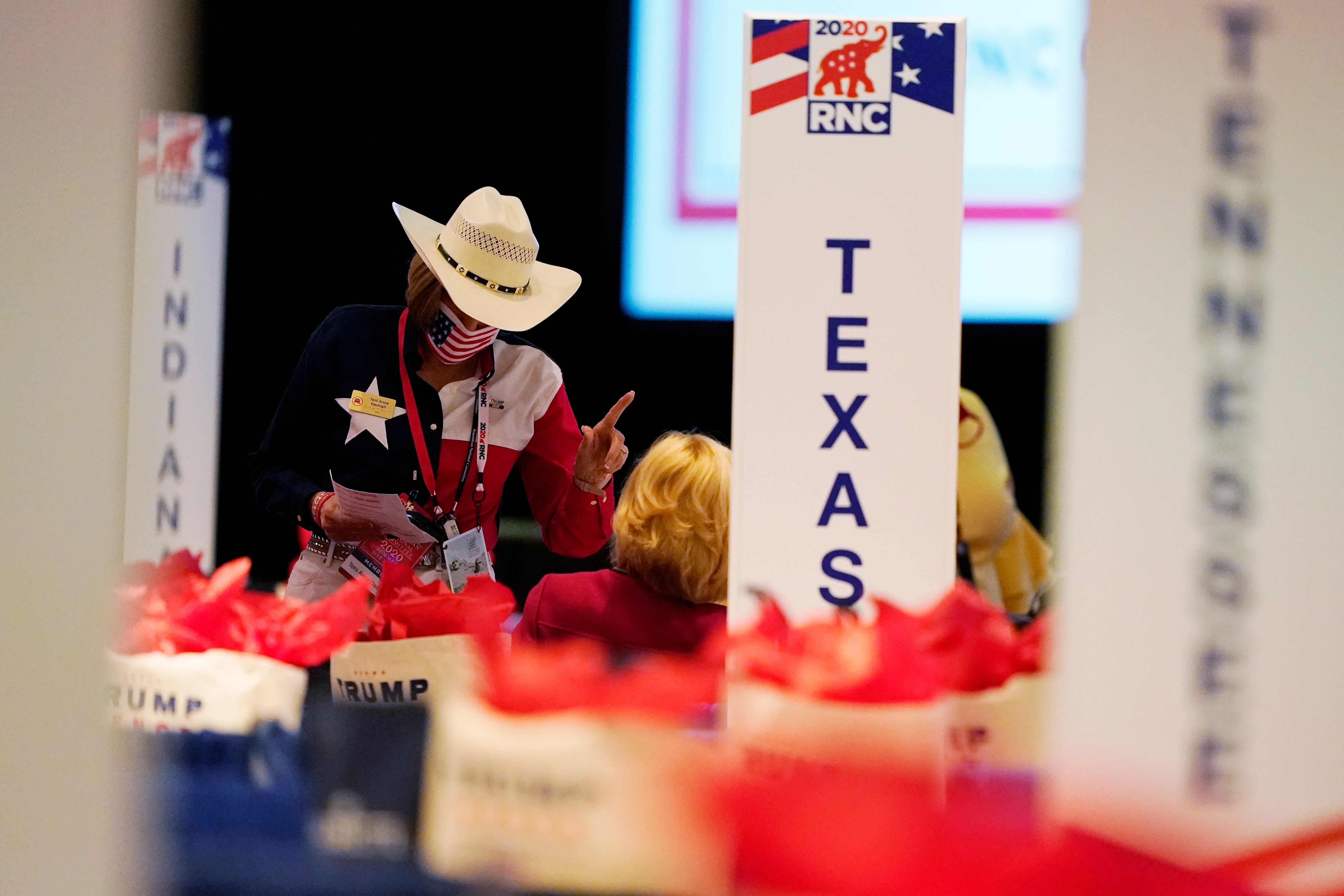
Despite the ongoing coronavirus pandemic, delegates are holding an in-person meeting and roll-call vote in the ballroom of the Charlotte Convention Center before attention turns to prime-time programming. Many of the usual trappings are present — the signs designating each state, the gift bags with Republican swag, expected appearances by the nominees — but chairs on the ballroom floor have been arranged with lots of space between them and masks are supposed to be worn.
It's a sharp contrast to the approach of Democrats, who created a roll call via video montage from states across the country to avoid a large-scale gathering last week at their well-received virtual convention.
"We are obviously disappointed we could not hold this event in the same way we had originally planned," RNC Chair Ronna McDaniel said as she began the proceedings. But she thanked the city for allowing the convention to move forward in its truncated form.
The GOP convention is a crucial moment for Trump, who is trailing in national and battleground state polls and under intense pressure to turn the race around. Aides hope the convention will give them a chance to recast the story of Trump's presidency and shift the campaign's thrust from a referendum on him to a choice between his vision for America's future and the one presented by Democratic nominee Joe Biden.
Trump, for his part, said he was hoping to set an optimistic tone.
"I think we're going to see something that is going to be very uplifting and positive. That's what I'd like it to be," he said in an interview that aired Sunday on Fox News Channel.
For both sides, it's an unconventional convention year.
The parties' election year gatherings are typically massive events, drawing thousands of delegates, party leaders, donors, journalists, and political junkies for a week of speeches, parties, and after-parties that inject hundreds of thousands of dollars into the local economy and deliver a multiday infomercial for the nominee.
But the coronavirus has changed all that, as much as Trump has resisted. Just 336 delegates — six from each of the 50 states, the District of Columbia, and U.S. territories — have been invited to cast proxy votes on behalf of the more than 2,500 regular delegates. And stringent safety measures have been put in place guided by a 42-page health and safety plan developed by a hired doctor.
Attendees were asked to practice enhanced social distancing and get tested prior to travel, fill out a pre-travel health questionnaire, and participate in a daily symptom tracker. They're also being tested onsite, have been asked to maintain a 6-foot (1.8-meter) distance from other people, and to use face coverings as a condition of participation — though many attendees were seen openly flouting those rules Monday morning. The RNC has also committed to contacting every participant five, 14, and 21 days after the event to check on potential symptoms.
The event had been met with protests, and police have made several arrests.
After the Charlotte kickoff, most of the GOP convention will take place in Washington, D.C., at and around the White House, as well as by video. It will feature remarks from a long list of well-known Trump supporters, including members of the Trump family, conservative firebrands and everyday Americans who campaign officials say have been helped by Trump's policies.
First lady Melania Trump will speak Tuesday from the Rose Garden, Vice President Mike Pence will appear from Fort McHenry in Baltimore on Wednesday, and Trump will deliver his marquee acceptance speech on Thursday from the South Lawn before a crowd of supporters — blurring the lines between governing and campaigning yet again.
But first comes the "official business" in Charlotte, which the party selected in 2018 to host the convention. The location has been the subject of a dizzying back-and-forth after Trump in June angrily dumped the city because it refused to guarantee the event could be held free from restrictions meant to prevent the spread of the virus, including mask-wearing and social distancing. After a search, party officials chose a new venue, Jacksonville in the crucial state of Florida, which at the time had looser virus restrictions.
But as cases in Florida ballooned, Trump announced unexpectedly last month that he was scrapping those plans, too, and instead would hold most of the festivities in Washington.
"It's a different world," Trump told reporters. "To have a big convention is not the right time."
With the pandemic still raging and the economy in tatters, Trump has a major task at hand. The Democrats' convention was "masterfully choreographed," said Douglas Brinkley, a presidential historian at Rice University.
"Now the burden is on Republicans to replicate the Democratic effort," Brinkley said. Besides needing a message that might attract new voters, he said, Republicans must also find a way to draw in viewers because the president is already so over-exposed.
"They're going to have a hard time garnering attention because we've lived with Trump for so long," Brinkley said. He expressed surprise that Trump hadn't tried to grab headlines by, for instance, replacing Pence on the ticket. "That would really grab everybody's attention and shake things up," he said. Otherwise, "there's a kind of flatness. 'Oh, Pence is speaking next week.'"
Besides the formal nomination roll call, the party is also approving a handful of new resolutions, including one that backs Columbus Day as a federal holiday and one that labels the Southern Poverty Law Center, which catalogs the country's hate groups, as a "radical organization." Another bemoans "cancel culture," warning that it "has grown into erasing of history, encouraging lawlessness, muting citizens, and violating free exchange of ideas, thoughts, and speech."
But they will not vote on a 2020 platform, after a unanimous vote to forego one this year.
"RESOLVED, That the Republican Party has and will continue to enthusiastically support the President's America-first agenda," a resolution instead reads, in part.
___
Associated Press writer Zeke Miller in Washington contributed to this report.