Google on Wednesday disclosed plans to infuse its dominant search engine with more advanced artificial-intelligence technology, a drive that's in response to one of the biggest threats to its long-established position as the internet's main gateway.
The gradual shift in how Google's search engine runs is rolling out three months after Microsoft's Bing search engine started to tap into technology similar to that which powers the artificially intelligent chatbot ChatGPT, which has created one of Silicon Valley's biggest buzzes since Apple released the first iPhone 16 years ago.
Google, which is owned by Alphabet Inc., already has been testing its own conversational chatbot called Bard. That product, powered by technology called generative AI that also fuels ChatGPT, has only been available to people accepted from a waitlist. But Google announced Wednesday that Bard will be available to all comers in more than 180 countries and more languages beyond English.
Bard's multilingual expansion will begin with Japanese and Korean before adding about 40 more languages.
Now Google is ready to test the AI waters with its search engine, which has been synonymous with finding things on the internet for the past 20 years and serves as the pillar of a digital advertising empire that generated more than $220 billion in revenue last year.
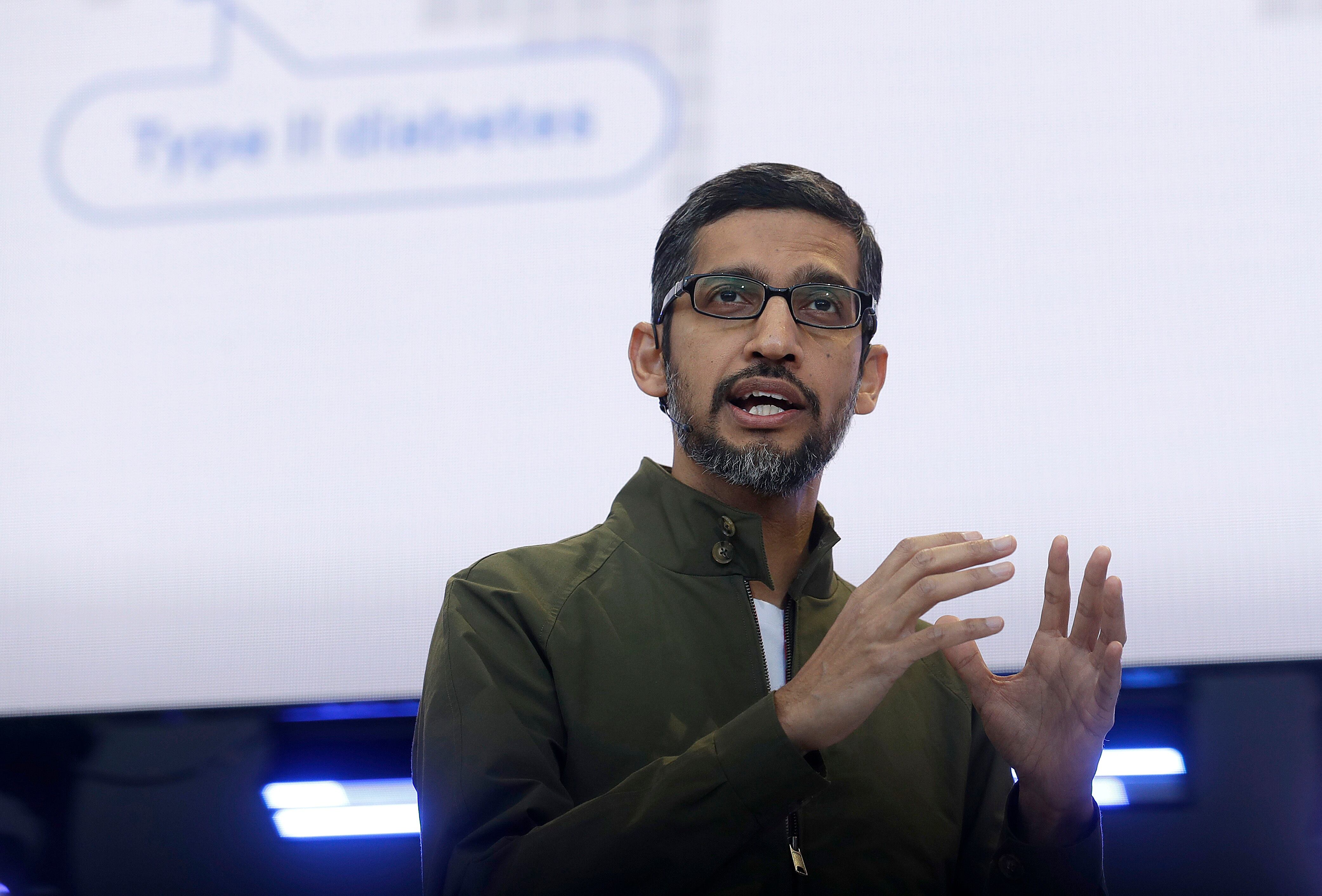
“We are at an exciting inflection point," Alphabet CEO Sundar Pichai told a packed developers conference in a speech peppered with one AI reference after another. “We are reimagining all our products, including search.”
More AI technology will be coming to Google's Gmail with a “Help Me Write” option that will produce lengthy replies to emails in seconds, and a tool for photos called “Magic Editor” that will automatically doctor pictures.
The AI transition will begin cautiously with the search engine that serves as Google's crown jewel.
The deliberate approach reflects the balancing act that Google must negotiate as it tries to remain on the cutting edge while also preserving its reputation for delivering reliable search results — a mantle that could be undercut by artificial intelligence's penchant for fabricating information that sounds authoritative.
The tendency to produce deceptively convincing answers to questions — a phenomenon euphemistically described as “hallucinations” — has already been cropping up during the early testing of Bard, which like ChatGPT, relies on still-evolving generative AI technology.
Google will take its next AI steps through a newly formed search lab where people in the U.S. can join a waitlist to test how generative AI will be incorporated in search results. The tests also include the more traditional links to external websites where users can read more extensive information about queried topics. It may take several weeks before Google starts sending invitations to those accepted from the waitlist to test the AI-injected search engine.
The AI results will be clearly tagged as an experimental form of technology and Google is pledging the AI-generated summaries will sound more factual than conversational — a distinct contrast from Bard and ChatGPT, which are programmed to convey more human-like personas. Google is building in guardrails that will prevent the AI baked into the search engine from responding to sensitive questions about health — such as, “Should I give Tylenol to a 3-year-old?” — and finance matters. In those instances, Google will continue to steer people to authoritative websites.
Google isn't predicting how long it will be before its search engine will include generative AI results for all comers. The Mountain View, California, company has been under intensifying pressure to demonstrate how its search engine will maintain its leadership since Microsoft began to load AI into Bing, which remains a distant second to Google.
The potential threat caused Alphabet's stock price to initially plunge, although it has recently bounced back to where it stood when Bing announced its AI plans to great fanfare. More recently, The New York Times reported Samsung is considering dropping Google as the default search engine on its widely used smartphones, raising the specter that Apple might adopt a similar tactic with the iPhone unless Google can show its search engine can evolve with what appears to be a forthcoming AI-driven revolution.
Alphabet's shares surged 4% Wednesday after Google's wave of AI announcements to finish at $111.75, the highest closing price since Bing began melding with ChatGPT in early February.
As it begins to ingrain AI in its search engine, Google is aiming to make Bard smarter by connecting with the next generation of a massive data set known as a “large language model,” or LLM, that fuels it. The LLM that Bard relies on is dubbed Pathways Language Model, or PaLM. The AI in Google's search engine will draw upon the next-generation PaLM2 and another technology known as a Multitask Unified Model, or MUM.
Although people will have to wait to see how Google's search engine will deploy generative AI to find answers, a new tool soon be more broadly available to all users. Google is going to add a new filter called “Perspectives” that will focus on what people are saying online about whatever topic is entered into the search engine. The new feature will be placed along existing search filters for news, images and video.
Besides using its annual tech showcase to tout its prowess in AI, Google also unveiled the first foldable smartphone in its Pixel line-up of gadgets. Google’s entry into a new type of smartphone design that allows users to deploy the device as a mini-tablet too comes nearly three years after Samsung — the leading maker of smartphones powered by Google’s Android software — introduced its first bendable model.
Foldable phones so far have remained a niche market, largely because of prices ranging between $1,500 and $2,000. Last year, about 14 million foldable phones were sold worldwide, accounting for just 1% of overall smartphone shipments, according to the research firm International Data Corp.
Google's foldable Pixel phone will sell for $1,800 and begin shipping next month. It will unfold with a hinge and, of course, be packed with AI.