Rep. Dingell: The Left and Right Agree GM Is 'the Worst Corporation in this Country'
*By Justin Chermol and Carlo Versano*
When General Motors announced a major restructuring that would result in mass layoffs and plant closures, the American automaker managed to do what few others have: unite the left and right in anger and disappointment.
Rep. Debbie Dingell (D-MI) represents a suburban Detroit district that will be affected by the reductions. She told Cheddar in an interview Wednesday that she was surprised by the timing, given that the auto industry is cyclical. Both Democrats and Republicans think "they are the worst corporation in this country."
"They have no fans right now," she said.
GM's newest strategy is twofold: the company is shrinking its sedan footprint in response to market conditions and consumer tastes, as well as investing in an electric, self-driving future it's terming "Zero Crashes, Zero Emissions, Zero Congestion."
Ford ($F), GM's main American rival, announced in April that it will scale about 90 percent of its auto production to trucks, utilities, and commercial vehicles by 2020. The company went on to explain that it would discontinue four of its sedan models and invest more in autonomous technology.
Back in June, in a cautionary note, GM [wrote](https://assets.bwbx.io/documents/users/iqjWHBFdfxIU/rJBrNbApznVU/v0) to the Department of Commerce, warning increased tariffs could lead to a "smaller GM."
Despite its foresight, GM didn't cite tariffs as a reason for the layoffs in its statement Monday. Instead, CEO Mary Barra said almost the opposite ー that the economy was so strong that it would be preferable to make changes now rather than trying to restructure during a slowdown. Automakers learned that lesson the hard way during the financial crisis.
Dingell said that while she indicated to President Trump that she would support a "NAFTA 2.0" trade bill, she has changed her mind in the wake of GM's restructuring.
"I will not support a trade bill that lets that company put any more jobs in Mexico," she said. "We need to keep those jobs here in the United States."
After the announcement, [President Trump](https://twitter.com/realDonaldTrump/status/1067494680416407552) and Prime Minister [Justin Trudeau](https://twitter.com/JustinTrudeau/status/1067082236686753792?ref_src=twsrc%5Etfw%7Ctwcamp%5Etweetembed%7Ctwterm%5E1067082236686753792&ref_url=https%3A%2F%2Fwww.cnn.com%2F2018%2F11%2F26%2Fbusiness%2Fgm-oshawa-plant%2Findex.html) both took to Twitter to call reductions in the U.S. and Canada a massive "disappointment." Since then, the two leaders have spoken on the phone to discuss the issue.
While pundits and industry analysts debate whether the era of the personally-owned car is coming to an end ー and perhaps where American automakers fall in the new mobility hierarchy ー the effects of GM's decisions will still weigh heavily on local communities that depend on it as the anchor business. And that, in turn, makes it a political issue for the president. President Trump dispatched his chief economic adviser Larry Kudlow to meet with Barra.
As for the future of the auto-industry, Rep. Dingell said she understands the harsh realities her constituents are facing: "It's no longer a car industry, its a mobility industry. And the mobility industry is changing."
"The model is going to change but you are still going to be building vehicles and there will be new jobs," she said.
The Biden administration on Tuesday quietly launched its website for Americans to request free at-home COVID-19 tests, a day before the site was scheduled to officially launch.
Just 27% of voters aged 18-29 approve of the job Biden is doing as president, according to a survey from The Economist and YouGov late last year. Santiago Mayer, executive director of Voters of Tomorrow, joins Cheddar Politics to discuss why President Biden is losing support among young voters.
Jesse Lehrich, co-founder of Accountable Tech, joins Cheddar News to discuss it being one year since Trump was exiled from social media and the former President's new platform 'Truth Social.'
Cliff Albright, co-founder of the group Black Voters Matter, joins Cheddar Politics to discuss why he boycotted President Biden's voting rights speech this week, and the push from Senate Democrats to debate and vote on the Freedom to Vote Act and the John Lewis Voting Rights Advancement Act.
Senator Jon Ossoff (D-Ga.) has teamed up with fellow Democratic senator and former astronaut Mark Kelly to introduce the Ban Congressional Stock Trading Act, a bill to essentially end stock trading by sitting lawmakers. From the other side of the aisle, Senator Josh Hawley (R-Mo.) introduced his own legislation to enact something similar. The dueling bills come at a time when it's popular to constrain members of Congress from owning and trading stocks. Karl Evers-Hillstrom, a business and lobbying reporter at The Hill, spoke to Cheddar about the significance of the bills, and what they could mean for lawmakers, their families, and staffers moving forward.
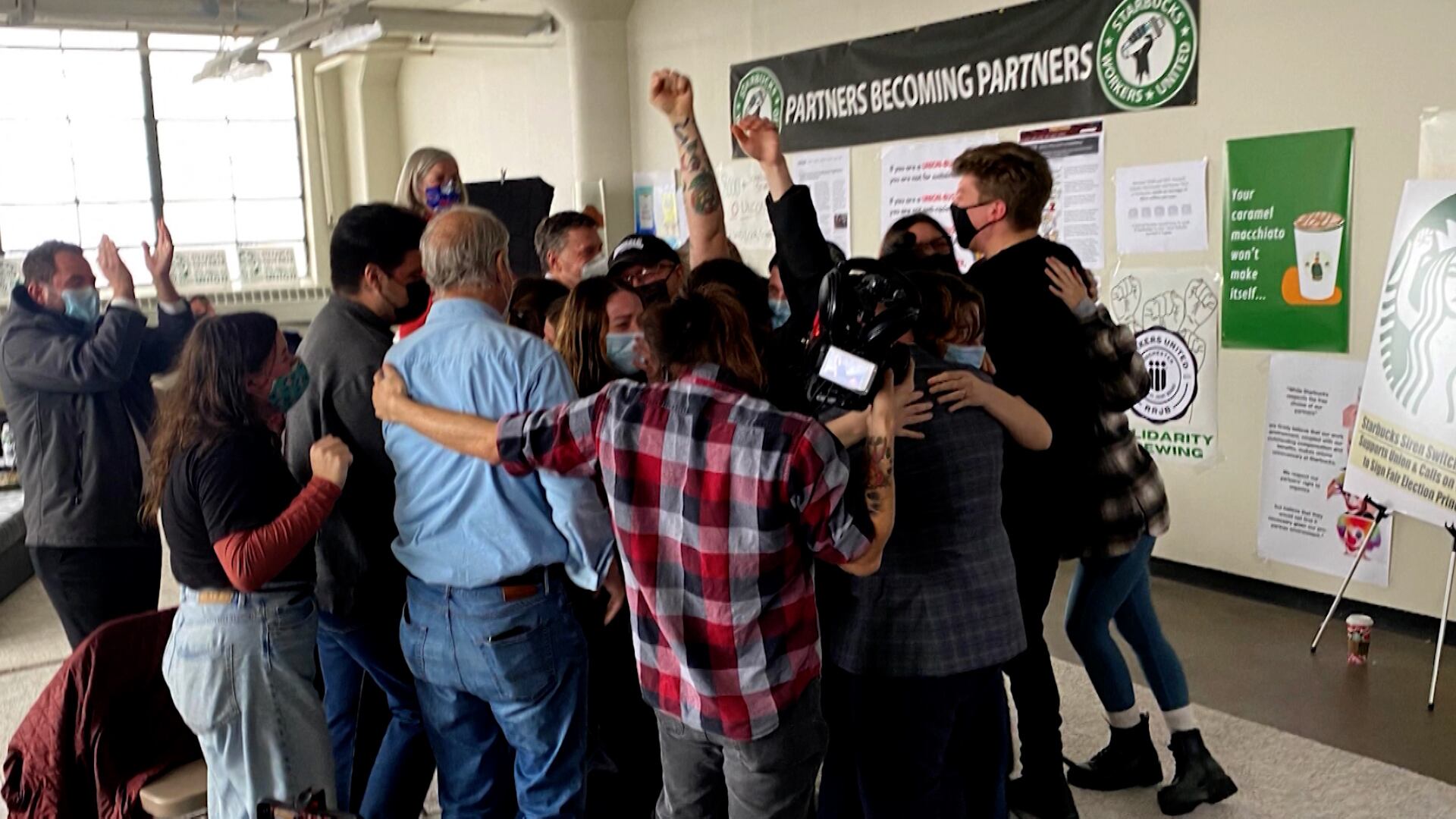
A second Starbucks location in the U.S. has officially voted to unionize. On Monday, the National Labor Relations Board announced workers at the Starbucks store located in the Buffalo, NY suburb of Cheektowaga voted 15-9 in favor of being represented by Workers United, an affiliate of the Service Employees International Union. The New York Times reports votes were tallied in December but remained inconclusive as the union challenged the ballots of several employees it said did not work at the store. A Starbucks spokesperson has said that it may appeal the labor board's decision, which comes as several other Starbucks stores across the country are also pushing to form a union. Danka Dragic, shift supervisor for the second Starbucks store in the country to unionize, joined Cheddar News' Closing Bell to discuss.
Earlier today, Minnesota Republican Representative, Tom Emmer, introduced a bill that would prevent the Federal Reserve from issuing a central bank digital currency directly to American consumers. According to the Congressman from Minnesota, requiring Americans to open a fed account to access a digital currency, would "put the Fed on insidious path akin to China's digital authoritarianism." Rep. Tom Emmer joined Cheddar's None of The Above to discuss more.
Sixteen of the country's most prestigious universities have been hit with a lawsuit claiming those schools illegally conspired to eliminate competitive financial aid offers for students. Just some of the schools mentioned include Yale, Brown, Columbia, UPenn, and Cornell. Author of "Who Gets In and Why" and Professor of practice at Arizona State University, Jeff Selingo, joined Cheddar to discuss more.