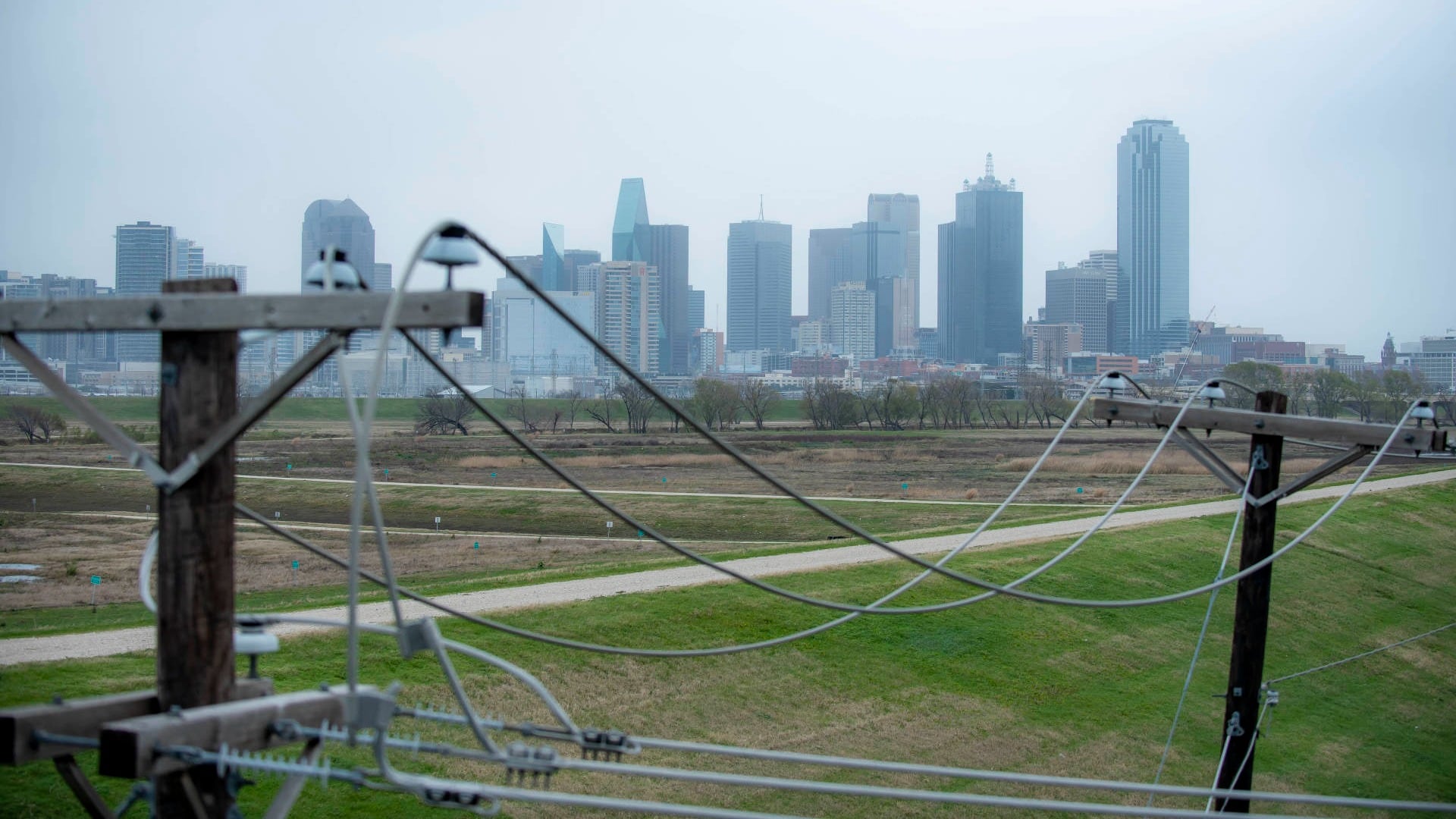
The Dallas skyline is visible from Sylvan Avenue in Dallas, Texas on Thursday, December 22, 2022. (Emil T. Lippe for The Washington Post via Getty Images)
Ford, General Motors, Google Nest, and several energy companies are partnering to support the growth of "virtual power plants" (VPPs) — or networks of decentralized power sources designed to kick in when the grid falls short. RMI, a nonprofit seeking to decarbonize the energy system, is spearheading the effort.
“Virtual power plants are poised for explosive growth, and RMI is committed to being at the forefront of their success by launching VP3,” said RMI CEO Jon Creyts in a press release. “Our analysis shows that VPPs can reduce peak power demand and improve grid resilience in a world of increasingly extreme climate events."
How does this work? Virtual power plants pool together both energy producers and consumers under a single entity, from wind and solar farms to home heaters that use smart thermostats. The idea is that these networks can coordinate to both provide and conserve energy as needed, depending on demand on the grid. This could entail using advanced software to prompt members to reduce their consumption.
On the supply side, producers in a VPP are able to better "monitor, forecast, optimize and trade their power," explains Next, one of Europe's largest VPP operators. "This way, fluctuations in the generation of renewables can be balanced by ramping up and down power generation and power consumption of controllable units."
So if a wind farm is overproducing, and a solar park is under producing, they can coordinate their output to provide a balanced load. It also allows them to potentially trade together on the same market, putting them in competition with large central power plants. It could also provide additional power options for large industrial consumers, such as automakers.
“Virtual power plants present an exciting opportunity to unlock additional value for homes, businesses and communities, helping to drive greater energy independence and grid decarbonization,” said Mark Bole, vice president and head of GM's V2X and Battery Solutions. “This collaboration underscores GM’s commitment to creating a more resilient grid, with EVs and virtual power plants playing a key role in helping to advance our all-electric future.”
Attack surface management startup CyCognito recently raised $100 million in its latest funding round, valuing the company at $800 million. CyCognito offers cyber security through its attack surface scanner, which uses artificial intelligence to identify weak spots in an organization's network. The new funding comes as companies around the world continue to add new defenses to the growing rise of cyber threats and attacks. CyCognito co-founder and CEO Rob Gurzeev joins Cheddar News' Closing Bell to discuss.
Adam Mosseri, head of Instagram, faced withering questions on Capitol Hill about the reports the social media app was aware of the severe mental health impacts it was having on teenage girls. Karen Kornbluh, the director of digital innovation and democracy for the German Marshall Fund, joined Cheddar to discuss the rare show of bipartisan outrage on display at the Senate hearing. "The senators came really loaded for bear on both sides of the aisle," she said. Kornbluh explained how senators like Richard Blumenthal (D-Conn.) set up fake Instagram accounts with teen girl profiles in order to research the effects firsthand.
A mental health crisis among young people is looming, and a large part of it is online. Cheddar News speaks with digital policy expert Karen Kornbluh on the issue.
Roshan Jhunja, head of retail at Square, joined Cheddar to talk about the financial services company's second annual Future of Retail report. Square expects the massive shift to e-commerce to continue into 2022 as more consumers get used to the online shopping experience. For Square, soon-to-be renamed Block, which began predominantly as a digital payment platform, Jhunja said the company is also helping sellers with automation amid ongoing labor shortages.
Facebook is undergoing more than a name change. The company, now known as Meta, has also seen an exodus of executives this year. While the timing of some of these resignations came before whistleblower allegations, it's undeniable the tech giant is undergoing big changes. Doug Astrop, Managing Partner at Exponential Investment Partners, joins Cheddar News' Closing Bell to discuss Facebook's current state, possible regulatory scrutiny, the impact of Instagram chief Adam Mosseri's Congressional testimony, and more.
Fast AF, a premiere quick commerce retailer for products and brands just announced the close of its Series A investment round. That round puts the value of the company at $200 million. The company gets items to customers ranging from masks to sneakers and is now launching its own in-house delivery service. Lee Hnetinka, founder and CEO of FastAF joins Cheddar News to discuss the announcement.
Carolina Navas, Snap's head of AR product strategy and product marketing, joins Cheddar News to discuss how Snapchat's augmented reality is changing the shopping game this holiday season.