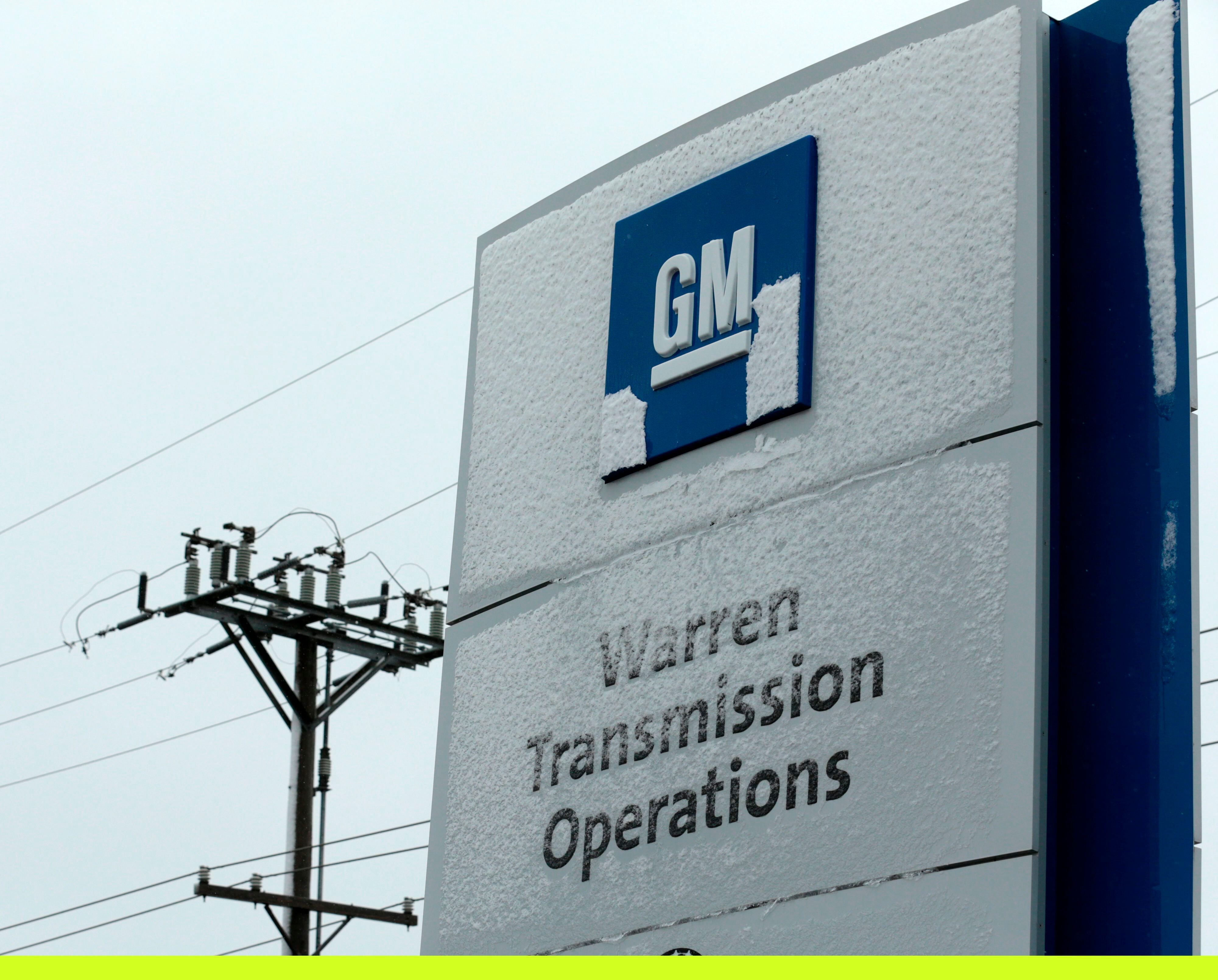
File photo of the shuttered General Motors Warren Transmission Operations facility. (Photo credit: JEFF KOWALSKY/AFP via Getty Images/FILE
After a series of angry outbursts from President Trump, General Motors on Friday announced that it will be working with the medical device maker Ventec Life Systems to ramp up production of ventilators at a GM factory in Indiana.
The companies are preparing to build as many as 200,000 ventilators.
GM will also start manufacturing surgical masks next week at its plant in Warren, Mich., where it hopes to produce 50,000 masks a day in as soon as two weeks, and as many as 100,000 masks a day if needed.
The ventilator breathing devices and the masks are in short supply as hospitals across the country have struggled to cope with soaring numbers of coronavirus cases.
GM last week was the first automaker to publicly confirm that it would use some of its manufacturing capacity to help produce the equipment. Ford and Tesla have since made similar announcements. All three companies have joined other automakers in halting vehicle production to help slow the spread of coronavirus.
“This unique partnership combines Ventec’s respiratory care expertise with GM’s manufacturing might to produce sophisticated and high-quality critical care ventilators,” Ventec CEO Chris Kiple said in a statement. “This pandemic is unprecedented and so is the response, with incredible support from GM and their suppliers. Healthcare professionals on the front lines deserve the best tools to treat patients and precision critical care ventilators like VOCSN are what is necessary to save lives.”
About 1,000 workers will return to the assembly lines to help with the production.
The announcement Friday afternoon followed a remarkable string of Twitter attacks by Trump, lashing out at GM and its CEO, Mary Barra. The president’s tirade began after an eye-popping New York Times report the previous evening that Trump had abruptly backed out of a deal in which the Federal government would buy some 80,000 ventilators for about $1.5 billion.
Federal officials cited concerns that GM would not be able to deliver as many ventilators as it promised. However, even as they worried about having too few ventilators, officials also fretted that the federal government would end up with an excess of ventilators.
Trump also reportedly cited concerns about the deal’s cost, although the price-tag would have amounted to about $18,000 a ventilator — a mere fraction of the $2 trillion relief package that Congress approved this week, or roughly equivalent to 18 F-35 fighter jets.
“We are proud to stand with other American companies and our skilled employees to meet the needs of this global pandemic,” GM’s Barra said in a statement. “This partnership has rallied the GM enterprise and our global supply base to support Ventec, and the teams are working together with incredible passion and commitment. I am proud of this partnership as we work together to address urgent and life-saving needs.”
The crypto industry is still reeling from Terra's recent crash. The company's blockchain was temporarily halted earlier this month after the collapse of its cryptocurrency Luna (LUNA) and its stablecoin TerraUSD (UST), which led to almost $45 billion being wiped from the tokens' market caps within a week. Now, many are left wondering what Terra's struggles mean for the broader crypto market. Reeve Collins, CEO of the NFT platform BLOCKv, joins Cheddar News' Closing Bell from Davos 2022 to discuss.
China's largest ride-hailing company will no longer be listed on the world's largest stock exchange. Didi shareholders voted on Monday to delist from the New York Stock Exchange, less than a year after launching a $4.4 billion IPO with the most significant U.S. share offering by a Chinese company since Alibaba debuted in 2014. Since going public in June of last year, around $70 billion has been wiped from Didi's market value and shares of the company have dropped nearly 90%. Now, Didi is expected to begin preparations to list in Hong Kong. Kevin T. Carter, founder and Chief Investment Officer of EMQQ Global, joins Cheddar News' Closing Bell to discuss.
Ahead of the Meta shareholder meeting, more than five hundred doctors have jointly sent a letter to investors to hold the Facebook parent accountable for the risks its platforms have posed to the public and mental health. Dr. Rob Davidson, a West Michigan ER physician and executive director of the Committee to Protect Health Care, joined Cheddar News to discuss how medical professionals are coming together to highlight the social media giant's spread of misinformation, especially during the pandemic. "We've seen the direct impacts of misinformation and disinformation that spreads like wildfire on the social media platforms," he said. "Our goal with this letter is to try to get the shareholders of Meta to convince leadership that they need to do a better job."
Snap downgraded its earnings and revenue expectations for the second quarter, saying the "macroeconomic environment" has deteriorated faster than the company anticipated. The warning sent shockwaves through the digital ad industry, dragging down a handful of other tech stocks, including Pinterest, Meta, and Twitter. Daniel Cobb, CEO and Chief Strategy Officer of Daniel Brian Advertising, joined Cheddar to discuss the reason behind this warning, and why it's bringing so many social media stocks down.
Pamela Rucker, CIO Advisor and Instructor for Harvard Professional Development, joins Cheddar to discuss how perceptions of Environmental, Social, and Governance–or ESG–changed over the past couple of years, and how using machine learning and artificial intelligence could pave the way to a more sustainable future.
Bob Lockett, Chief Diversity & Talent Officer, ADP, joins Cheddar to break down why offering more flexibility at work is a top way to retain talent at work, and how strong DEI policies help encourage employee loyalty.