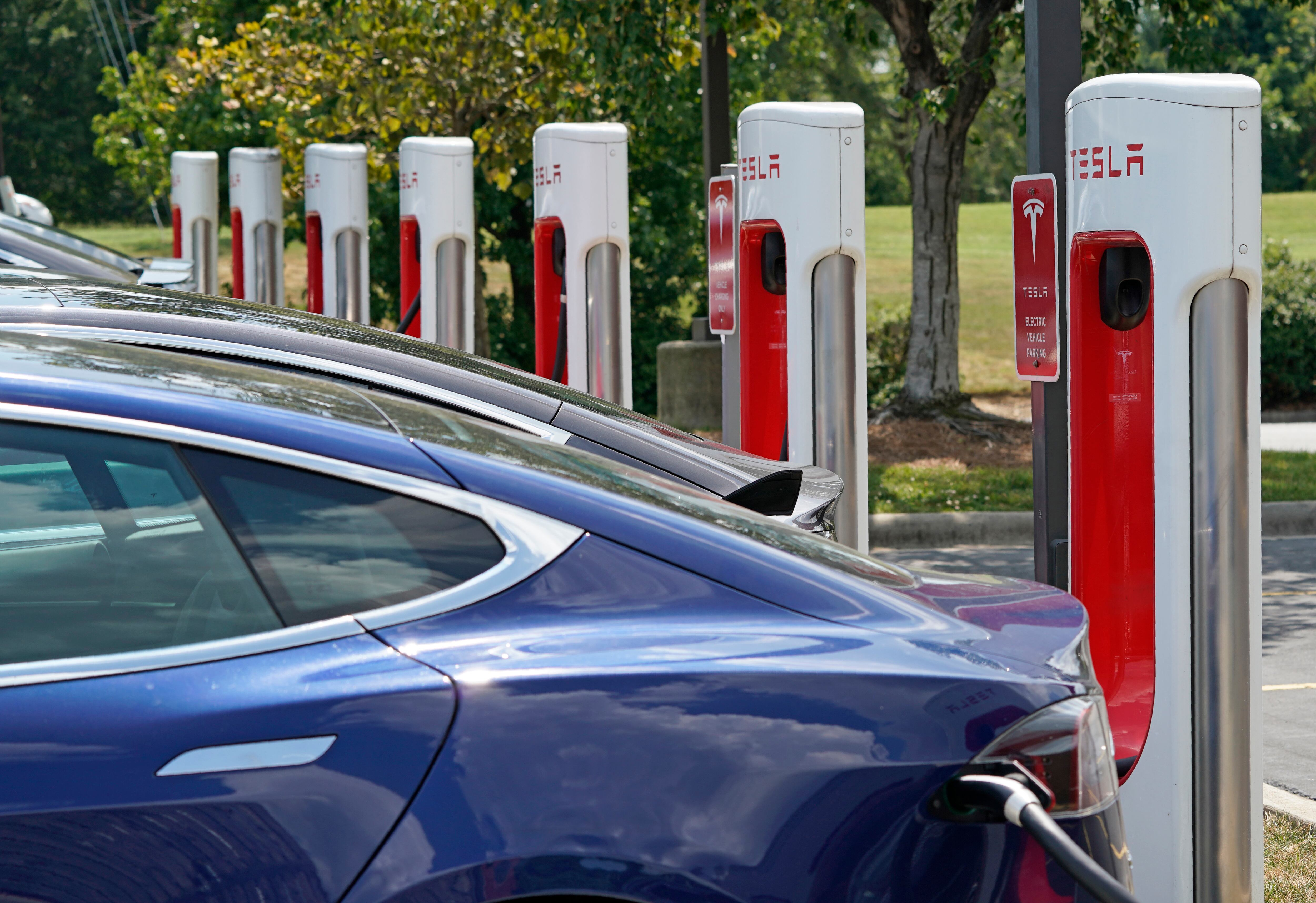
The newest electric vehicles from Tesla, GM, and now Ford can drive from New York City to Washington, DC, on a single charge — with plenty left over to circle the block for parking — but so-called "range anxiety" remains one of the most stubborn challenges facing broader adoption of battery-powered cars and SUVs.
Tesla has sought to overcome it by building a network of more than 3,000 chargers across North America. Ford, ahead of the unveiling of its "Mustang-inspired" Mach E SUV this weekend, announced last month that it's investing in 12,000 chargers across the continent.
Now a new analysis from the big data firm StreetLight Data and the tech and industrial conglomerate Siemens hopes to better guide city planners and utility companies on where to put all those charging stations.
"People seem to go, Oh, there's a lot of cars here, and a Whole Foods, so probably this is where those rich green people come," StreetLight CEO and co-founder Laura Schewel said. "It's not really data-driven, and it's driven by assumptions of who we think electric vehicle drivers should be. We want people to think about what the EV infrastructure should be, then build it the way it should be to meet our goals."
StreetLight and Siemens studied Santa Clara — a Siemens client, but also a prosperous city in the heart of Silicon Valley, and as a result, a hotbed of early tech adopters, EV drivers, and EV charging stations, offering plenty of variables to study where chargers are located and who's using them the most.
The companies then generated a heat map to help policymakers figure out what to consider in deciding where to put them.
"There are a lot of dynamics there that make it a great place to drive EV charging and EV usage, but you still have to prioritize," said Martin Morzynski, vice president of product management at StreetLight. "The EV planning universe, it's in the dark ages, and it's so much more complex: What are grid requirements, range, short trips, long trips?"
For now, one of the least important places when it comes to city driving and encouraging drivers to switch to electric vehicles are public parking lots, the team found. Rather, homes and offices are the most crucial spots for charging — a finding that corroborates, and is corroborated by, similar industry findings.
"It's quite easy to recharge at home because you have space, you have a parking lot. For public charging, it might not be that important," Guillaume Devauchelle, vice president of innovation and research and development at Valeo, a French automotive supplier that's made heavy investments in electric vehicle technology.
But with so many employers having installed EV chargers at their offices, leaders in Santa Clara are interested in how to expand the number of public charging stations — and the findings from the Siemens and StreetLight analysis could have far-reaching implications in deciding where to install the charging spots.StreetLight's Morzynski spoke with Cheddar in a recent interview. The conversation was edited and condensed for clarity and brevity.
What's the planning typically like when it comes to installing EV charging stations?
You've got shopping malls putting up chargers and factory outlets – and it's partly marketing, it's signaling innovation. And when you first build infrastructure, the direction tends to be, Where do I put it where there's a lot of people? With EVs, that just isn't enough, because you have capacity restraints. You need to ask, where are there enough people who are taking short trips? Do you have trucks that are taking short trips? Do you have cities that want to incentivize local traveling?
What did your analysis find?
What we found important was inferred trip purpose: 'Why am I driving?' For most people, the most important trips are from home to work, from home to shopping, or home to school.
So you need one or two things to make this work: You either incentivize developers of multi-family housing to include EV infrastructure at the home, or you incentivize employers to build EV infrastructure at the workplace. And you need to make it a no-brainer for the employee: 'Even if I don't have EV charging at home, I can do it at the office.' If you have charging infrastructure at those places, you make it a no-brainer for car owners to switch.
There's also another input here: Cities increasingly want access for people who have medium to lower incomes. You don't want it only for people who drive Tesla. You want it viable to people at apartments they rent knowing that these are lower-cost vehicles. That means providing infrastructure to people who are middle- or low-income, and at the same time making [electric] utilities happy because they have locations they want to utilize.
How easily can this research from a city like Santa Clara — where there are high incomes, high resources, and relatively high rates of EV adoption — be applied to other cities?
Cities and municipalities can use this. In some cases, a developer like a large corporate campus wants to tap into the knowledge. EV companies use our data to make the lobbying process with cities interesting and faster.
This can be repeated anywhere — the one additional layer of input is the existing location of infrastructure and the grid location and needs. But origins of trips, concentrations of people traveling sufficient differences, concentrations of people in different demographics, all of that is already in the platform.
So what's next?
We've lived in a universe where a personal vehicle is a personal vehicle. Now you've got fewer owners, fewer places to refuel, so you have a situation where, in the early phases of adoption, you have limited supply and limited demand, particularly for charging, and you're in a place where you have to incentivize both until you get broad penetration.
You have to know that either there's a lot of people here who have a lot of access to charge, or you have to get them to know that they have access to charge.