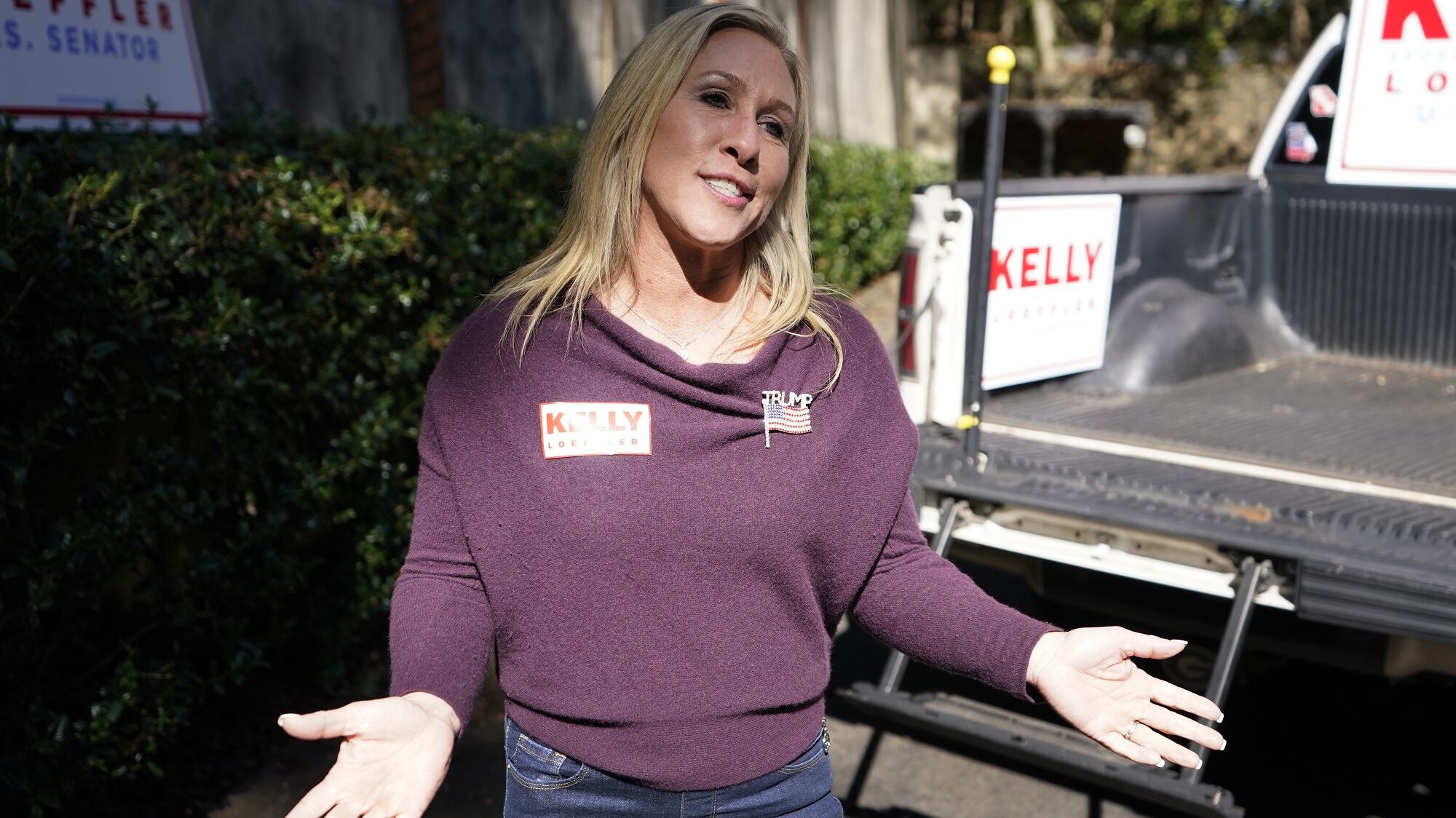
Republican candidate for Georgia's 14th congressional seat Marjorie Taylor Greene is shown during a campaign rally for Sen. Kelly Loeffler Saturday, Oct. 31, 2020, in Roswell, Ga. (AP Photo/John Bazemore)
By Ben Nadler
Republican Marjorie Taylor Greene, who expressed racist views and support for QAnon conspiracy theories in a series of online videos, has won a U.S. House seat representing northwest Georgia.
Her candidacy was bolstered by President Donald Trump, who has called her a “future Republican Star.”
Greene was heavily favored in the conservative district even before Democratic challenger Kevin Van Ausdal suddenly dropped out in September, saying he was moving out of state.
Greene thanked her staff and asked supporters to pray for President Donald Trump to win reelection at a watch party Tuesday night, video of which was livestreamed on Facebook.
In her remarks, Greene pledged to “fight hard to make sure that Nancy Pelosi and the squad and the radical Democrats in the House do not steal anything away from America, because this country was never ever meant to be a socialist nation.”
Greene is a businesswoman and political newcomer who’s gained large followings on social media in part by posting incendiary videos and comments.
Greene has claimed in online videos that Black and Hispanic men are being held back by “gangs and dealing drugs,” alleged an “Islamic invasion” of government offices and accused Jewish billionaire George Soros of collaborating with Nazis.
She has also embraced QAnon, a far-right U.S. conspiracy theory centered around the debunked belief that Trump is fighting a secret campaign against “deep-state” enemies and a child sex trafficking ring of satanic pedophiles and cannibals.
In more recent videos and posts, she has attacked everything from the Black Lives Matter movement to the use of facemasks to protect against the coronavirus.
After some of her comments came to light, Greene was condemned by some future House colleagues within her own party, but many other Republicans including Trump and Republican U.S. Sen. Kelly Loeffler have embraced her.
She had a blunt message for her detractors in a speech after winning a GOP primary runoff in August: “I will not apologize.”
“Congratulations to future Republican Star Marjorie Taylor Greene on a big Congressional primary win in Georgia against a very tough and smart opponent,” Trump tweeted after her primary win. “Marjorie is strong on everything and never gives up - a real WINNER!”
Greene initially started campaigning for a different House seat, challenging Democratic Rep. Lucy McBath in Georgia’s 6th Congressional District, made up of suburbs north of Atlanta. She switched to the more conservative 14th District after Republican Rep. Tom Graves announced that he wasn’t seeking reelection.
Democrats weren’t able to replace Van Ausdal on the ballot because he dropped out too close to the election, leaving Greene essentially unopposed in the race.
The seat has been open since Graves stepped down in October.
Emily Hoeven, newsletter editor at CalMatters, joins Cheddar News to discuss California Governor Gavin Newsom's gun law modeled after Texas's abortion law.
Chuck Rocha, host of 'Nuestro' podcast and opinion contributor at The New York Times, joins Cheddar News to discuss why Democrats are losing Hispanic voters.
More businesses are requiring workers to return to the office, but there is concern that many employees in the middle class, especially women and people of color, need remote work options for reasons including childcare and financial security. Joan Williams, director of the Center for WorkLife Law at the University of California, joined Cheddar to discuss why office mandates could be detrimental to the middle class. She noted that while companies claim a return to offices would help foster more collaboration and efficiency, reports show that they are successfully able to do their jobs from home.
The U.S. postal service has confirmed that it secretly developed and tested a blockchain-based mobile voting system ahead of the 2020 election. Susan Greenhalgh, senior advisor on election security, Free Speech for People, joins Cheddar News to discuss the cybersecurity complications of a mobile voting system.
The U.S. Supreme Court ruled to allow the controversial Texas abortion law to remain in effect, banning abortion at six weeks and allowing any private citizen to sue a person or doctor aiding or abetting someone seeking an abortion. Outraged at this decision, California Governor Gavin Newsom is working to draft a proposal in line with the law as it relates to guns. Shawn Hubler, California correspondent at the New York Times, joins Cheddar News to discuss.
Even as tech giant Google implements a vaccination mandate, charging its employees to declare their vaccine status within a time frame or risk dismissal, the federal government is tangled up in the court system trying to impose one of its own. Cindy Cohn, the executive director of the Electronic Frontier Foundation, and Harry Nelson, founder and managing partner of Nelson Hardiman LLP, joined Cheddar to debate the ethics, efficacy, and legality surrounding the issue. While Cohn noted that she thinks the federal mandate might be legally sound, her organization is also concerned with a separate question of privacy. "At EFF what we're most interested in is the digital surveillance that's going along with some of these attempts to try to track and confirm whether people are vaccinated or not," she said.