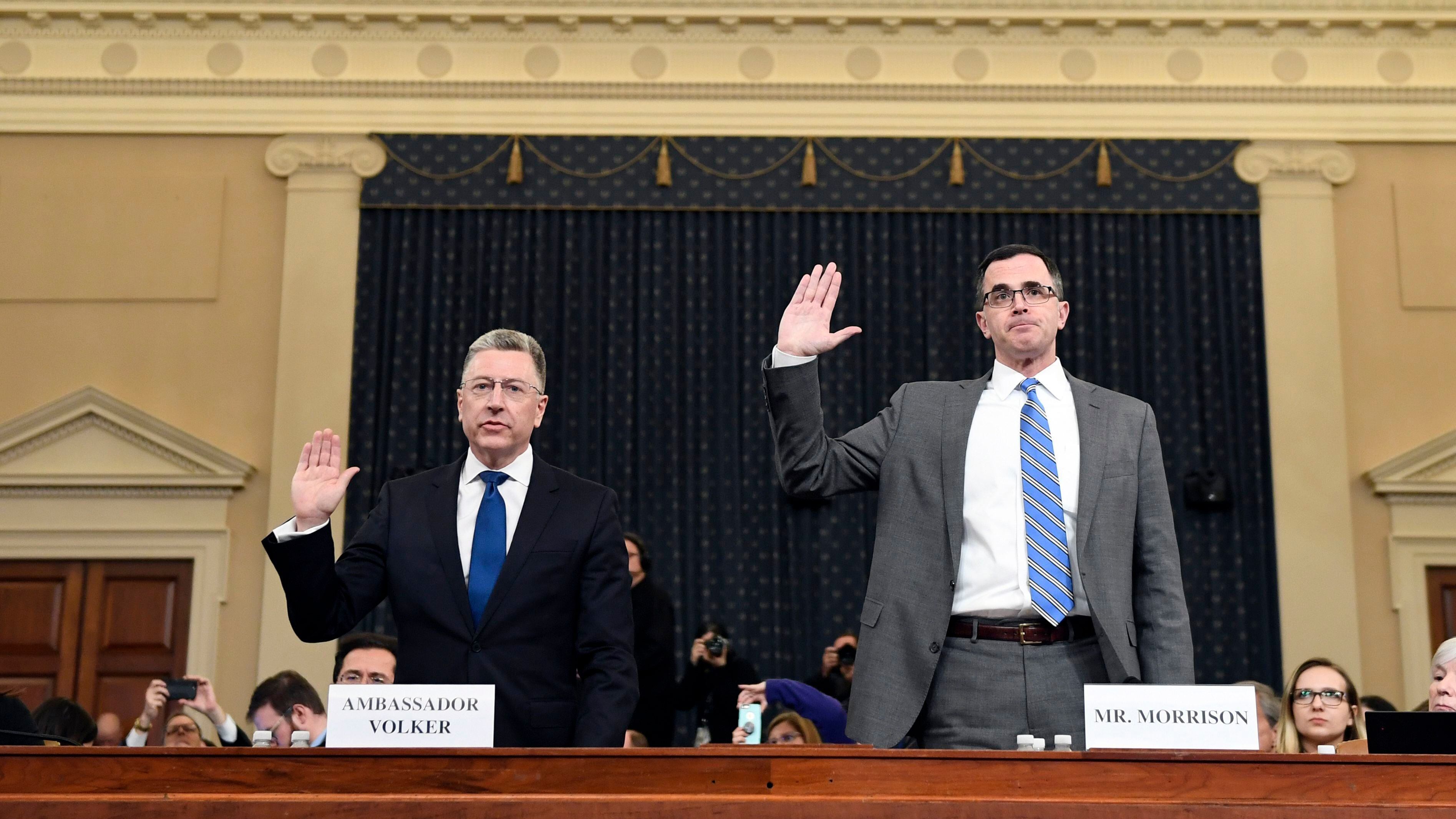
The third day of impeachment hearings finished up with testimony from Kurt Volker, the former special envoy to Ukraine who attempted to clarify inconsistent testimony, and Timothy Morrison, a former National Security Council official. While both were originally on the Republican witness list, they did not provide testimony in defense of President Trump. Instead, both said the president's actions were unusual and Volker said the White House’s focus on "conspiracy theories" was damaging to national security. Both also testified that Trump's personal lawyer Rudy Giuliani was a key figure in Ukraine policy.
Volker, whose closed-door testimony from October 3 differed from other witnesses, attempted to explain the discrepancies and testified he was out of the loop and unaware that some working for the administration saw a link between the release of security aid and a commitment that Ukraine investigate former Vice President Joe Biden. He also testified he did not know that, at the time, the proposed Ukrainian investigation into Burisma was code for an investigation into the Bidens.
"I drew a sharp distinction between the two," he said.
GOP officials had told Axios that the Republicans viewed Volker and Morrison as star witnesses to undermine the impeachment case.
Morrison, a longtime Republican congressional aide, focused his prepared remarks on his concerns with the hearings. He said he does not know who the whistleblower is, emphasized that he resigned from his position voluntarily, and urged lawmakers to focus on the conflict between Ukraine and Russia and how impeachment hearings may hurt Ukraine. During his private testimony, Morrison said Sondland "believed and at least related to me that the president was giving him instruction.” At first, Sondland insisted he was not involved in discussions to withhold security aid in exchange for a promise Ukraine investigate the Bidens and said he “never” thought there was a precondition on the frozen military aid. After his testimony, he released a sworn statement in which he acknowledged that he told Ukrainian officials the nation would likely need to give President Trump the public promise to investigate to unlock military aid. Sondland will testify publicly tomorrow.
Morrison said he "feared" how disclosure of the July 25 phone call "would play in Washington's climate," he said. "My fears have been realized."
Later, Democratic counsel Daniel Goldman asked "You would agree, right, that asking a foreign government to investigate a domestic political rival is inappropriate, would you not?" to which Morrison replied: "It is not what we recommend the president discuss."
Volker, sometimes referred to as one of the "three amigos" that worked in Ukraine to advance President Trump's agenda, said he "cringes" at the title. "I never used that term – and frankly cringe when I hear it – because, for me, the 'three amigos' will always refer to Senator John McCain, Senator Joseph Lieberman, and Senator Lindsey Graham." Sondland and Energy Secretary Rick Perry, who steps down this year, are the other two members of the informal group with Volker. Sondland has had multiple, direct contacts with the president on the matter of Ukraine.
"I did not know of any linkage between the hold on security assistance and Ukraine pursuing investigations," Volker said. He emphasized that he was not included in discussions and he has "learned many things that I did not know at the time of the events in question." Throughout his opening statement, he clarified instances where he said he had learned information since the time of the events in question, including most importantly the linking of aid to the promise of investigations.
Volker testified that he told the Ukrainians that they did not need to take action in order to receive the frozen military aid. He told them “the opposite,” and assured Ukrainians that it was an internal U.S. problem.
"I did not know others were conveying a different message to them around the same time,” he said.
"My role was not some irregular channel, but the official channel," Volker said in his opening statement.
Volker said, "despite unanimous, positive assessment and recommendations of those of us who were part of the U.S. Presidential Delegation," President Trump "was receiving a different, negative narrative about Ukraine and President Zelensky. That negative narrative was fueled by accusations from Ukraine's then-Prosecutor General and conveyed to the President by former mayor Rudy Giuliani," Volker said.
He called it a "tragedy" for the U.S. and Ukraine that efforts in the area "which were bearing fruit, have now been thrown into disarray," he said.
Volker's testimony about the July 10 meeting at the White House differed from senior director for Europe and Russia at the National Security Council Fiona Hill and Lt. Col. Alexander Vindman's accounts, and he attempted to clarify what he had said.
Hill and Vindman testified that the president’s then-national security adviser John Bolton ended a meeting abruptly when Sondland brought up the investigations and a smaller group of officials continued the conversation later.
In a modification of his private testimony, Volker said Tuesday that European Union Ambassador Gordon Sondland mentioned the investigations during a meeting with Ukrainian officials.
"As I remember, the meeting was essentially over when Ambassador Sondland made a generic comment about the investigations," he said." I think all of us thought it was inappropriate. The conversation did not continue and the meeting concluded. Later on, in the Ward Room, I may have been engaged in a side conversation, or had already left the complex, because I do not recall further discussion regarding investigations or Burisma."
During the second half of testimony today, Vice President Pence's National Security Advisor Keith Kellogg, who was on the July 25 phone call released a statement in which he wrote "I heard nothing wrong improper on the call. I had and have no concerns." Pence's chief of staff Marc Short went on Fox News Tuesday and said Jennifer WIlliams, who testified this morning had said that she found the phone call "unusual" and never raised any concerns. Williams had testified she did not raise concerns because her superiors were on the call.