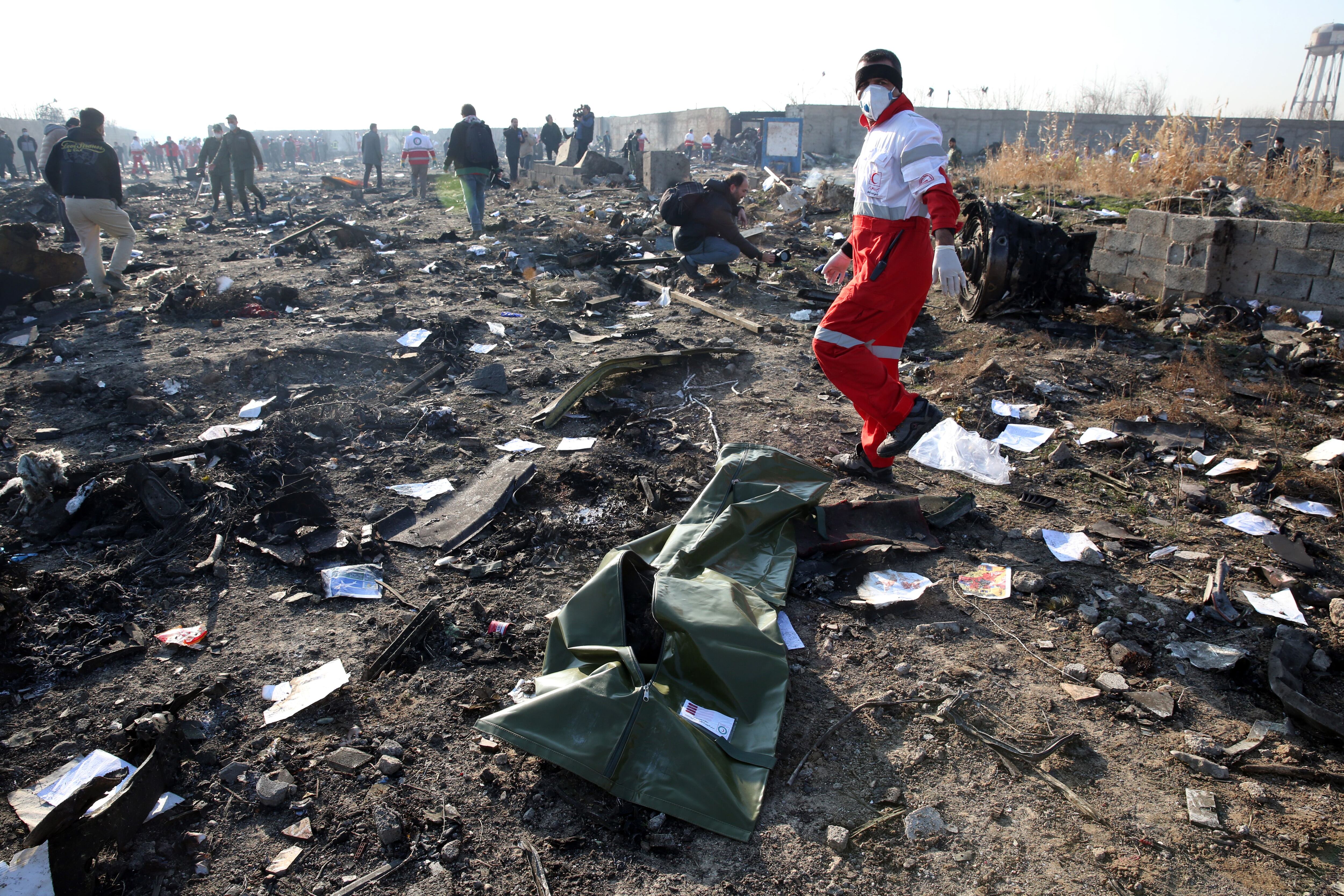
While teams carry out the grim task of clearing the wreckage of Ukraine International Airlines flight 752 near Tehran, Iran, investigators are facing a unique hurdle in their efforts to figure out what brought down the Boeing 737-800: Who gets to investigate when a plane crashes in a heavily sanctioned country?
Early Wednesday morning, the Kyiv-bound flight crashed shortly after takeoff, killing the 167 passengers and nine crew members aboard.
In the initial hours after the crash, both Iran and Ukraine were quick to blame a mechanical failure, although just as quickly, Ukraine changed course and said the cause was unclear. Of note, the U.S.-made Boeing 737-800 is a different model from the Boeing 737 Max that remains grounded worldwide for mechanical issues that led to two fatal crashes.
On Thursday, President Trump publicly suggested the plane was shot down by an Iranian anti-aircraft missile.
A day earlier, in a Wednesday public address, President Donald Trump placed additional sanctions on Iran, already weighed down by sanctions re-imposed in 2018. These restrictions put Boeing — and the U.S. National Transportation Safety Board — in an immediate conundrum: Can regulators and aviation authorities investigate the causes behind the crash of PS752 when the country leading the investigation is sanctioned?
Experts say geopolitical tensions and sanctions make a hard job already harder, restricting the flow of information necessary to find the facts of the crash. "It's very difficult for the investigative authorities to do a normal job of an accident investigation," said Jim Hall, a former chairman at the National Transportation Safety Board, to Cheddar.
Because the crash happened on Iranian soil, Iran is responsible for leading the investigation under International Civil Aviation Organization rules. Other countries, in this case, Ukraine and the United States (where the plane was built), are also entitled to appoint representatives under the rules.
In a statement, the ICAO says it is in contact with the involved countries and will assist them "if called upon." Both the U.S. and Iran are member states of the ICAO.
Boeing has not returned a request for comment from Cheddar.
Gregory Feith, a former senior investigator with the National Transportation Safety Board, tells Cheddar the investigative authority usually responds to an incident by first assembling different teams, each with a variety of experts: one team, for instance, would respond to the accident aircraft site, while another would review the overall operations of the airline itself, poring over maintenance records. Additional teams would be created depending on the circumstances: a fire specialist team for instance if there was a fire involved, or a weather team if there was inclement weather.
Each group then gathers information, and together with advisors, formulate the facts, conditions, and circumstances used to develop the cause ー and any recommendations for enhancing safety.
But U.S. sanctions and continued tensions with Iran could create a stumbling block for the investigation. "I don't think Iran or even the United States should lead this investigation," says Hall. He says political tensions appear to be interfering with a timely investigation, which should be conducted with full transparency from all sides.
"Junk in, junk out," said Hall. "If you don't get the correct parties and information, you're not going to have a meaningful conclusion."
Ukraine International Airlines flight PS752 took off from Tehran mere hours after Iran fired several ballistic missiles at bases in Iraq housing U.S. troops.
On Thursday, President Trump said the plane was "flying in a pretty rough neighborhood."
"Someone could have made a mistake on the other side," he added, implying Iran could have mistakenly shot down the plane.
As Iran and the U.S. cast around blame for the crash, Hall says relying on ICAO itself, and its investigative unit, could provide the solution. "They would be the perfect party in this situation to step in and oversee and conduct, be the lead of the investigation," says Hall. "Iran, the U.S., Boeing, and others could coordinate through ICAO rather than through the national bodies."
"Commercial aviation is so important to the world," says Hall. "People get on these flights because people assume they're safe."