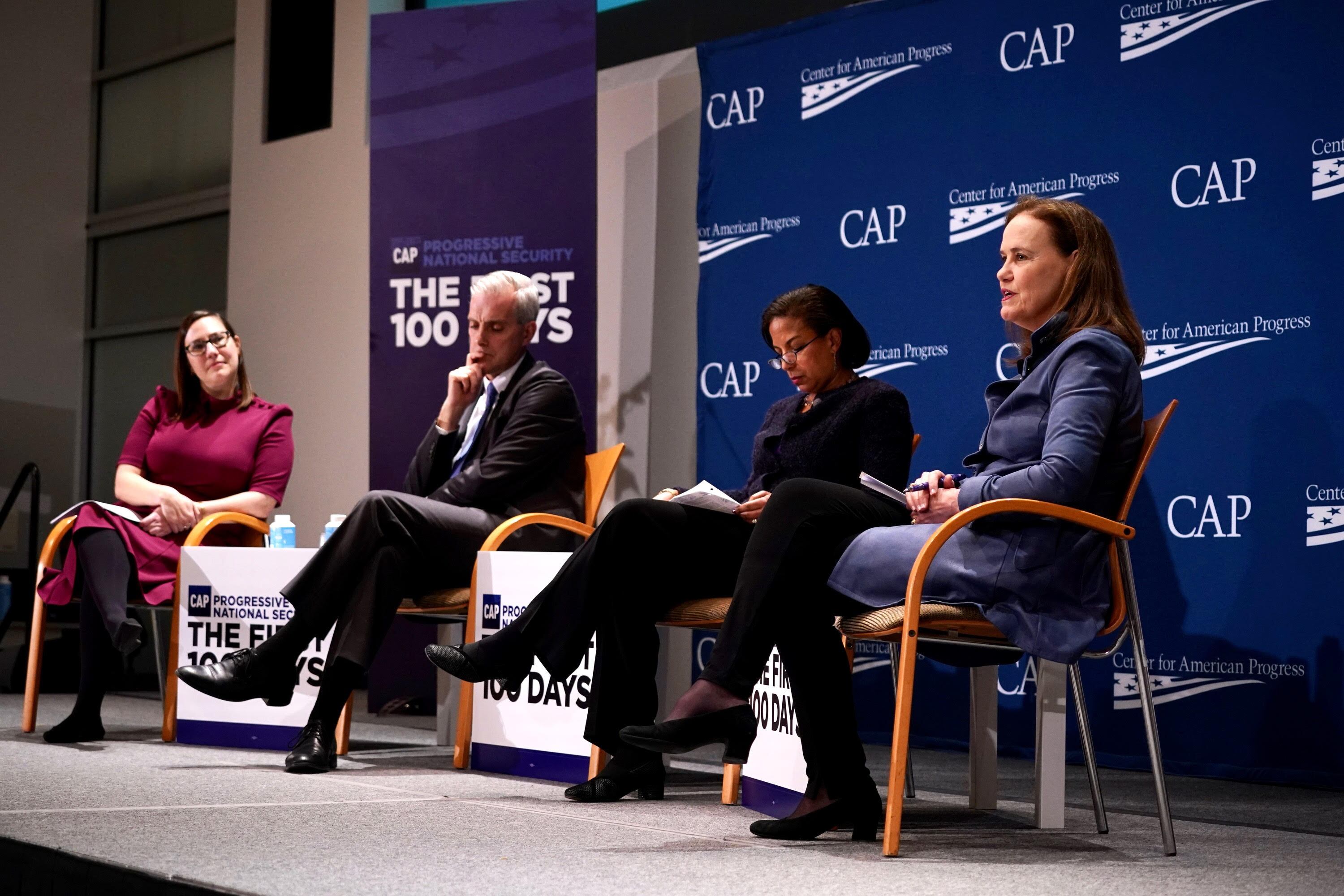
Senior foreign policy officials from the last several presidential administrations gathered in Washington D.C. Tuesday for a series of panels and workshops aimed at creating a “roadmap for an incoming administration’s first 100 days in office,” according to the Center for American Progress.
Solutions that stem from the summit, hosted by the progressive think tank, are intended to help provide a new administration with approaches to handling pressing issues, such as mending fences with European allies and de-escalating tensions with nations like Iran and China.
Though the roadmap would likely be of more interest to a new administration come 2021, it will also be available to President Donald Trump if he wins re-election this November, although the organization does not believe the president’s advisors would take the advice of the progressive experts who were gathered.
Katrina Mulligan, a former Department of Justice national security expert who now works on national security and international policy at CAP, said the eventual goal is to put together “a menu of options” with a “focus on those activities or actions that would have the highest impact.”
Mulligan said experts who were working with the White House as far back as the Reagan administration planned to be in attendance. She said she hopes the next administration takes advice on, what she describes as, both offensive and defensive moves. “What do you need to do to repair things that are inherited on day one and what are the things you need to do to lay out an affirmative agenda?”
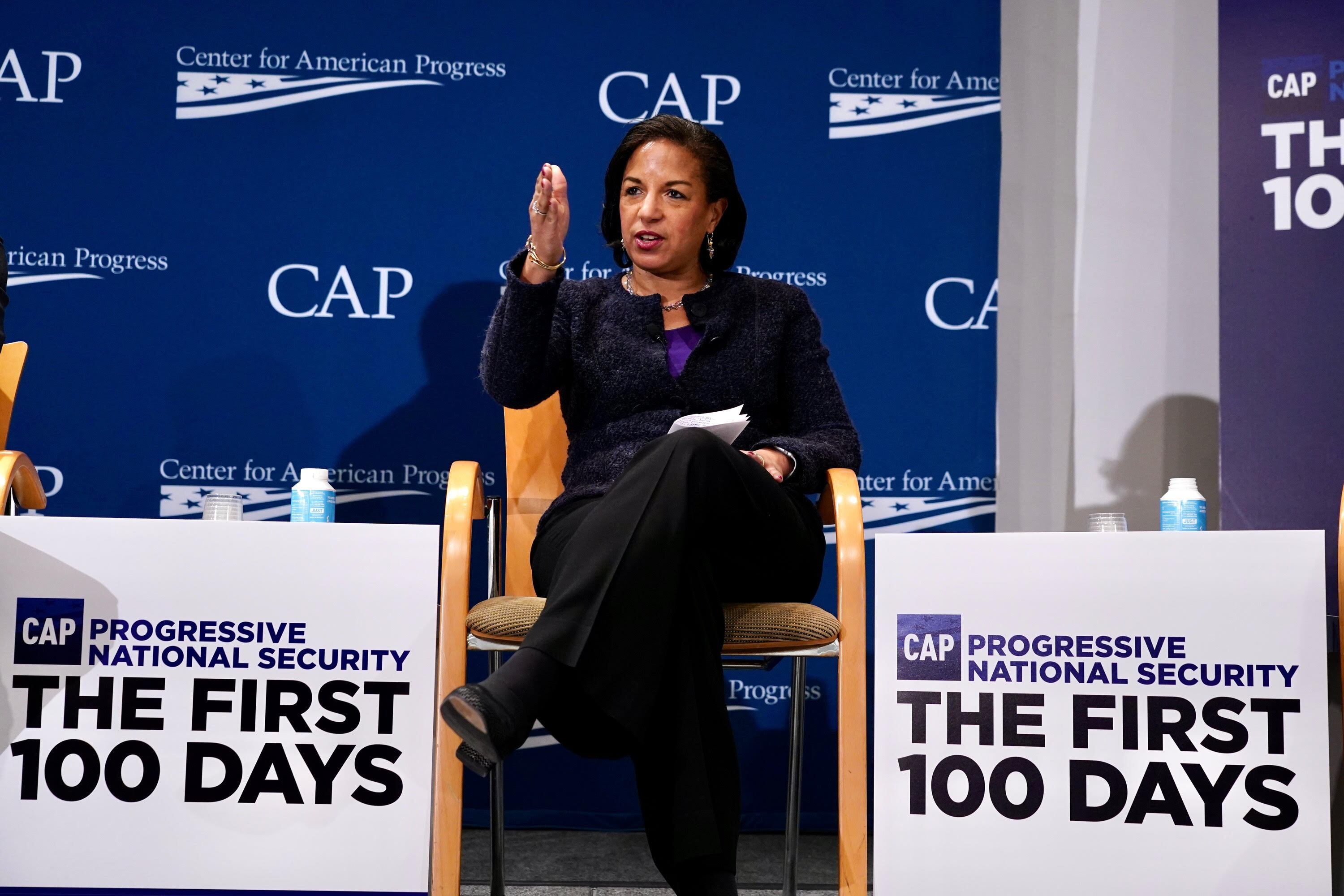
<i>Former Ambassador Susan Rice speaks at CAP’s opening event. / Center for American Progress</i>
Attendees include former Ambassador to the United Nations Samantha Power, former National Security Advisor Ambassador Susan Rice, former White House Chief of Staff Denis McDonough, former Under Secretary of Defense Michèle Flournoy and former Deputy National Security Advisor Avril Haines.
The group hopes to outline possible executive actions, diplomatic priorities and policy implementation activities, though Mulligan said there wasn’t a “specific catalyst” for the agenda- planning meetings.
After President Trump took office, employees left the State Department in droves. The State Department lost 12 percent of its foreign affairs specialists in the first eight months of Trump’s presidency.
Those who remain have worked on Trump’s ‘America First’ platform, which focuses on domestic priorities over stronger international ties. The president has also butted heads with allied leaders during his time in office, while actively working to strengthen bonds with leaders of nations traditional hostile toward the U.S. such as North Korea’s Kim Jong Un and Russia’s Vladimir Putin.
A new administration will need a robust employee base in order to accomplish lofty foreign policy goals, so Mulligan is leading a group to formulate ideas on that very issue. “I worry about the hollowing out of career civil service at the State Department, particularly,” Mulligan said. “I worry about the legacy of ‘America First’ and what it means for a lot of people who don’t understand the risk of isolating America by treating other countries the way we’ve been treating them.”
Together, she said CAP hopes to provide a roadmap in six to nine months for a new president.
Stock trading app Robinhood already has been offering cryptocurrency investments but seems further excited about the asset class following President Biden's recent announcement of an executive order. Dan Gallagher, the chief legal and corporate affairs officer for Robinhood, joined Cheddar News to talk about the White House's tentative vision for digital currency. "I think this executive order firmly states that, yes, crypto is here to stay, which it talks about the important competitive issues around crypto and how the United States needs to be a leader, a global leader, in innovation and technology regarding crypto," he said. Gallagher also discussed having clarity around meme stocks going forward but worried about overregulation slowing down innovation.
As Russia’s attack on Ukraine, the latest inflation report showed the consumer price index rose 7.9 percent — a 40-year high. Heather Boushey, a member of the White House Council of Economic Advisers, joined Cheddar News to discuss what American consumers might be in store for as prices keep rising. "Forecasters at this point believe that the American economy will be resilient," she said. "They’re still predicting that the unemployment rate will continue to be lower at the end of the year than it is today, and we are still seeing folks believe that over time prices will come back down." Boushey did note that it would be dependent on how long the current situation lasts.
Simon Shuster, TIME's Moscow correspondent joins Cheddar to discuss how Ukraine could become part of the EU and what it would mean for politics in Europe.
President Biden has banned imports of Russian oil to the U.S. in retaliation for its invasion of Ukraine. The president warned of higher prices at the gas pump, leading some analysts to think it could propel the transition to clean, renewable energy. Michael Jones, chairman and CEO of investment solutions company Caravel Concepts, discussed how the ban is hitting green energy stocks as gas prices continue to surge. "I think the 10-year prospects for renewables just got a whole lot better because ultimately this is going to force a transition into renewables," he said.
Amid ongoing tensions in the Russia-Ukraine region, many American travelers are nervous about traveling to Europe.
It comes at a time when international travel was set to make a comeback, but uncertainty surrounding the conflict may delay the overall recovery. Francesca Page, Travel Expert, joined Cheddar's Opening Bell to discuss.
Russia's invasion of Ukraine is coming for the global food supply. Ongoing tensions in the region are threatening the supply of various agricultural products including wheat, barley and corn. Vladik Rikhter, CEO & Cofounder of Zenput joined Cheddar's Opening Bell to discuss how this could impact food prices overseas.
Chris Natividad, CIO of EquBot, joins Cheddar News' Closing Bell, where he elaborates on what ultimately dragged the Dow, S&P, and Nasdaq lower on Tuesday and discusses how investors are reacting to rising oil prices and February CPI data coming out later this week.
Adam Johnson, Portfolio Manager at Adviser Investments, joins Cheddar News' Closing Bell, where he explains why he believes we saw markets jump during Wednesday's session, and adds that investors have already priced in 'every possible kind of bad news we could have.'
Jennifer Klein, the White House Gender Policy Council's co-chair and executive director, spoke to Cheddar News about the economic impact of the pandemic showing the need for a group like the Gender Policy Council, and the need to address issues that have affected women the most,