By Marcia Dunn
Elon Musk’s SpaceX is about to take its most daring leap yet with a round-the-world test flight of its mammoth Starship.
It's the biggest and mightiest rocket ever built, with the lofty goals of ferrying people to the moon and Mars.
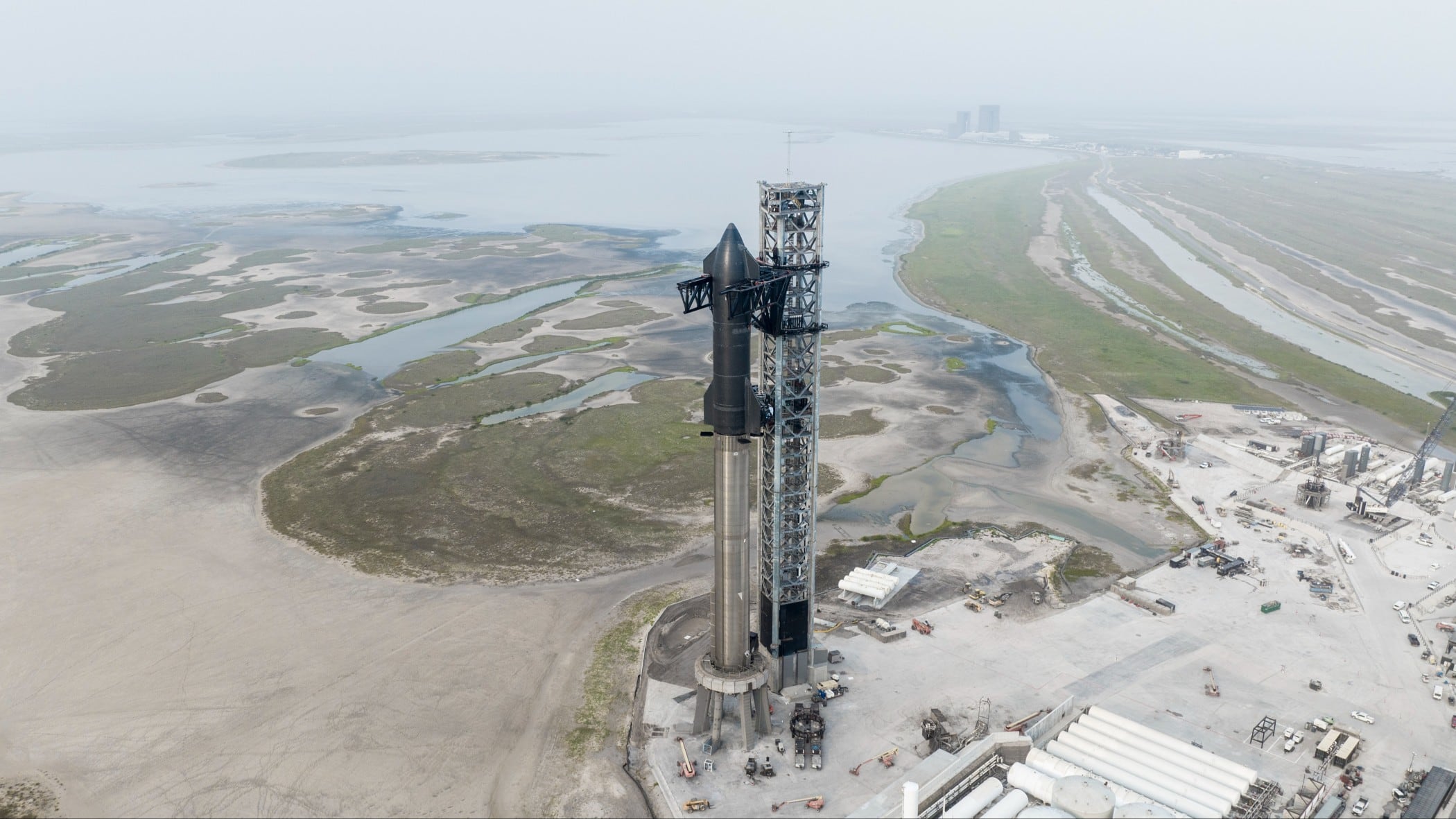
Jutting almost 400 feet (120 meters) into the South Texas sky, Starship could blast off as early as Monday, with no one aboard. Musk's company got the OK from the Federal Aviation Administration on Friday.
It will be the first launch with Starship's two sections together. Early versions of the sci-fi-looking upper stage rocketed several miles into the stratosphere a few years back, crashing four times before finally landing upright in 2021. The towering first-stage rocket booster, dubbed Super Heavy, will soar for the first time.
For this demo, SpaceX won’t attempt any landings of the rocket or the spacecraft. Everything will fall into the sea.
“I’m not saying it will get to orbit, but I am guaranteeing excitement. It won’t be boring,” Musk promised at a Morgan Stanley conference last month. “I think it’s got, I don’t know, hopefully about a 50% chance of reaching orbit.”
Here’s the rundown on Starship’s debut:
SUPERSIZE ROCKET
The stainless steel Starship has 33 main engines and 16.7 million pounds of thrust. All but two of the methane-fueled, first-stage engines ignited during a launch pad test in January — good enough to reach orbit, Musk noted. Given its muscle, Starship could lift as much as 250 tons and accommodate 100 people on a trip to Mars. The six-engine spacecraft accounts for 164 feet (50 meters) of its height. Musk anticipates using Starship to launch satellites into low-Earth orbit, including his own Starlinks for internet service, before strapping anyone in. Starship easily eclipses NASA’s moon rockets — the Saturn V from the bygone Apollo era and the Space Launch System from the Artemis program that logged its first lunar trip late last year. It also outflanks the former Soviet Union’s N1 moon rocket, which never made it past a minute into flight, exploding with no one aboard.
GAME PLAN
The test flight will last 1 1/2 hours, and fall short of a full orbit of Earth. If Starship reaches the three-minute mark after launch, the booster will be commanded to separate and fall into the Gulf of Mexico. The spacecraft would continue eastward, passing over the Atlantic, Indian and Pacific oceans before ditching near Hawaii. Starship is designed to be fully reusable but nothing will be saved from the test flight. Harvard astrophysicist and spacecraft tracker Jonathan McDowell will be more excited whenever Starship actually lands and returns intact from orbit. It will be "a profound development in spaceflight if and when Starship is debugged and operational,” he said.
LAUNCH PAD
Starship will take off from a remote site on the southernmost tip of Texas near Boca Chica Beach. It's just below South Padre Island, and about 20 miles from Brownsville. Down the road from the launch pad is the complex where SpaceX has been developing and building Starship prototypes for the past several years. The complex, called Starbase, has more than 1,800 employees, who live in Brownsville or elsewhere in the Rio Grande Valley. The Texas launch pad is equipped with giant robotic arms — called chopsticks — to eventually grab a returning booster as it lands. SpaceX is retooling one of its two Florida launch pads to accommodate Starships down the road. Florida is where SpaceX's Falcon rockets blast off with crew, space station cargo and satellites for NASA and other customers.
THE ODDS
As usual, Musk is remarkably blunt about his chances, giving even odds, at best, that Starship will reach orbit on its first flight. But with a fleet of Starships under construction at Starbase, he estimates an 80% chance that one of them will attain orbit by year’s end. He expects it will take a couple years to achieve full and rapid reusability.
CUSTOMERS
With Starship, the California-based SpaceX is focusing on the moon for now, with a $3 billion NASA contract to land astronauts on the lunar surface as early as 2025, using the upper stage spacecraft. It will be the first moon landing by astronauts in more than 50 years. The moonwalkers will leave Earth via NASA’s Orion capsule and Space Launch System rocket, and then transfer to Starship in lunar orbit for the descent to the surface, and then back to Orion. To reach the moon and beyond, Starship will first need to refuel in low-Earth orbit. SpaceX envisions an orbiting depot with window-less Starships as tankers. But Starship isn't just for NASA. A private crew will be the first to fly Starship, orbiting Earth. Two private flights to the moon would follow — no landings, just flyarounds.
OTHER PLAYERS
There are other new rockets on the horizon. Jeff Bezos’ Blue Origin is readying the New Glenn rocket for its orbital debut from Cape Canaveral, Florida, in the next year or so. Named after the first American to orbit the world, John Glenn, the rocket towers over the company’s current New Shepard rocket, named for Mercury astronaut Alan Shepard’s 1961 suborbital hop. NASA will use New Glenn to send a pair of spacecraft to Mars in 2024. United Launch Alliance expects its new Vulcan rocket to make its inaugural launch later this year, hoisting a private lunar lander to the moon at NASA’s behest. Europe’s Arianespace is close to launching its new, upgraded Ariane 6 rocket from French Guiana in South America. And NASA’s Space Launch System moon rocket that will carry astronauts will morph into ever bigger versions.
The Associated Press Health and Science Department receives support from the Howard Hughes Medical Institute’s Science and Educational Media Group. The AP is solely responsible for all content.