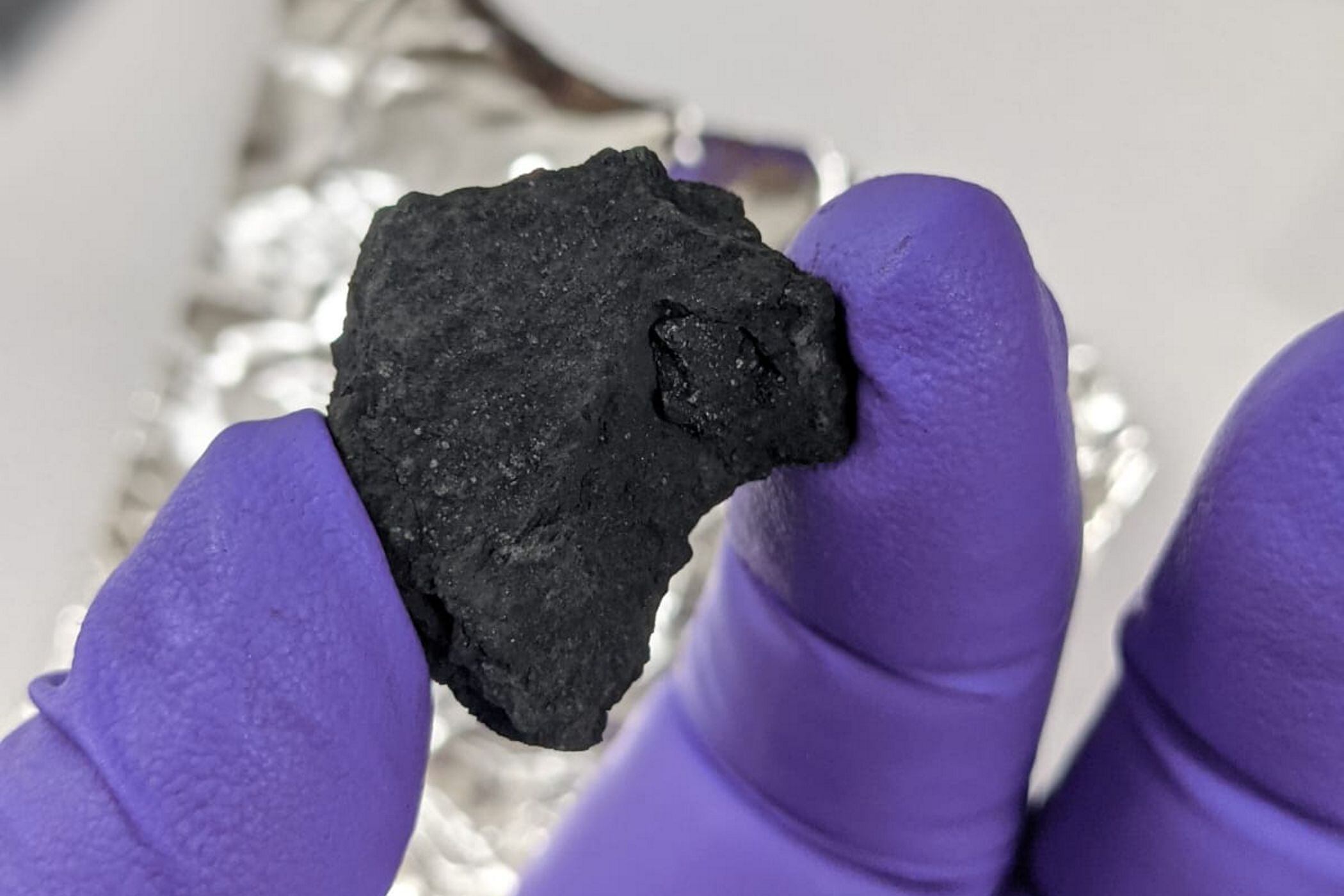
Held meteroite recovered from Winchcombe CREDIT Trustees of the Natural History Museum
One small piece of rock, but a giant discovery for scientists. This is one of the first pieces of meteorite to be discovered in the UK for three decades.
"This is a once in a lifetime experience really for us," says Ashley King from the Natural History Museum.
"So, it's incredibly rare for meteorites to actually be witnessed coming down, landing on the earth, and being recovered."
The rocks that have been found are so rare, they're a type of meteorite never before seen in the UK.
"This is what we call a carbonaceous chondrite meteorite, and so that means it comes from the birth of our solar system," explains King.
"So, this rock is 4.6 billion years old, and it contains all the ingredients that were there when our solar system was forming, that went into making asteroids, went into making comets, and ultimately. Went into making planets like the Earth."
When a fireball meteor was seen shooting through the night sky, scientists dared to dream that small pieces of it may have landed.
They asked people to search in an area just north of the English town of Cheltenham and began getting calls from the town of Winchcombe.
Sure enough, the rocks people were finding here were meteorites.
Scientists began searching the local area, that search led them here, to Lachland Bond's parents' farm.
"So, we actually found out via the scientists coming to our door, knocking and saying that there had been a potential meteorite falling on our land and if they could have a little look," explains Bond.
Within an hour, they found something.
"If it gives us a little bit of a glimpse into history, then that will be a wonderful thing to be able to say that it happened on our land," says Bond.
The last time a meteorite was discovered in the UK was back in 1991.
People in Winchcombe sense history has been made here.
"From our point of view, it's exciting, people have actually had a purpose to go out and walk at the moment, not they didn't have a purpose already, but they certainly now have a purpose to go out and walk," says one resident.
"This is exciting news. Yeah, it is, yes. Puts Winchcombe on the map for yet another reason," says another.
Carlo and Baker cover the latest developments after a devastating tornado outbreak over the weekend, plus an eye on Omicron and inflation, and not even Spielberg can save the box office.
Reusable rocket developer Stoke Space Technologies raised $65 million in a Series A round led by Breakthrough Energy Ventures, a firm founded by Bill Gates. Stoke says its reusable rockets provide the satellite industry with low-cost, on-demand access to and from orbit. As companies like SpacX and Blue Origin are also making commitments to rocket reusability, Stoke says it is taking a different approach with a system designed to be 100% reusable, comprised of rockets designed to fly daily, like an airplane. Stoke co-founder and CEO Andy Lapsa joins Cheddar News' Closing Bell to discuss.
Humans are set to return to a place we have not been in nearly 50 years: the moon. NASA's Artemis program is expected to have astronauts back on the lunar surface by 2025. NASA says it will use what it learns on the moon to take the next giant leap - sending the first astronauts to Mars. The Artemis program also includes contributions from private companies like SpaceX, as well as academic research institutions like Georgia Tech. Georgia Tech professor of practice and former NASA astronaut Sandra Magnus joins Future of Space: Humankind's Leap Forward to discuss.
The CDC warns that COVID-19 is rapidly spreading with Omicron variant cases doubling every two days in the United States. How do current vaccines hold up against the new strain, and what does it mean for your upcoming holiday travel? Cheddar News breaks things down with infectious diseases specialist Dr. William Schaffner of Vanderbilt University School of Medicine.
President Joe Biden is expected to meet with his COVID-19 response team as the omicron variant continues to surge across the country. Experts say Delta is driving this surge but Dr. Anthony Fauci says Omicron will take over. Emergency physician Dr. Daniel Fagbuyi joins Cheddar News to discuss.
Omicron is on course to become the dominant COVID strain in the U.S., even as Delta is causing another spike in cases. According to Johns Hopkins University data, cases across the country are up 40% from last month, with New York City as a major hotspot. Outbreaks are now causing Broadway performances to be canceled, colleges and universities to shift to online classes, sports leagues to postpone games, and more. Dr. Jen Caudle, family physician and associate professor at Rowan University, joined Cheddar to discuss the surge in cases and how we can best protect ourselves against the new variant.