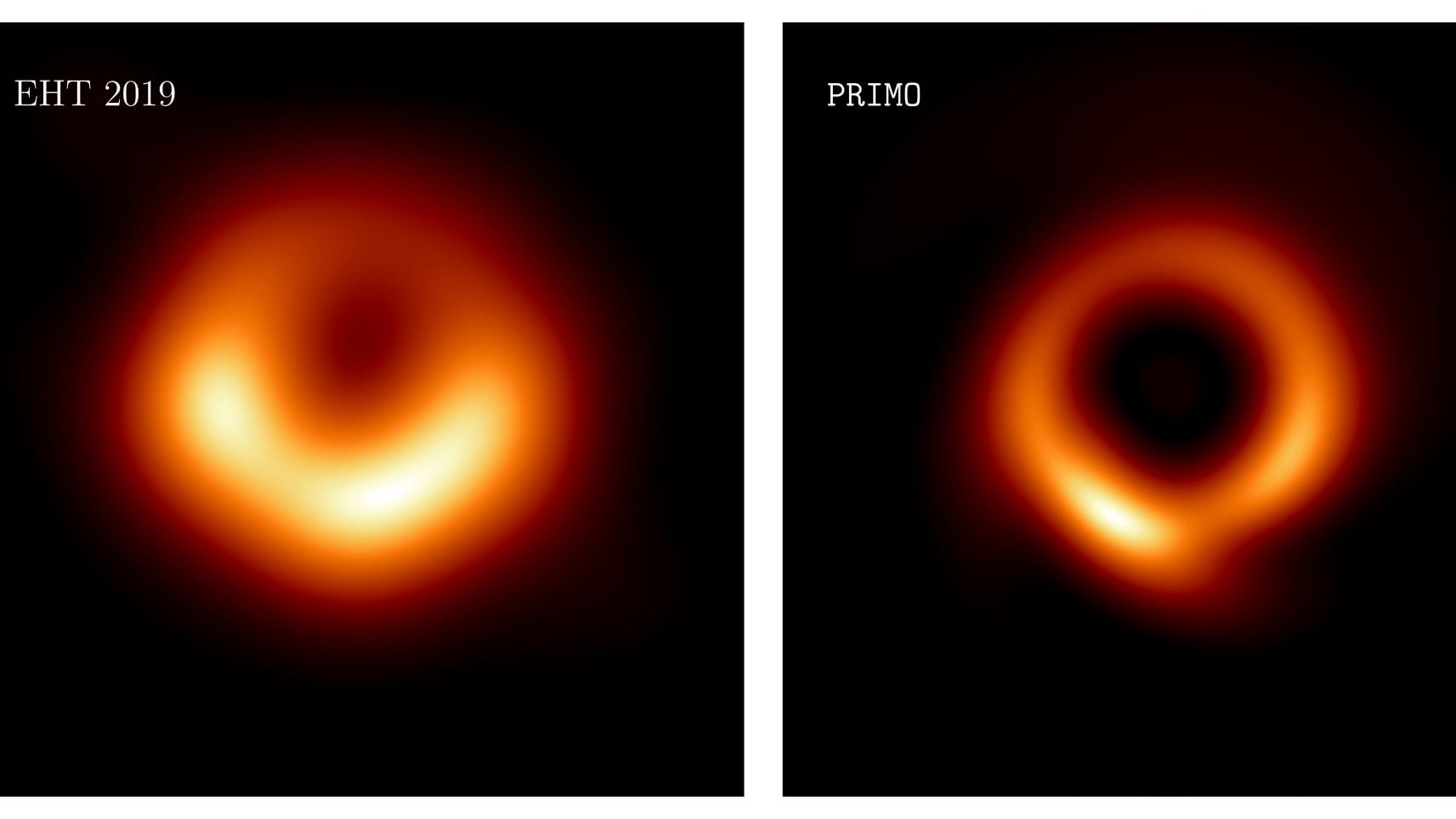
This combination of images provided by researcher Lia Medeiros shows images of the M87 black hole released in 2019, left, and an updated one for 2023. The new version, published Thursday, April 13, 2023, in the Astrophysical Journal Letters — keeps the original shape, but with a skinnier ring and a sharper resolution. Even with many telescopes working together, gaps remained in the data. In the latest study, scientists relied on the same data and used machine learning to fill in the missing pieces. (Lia Medeiros via AP)
By Maddie Burakoff
The first image of a black hole captured four years ago revealed a fuzzy, fiery doughnut-shaped object. Now, researchers have used artificial intelligence to give that cosmic beauty shot a touch-up.
The updated picture, published Thursday in the Astrophysical Journal Letters, keeps the original shape, but with a skinnier ring and a sharper resolution.
The image released in 2019 gave a peek at the enormous black hole at the center of the M87 galaxy, 53 million light-years from Earth. A light-year is 5.8 trillion miles. It was made using data gathered by a network of radio telescopes around the world, showing swirling light and gas.
But even with many telescopes working together, gaps remained in the data. In the latest study, scientists relied on the same data and used machine learning to fill in the missing pieces.
The resulting picture looks similar to the original, but with a thinner “doughnut” and a darker center, researchers said.
“For me, it feels like we’re really seeing it for the first time,” said lead author Lia Medeiros, an astrophysicist at the Institute for Advanced Study in New Jersey.
By having a clearer picture, researchers hope to learn more about the black hole’s properties and gravity in future studies. And Medeiros said the team plans to use machine learning on other images of celestial objects, including possibly the black hole at the center of our Milky Way galaxy.
___
The Associated Press Health and Science Department receives support from the Howard Hughes Medical Institute’s Science and Educational Media Group. The AP is solely responsible for all content.

Cheddar's own Chloe Aiello takes a tour of the ARTECHOUSE to see its latest exhibit "Beyond the Light," which features images from the James Webb Space Telescope.
U.S. and British cybersecurity officials warned Wednesday that a Russian cyber-extortion gang's hack of a file-transfer program popular with corporations could have widespread global impact. Initial data-theft victims include the BBC, British Airways and Nova Scotia's government.
Apple recently acquired augmented reality company Mira following its launch of the Vision Pro headset. Cheddar News explains how Apple is looking to tap into the AR market long dominated by Meta.
NJR Clean Energy Ventures built a vast array of solar panels, linked them together, and placed them on the surface of the water at Canoe Brook Reservoir.
The Consumer Financial Protection Bureau laid out a number of concerns about the growing use of chatbots by banks to handle routine customer service requests.
With concerns about misinformation spreading online, European Union officials want to more closely regulate artificial intelligence, and they're asking the world's biggest tech companies for help.
Sens. Elizabeth Warren, Ron Wyden, Ed Markey, and Mazie Hirono sent a letter to top officials at Twitter expressing their concerns over the platform's privacy policy.
The world's largest cryptocurrency exchange Binance and its founder Changpeng Zhao are accused of misusing investor funds, operating as an unregistered exchange and violating a slew of U.S. securities laws in a lawsuit filed by the SEC.
Apple on Monday unveiled a long-rumored headset that will place its users between the virtual and real world, while also testing the technology trendsetter's ability to popularize new-fangled devices after others failed to capture the public's imagination.