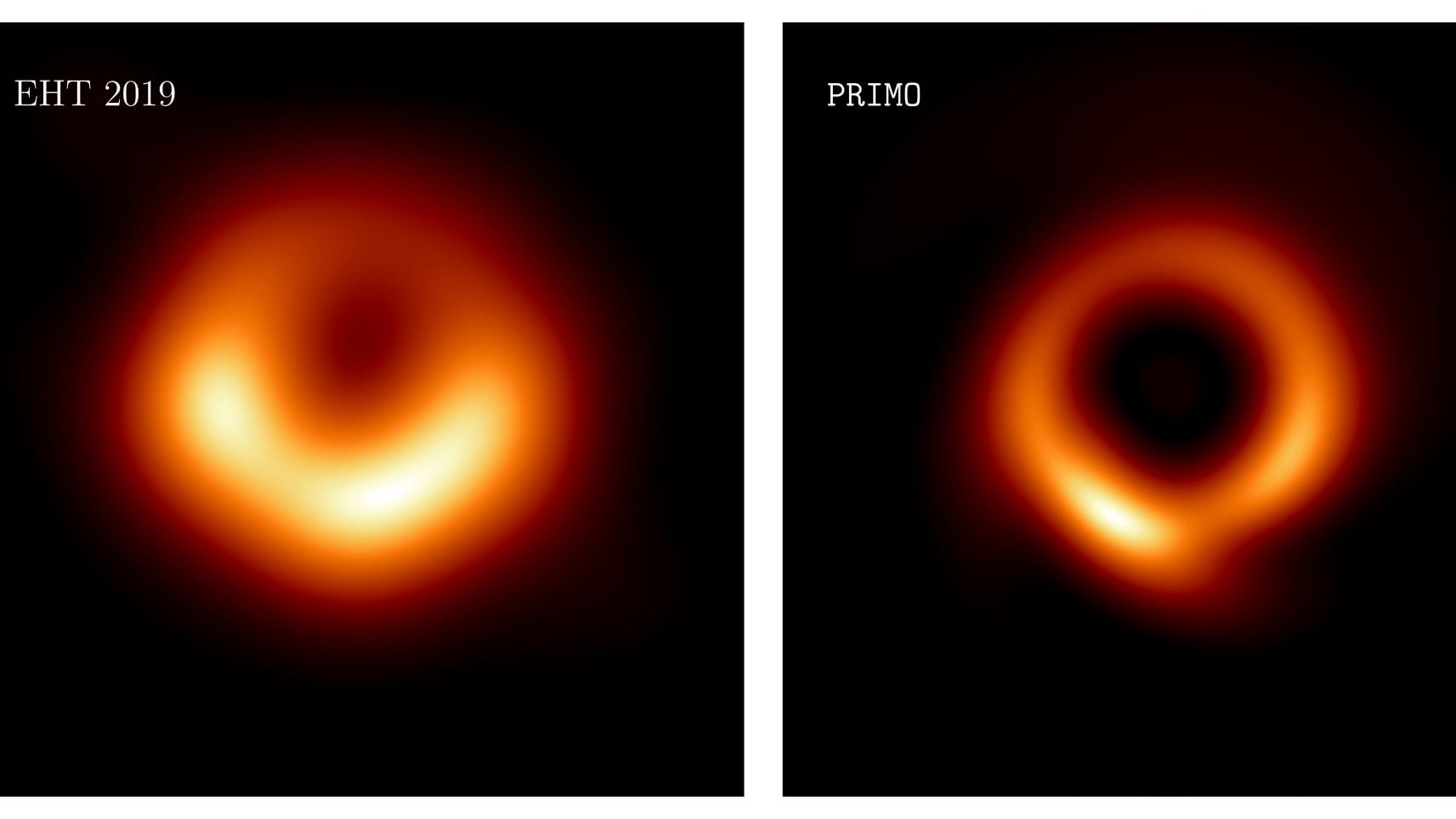
This combination of images provided by researcher Lia Medeiros shows images of the M87 black hole released in 2019, left, and an updated one for 2023. The new version, published Thursday, April 13, 2023, in the Astrophysical Journal Letters — keeps the original shape, but with a skinnier ring and a sharper resolution. Even with many telescopes working together, gaps remained in the data. In the latest study, scientists relied on the same data and used machine learning to fill in the missing pieces. (Lia Medeiros via AP)
By Maddie Burakoff
The first image of a black hole captured four years ago revealed a fuzzy, fiery doughnut-shaped object. Now, researchers have used artificial intelligence to give that cosmic beauty shot a touch-up.
The updated picture, published Thursday in the Astrophysical Journal Letters, keeps the original shape, but with a skinnier ring and a sharper resolution.
The image released in 2019 gave a peek at the enormous black hole at the center of the M87 galaxy, 53 million light-years from Earth. A light-year is 5.8 trillion miles. It was made using data gathered by a network of radio telescopes around the world, showing swirling light and gas.
But even with many telescopes working together, gaps remained in the data. In the latest study, scientists relied on the same data and used machine learning to fill in the missing pieces.
The resulting picture looks similar to the original, but with a thinner “doughnut” and a darker center, researchers said.
“For me, it feels like we’re really seeing it for the first time,” said lead author Lia Medeiros, an astrophysicist at the Institute for Advanced Study in New Jersey.
By having a clearer picture, researchers hope to learn more about the black hole’s properties and gravity in future studies. And Medeiros said the team plans to use machine learning on other images of celestial objects, including possibly the black hole at the center of our Milky Way galaxy.
___
The Associated Press Health and Science Department receives support from the Howard Hughes Medical Institute’s Science and Educational Media Group. The AP is solely responsible for all content.
Ten philanthropic foundations are committing $500 million across the next five years to place human interests at the forefront of artificial intelligence's rapid integration into daily life.
Jesse Pickard, CEO of The Mind Company, shares how Elevate and Balance are redefining mental fitness with science-backed tools for brainpower and wellness.
Apple has taken down an app that uses crowdsourcing to flag sightings of U.S. immigration agents after coming under pressure from the Trump administration.
Former Cisco Systems CEO John Chambers learned all about technology’s volatile highs and lows as a veteran of the internet’s early boom days during the late 1990s and the ensuing meltdown that followed the mania. And now he is seeing potential signs of the cycle repeating with another transformative technology in artificial intelligence. Chambers is trying take some of the lessons he learned while riding a wave that turned Cisco into the world's most valuable company in 2000 before a crash hammered its stock price and apply them as an investor in AI startups. He recently discussed AI's promise and perils during an interview with The Associated Press.
Tesla reported a surprise increase in sales in the third quarter as the electric car maker likely benefited from a rush by consumers to take advantage of a $7,500 credit before it expired on Sept. 30. The company reported Thursday that sales in the three months through September rose 7% compared to the same period a year ago. The gain follows two quarters of steep declines as people turned off by CEO Elon Musk’s foray into right-wing politics avoided buying his company’s cars and even protested at some dealerships. Sales rose to 497,099 vehicles, compared with 462,890 in the same period last year.
OpenAI could now be the world’s most valuable startup, ahead of Elon Musk’s SpaceX and TikTok parent company ByteDance, after a secondary stock sale designed to retain employees at the ChatGPT maker. Current and former OpenAI employees sold $6.6 billion in shares to a group of investors, pushing the privately held artificial intelligence company’s valuation to $500 billion, according to a source with knowledge of the deal who was not authorized to discuss it publicly. The valuation reflects high expectations for the future of AI technology and continues OpenAI’s remarkable trajectory from its start as a nonprofit research lab in 2015.
Tom’s Guide Editor-in-Chief Mark Spoonauer breaks down Apple & Amazon's latest product drops—what's hot, what's hype, and what really matters for users.